IN Brief:
- TULPAR completed static and moving live-fire trials with Leonardo's HITFACT MkII 120 mm turret.
- Integration covered mechanical, electrical, electronic, software, fire-control, and stabilisation interfaces.
- No customer procurement has been announced for the tested medium-tank configuration.
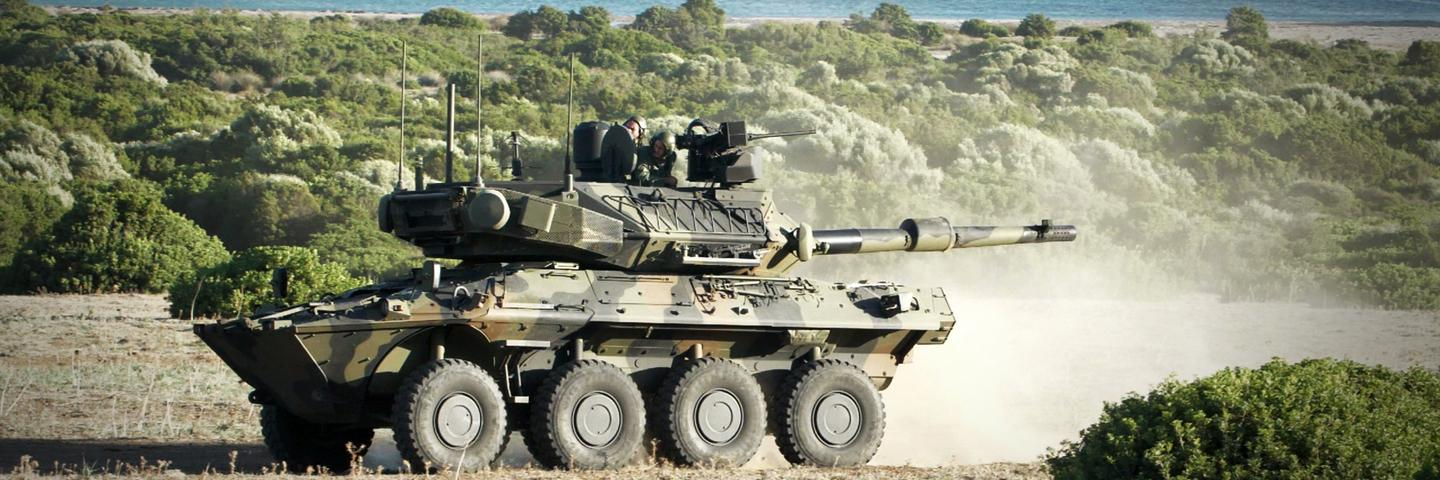
Otokar and Leonardo have completed integration and live-fire trials of the TULPAR tracked armoured vehicle fitted with Leonardo’s HITFACT MkII 120 mm turret, moving the joint medium-tank configuration beyond exhibition integration and through static and dynamic firing tests.
Engineering teams completed mechanical, electrical, electronic, and software integration before the firing campaign. Otokar says the programme included functional checks, safety inspections, and system validation, followed by live firing while stationary and moving. The weapon system, fire-control system, stabilisation, and wider platform-turret functions were assessed against planned test objectives.
A 120 mm turret changes the engineering balance of a medium tracked chassis. Recoil loads, centre of gravity, electrical demand, ammunition storage, crew protection, and fire-control interfaces all have to be absorbed without eroding the mobility and growth margins that distinguish the platform from a conventional main battle tank. Dynamic firing adds another level of validation because the stabilisation system has to maintain weapon and sight performance as the chassis moves.
TULPAR is built around a modular tracked architecture that Otokar offers across gross vehicle weights from 28 to 45 tonnes. The family is intended to support infantry fighting, direct fire, recovery, mortar, air-defence, and other mission configurations while retaining common platform elements. That weight range gives the manufacturer room to adjust armour, mission equipment, and turret installations around different customer requirements.
Leonardo’s HITFACT MkII provides the heavy direct-fire element. The turret can accept a 120/45 mm smoothbore gun or a 105/52 mm rifled weapon and can be configured with manual or automatic ammunition loading. Its digital fire-control system uses stabilised commander and gunner sights combining day and thermal channels with laser rangefinding.
The turret is designed for installation on lighter wheeled vehicles and medium tanks rather than only on traditional heavy tracked platforms. Leonardo uses a low-recoil gun installation and separates ammunition from the crew compartment. Those design choices reduce some of the integration penalties associated with fitting a main-battle-tank-calibre weapon to a lighter chassis, although vehicle-level protection, ammunition capacity, and mobility remain dependent on the final customer configuration.
For Otokar, the firing programme demonstrates the upper end of TULPAR’s modular payload proposition. A vehicle family able to accommodate infantry, support, and large-calibre direct-fire variants gives prospective operators the possibility of sharing chassis components, maintenance practices, and training across several roles. The amount of commonality ultimately retained will depend on the protection, communications, and mission systems specified by individual customers.
The tested configuration also reflects the increasing payload demands placed on medium tracked vehicles. Heavy weapons, active and passive protection, networked sensors, and larger electrical loads all consume weight, power, cooling, or internal volume. Manufacturers have to preserve sufficient growth margin for later upgrades without allowing vehicle mass to undermine mobility or transportability.
Leonardo gains another demonstrated host platform for HITFACT MkII. The turret has been developed for integration on both wheeled and tracked vehicles, and successful firing on TULPAR provides evidence that its mechanical and digital interfaces can be made to work on a chassis outside Leonardo’s own vehicle portfolio.
No launch customer has been announced for the combined TULPAR-HITFACT MkII configuration. The test campaign is therefore an engineering and export-readiness step rather than a procurement award. It gives the two companies a configuration that has progressed beyond trade-show display and can be presented against future requirements with live-fire evidence behind it.
Customer selection would introduce another integration phase. National radios, battle-management systems, protection suites, ammunition choices, and maintenance arrangements can all affect weight, electrical architecture, and internal layout. A configuration that has completed company trials may still require further qualification after customer-specific equipment is incorporated.
The industrial structure could also influence future bids. Otokar has increasingly combined exports with local production and industrial-participation arrangements, while Leonardo supplies turrets, sensors, and electronics across international land programmes. A future TULPAR package could therefore divide platform, turret, integration, and national workshare differently according to procurement policy.
Static and moving firing trials remove one category of technical uncertainty by demonstrating that the current platform and turret configuration can function together under representative firing conditions. The next step is commercial: securing a defined customer requirement and showing that tested performance can be preserved once national equipment, qualification, and support obligations are added.