IN Brief:
- Marand won an international tender to manufacture three additional Type 26 gas-turbine acoustic enclosures.
- The Melbourne work extends production already supporting Australia's Hunter-class frigates.
- Rolls-Royce has also opened Canberra headquarters for its wider Pacific Rim defence operation.
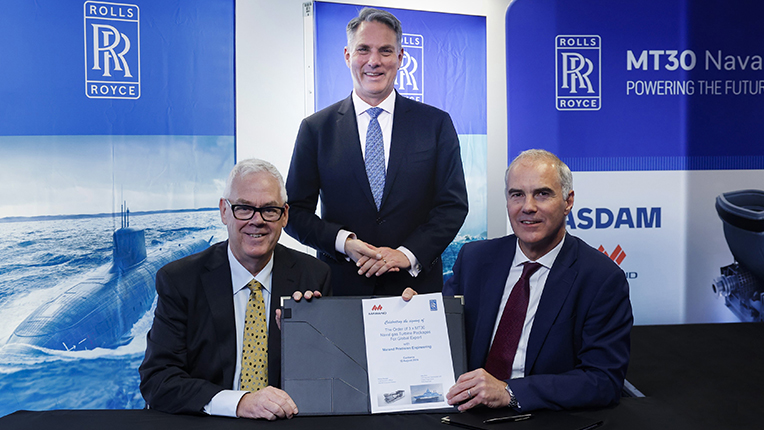
Rolls-Royce is expanding naval propulsion manufacturing in Australia after selecting Marand Precision Engineering to produce three additional gas-turbine acoustic enclosures and associated ship interface systems for the Type 26 Global Combat Ship programme. The Melbourne work extends an existing manufacturing relationship supporting Australia’s Hunter-class frigates into an export programme built around the same MT30 gas-turbine family.
Rolls-Royce selected Marand through an international tender. The Australian company will manufacture and assemble the enclosures at its Melbourne facility before supplying them to Rolls-Royce, with company engineers already co-located alongside the local production team to support design development, packaging, and testing.
Marand already manufactures equivalent equipment for the Royal Australian Navy’s Hunter-class programme. Completed propulsion packages are supplied to BAE Systems Australia, while Rolls-Royce provides the MT30 gas turbines and mtu power-generation equipment contributes to the wider Hunter propulsion arrangement.
The acoustic enclosure is considerably more involved than its name suggests. It provides mechanical support and noise suppression around the turbine while incorporating controls, air intake, exhaust routing, ventilation, and auxiliary services. Manufacturing it requires the gas turbine to be packaged around the dimensional, acoustic, airflow, maintenance, and ship-interface requirements of the installation.
That places the work close to the boundary between engine manufacture and ship integration. Small discrepancies in interfaces, structure, access, or routing can produce disproportionately expensive problems once a propulsion module reaches the shipyard. Co-locating Rolls-Royce engineering staff with Marand’s manufacturing team gives both companies a shorter route between design decisions, production questions, and test results.
The new award also changes Marand’s role in the programme. Work that began around Australia’s Hunter-class build will now support the broader Type 26 supply chain, establishing an Australian manufacturing contribution to an export programme rather than a local-content arrangement confined to one national customer.
Type 26 provides a natural platform for that approach because its industrial footprint is already international. The Royal Navy’s City-class frigates provide the original British programme, Australia’s Hunter class is derived from the Type 26 design, and Canada is developing its River-class destroyers from the same design family. National configurations differ considerably, but common propulsion technologies create opportunities for qualified suppliers to support more than one build programme.
Commonality only produces industrial savings where configuration is controlled carefully. Naval programmes routinely diverge as customers specify different combat systems, standards, support arrangements, and ship changes. A supplier working across several programmes therefore has to preserve repeatable manufacturing processes without assuming that every interface remains identical.
For Marand, three additional enclosures are not a large production run, but the award gives the Melbourne team repeat work around a technically demanding propulsion package. Qualification, documentation, test evidence, dimensional control, and production learning become more valuable when the same industrial capability can serve several customers rather than disappearing after one domestic batch.
Rolls-Royce announced the manufacturing expansion alongside the opening of a dedicated Pacific Rim Defence headquarters in Canberra. The facility was formally opened on 12 August and will serve operations across Australia, New Zealand, Japan, and South Korea. The company plans further investment in the headquarters over the next five years.
The Canberra operation adds a regional organisational layer to an Australian defence footprint that already spans air, naval, land, and submarine programmes. Rolls-Royce personnel also remain embedded at Australian Defence Force locations, while the company’s propulsion activities include the Hunter-class programme and wider work associated with AUKUS.
Manufacturing policy across Australia has increasingly concentrated on whether local suppliers can develop capabilities that persist beyond a single acquisition. Export work provides a tougher measure than a domestic participation percentage because the supplier has to compete on cost, quality, delivery, and technical performance against companies outside its home market.
Marand’s selection through an international tender provides that test. The company now has to turn experience gained on Hunter into repeatable production for another Type 26 requirement while preserving the engineering controls expected around a naval gas-turbine package.
The award will not transform the Type 26 supply chain by itself, and three enclosures remain three enclosures. Its industrial value lies in where they will be built and why: an Australian supplier already qualified through a domestic frigate programme has won further work for the wider ship family. If that pattern continues, sovereign capability begins to look less like protected local work and more like a supplier base capable of competing beyond the programme that created it.