IN Brief:
- The UK Alpha Resilience and Capability programme has formally closed after six years of collaboration involving AWE, the Ministry of Defence and civil nuclear organisations.
- Its engineering deliverables include common glovebox and containment standards and a non-active training facility at Sellafield.
- More than 170 operators had received training through the facility from April 2025, according to the government's previously published case study.
The UK Alpha Resilience and Capability programme has formally closed after six years of collaboration between civil and defence nuclear organisations, leaving common engineering standards, specialist training facilities and knowledge-sharing arrangements developed to support work involving alpha-emitting materials.
Known as UK ARC, the programme began in 2020 and involved organisations including AWE Nuclear Security Technologies, the Ministry of Defence, Sellafield, the Nuclear Decommissioning Authority, the Office for Nuclear Regulation and the UK National Nuclear Laboratory. Its formal conclusion was confirmed on 21 October 2026.
The programme addressed common technical and skills requirements across nuclear organisations that operate under different missions but encounter similar engineering problems. Its deliverables include glovebox design standards, a dedicated non-active training facility and collaborative systems intended to preserve and share specialist knowledge.
Although ARC has ended as a programme, the announcement concerns the closure of the collaborative initiative rather than the withdrawal of its engineering products. The standards and training resources were developed for continued use within the participating organisations’ existing and future nuclear activities.
Alpha-emitting materials require particularly careful handling where processes create the possibility of contamination. Alpha radiation has limited penetration through many ordinary materials, but radioactive substances that enter the body can create substantial hazards. Facilities handling such materials consequently depend on engineered containment and controlled working procedures.
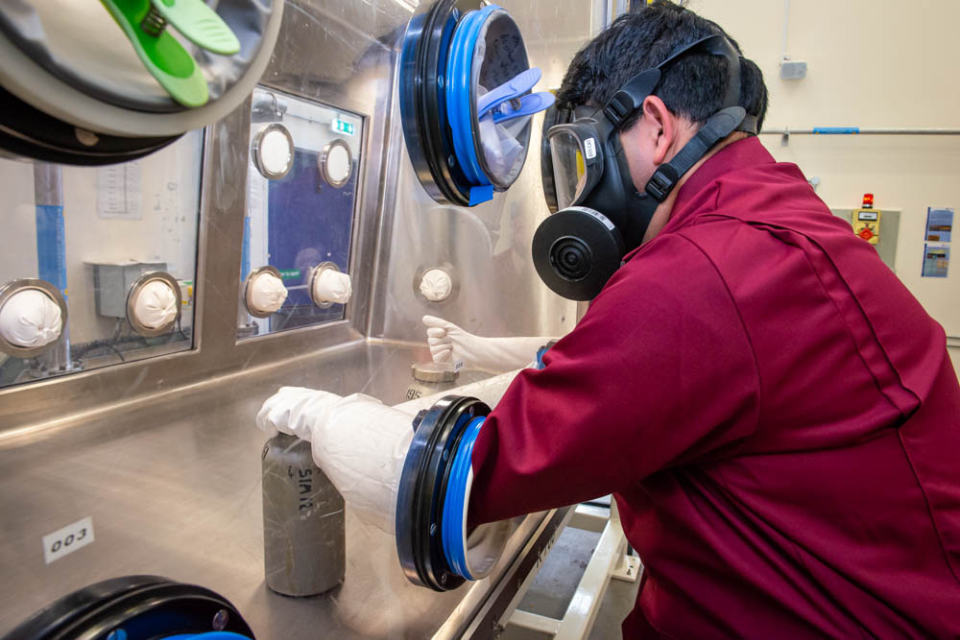
One of the principal containment arrangements used in nuclear operations is the glovebox. This is an enclosed workspace fitted with sealed gloves, allowing an operator to manipulate materials inside the enclosure while maintaining a physical separation between the process and the surrounding environment.
Glovebox engineering involves more than providing a sealed container. Designers must consider the work carried out inside the enclosure, the movement of materials into and out of it, operator access, ventilation, inspection and arrangements for maintenance or eventual decommissioning.
Each connection or opening introduces an interface that must be addressed within the containment design. Transfer mechanisms, electrical penetrations, ventilation connections and glove ports require suitable specifications, while the materials and components selected must remain compatible with the intended process and operating environment.
Containment systems also need to account for faults and abnormal conditions. The safety case for an installation determines the relevant protective measures and operating limits, which may include arrangements addressing ventilation performance, equipment condition and the detection or management of contamination.
Different facilities can develop different solutions to these requirements, even when they perform broadly comparable work. Such variation can complicate procurement and maintenance where engineers, suppliers and operators use inconsistent specifications for similar equipment.
UK ARC brought specialists from the civil and defence nuclear sectors together to develop common engineering standards and guidance. In 2024, major nuclear operators agreed new standards covering glovebox and containment design, establishing a shared technical basis for future equipment projects.
The standards address the lifecycle of containment equipment, allowing design and manufacturing requirements to be considered alongside operation, maintenance and later changes. Consistent requirements can also help suppliers understand the characteristics that equipment must demonstrate before it is accepted by a nuclear operator.
Common standards do not remove the need for an individual facility to establish its own safety case. Equipment still has to be assessed against the materials handled, the process involved and the applicable regulatory requirements. A shared specification provides a common engineering reference rather than approval for every possible installation.
Work on the standards continued into 2026. The Office for Nuclear Regulation published a Technical Assessment Guide on gloveboxes in January, with inspectors and industry specialists discussing the new guidance at a technical conference in February.
The regulator’s involvement provides an additional reference for technical assessment, although compliance decisions remain subject to the requirements applicable to each licensed site and its operations. Engineering standards developed through collaboration and regulatory assessment guidance perform related but distinct functions.
ARC also delivered the Glovebox Training Facility at Sellafield, which opened in October 2023. The facility allows personnel to practise specialist handling procedures using representative non-active equipment, reducing the need for initial training to take place inside operational nuclear facilities.
Working through glove ports requires physical dexterity and familiarity with the restricted movement available inside an enclosure. Operators may need to position equipment, manipulate tools and transfer materials while observing the process through windows and maintaining the specified containment arrangements.
A dedicated training environment allows those activities to be practised repeatedly without exposing trainees to radioactive material. The Sellafield facility also provides adjustable conditions, including lighting and temperature, so courses can reproduce selected features of the environments in which personnel may eventually work.
The training arrangements were developed through ARC and supported by pilot courses before wider adoption. Standardised instruction creates a more consistent foundation for assessing operator competence, although personnel must still complete the site-specific training and authorisations needed for their eventual duties.
Government case-study information states that more than 170 operators were trained through the facility from April 2025. Responsibility for the facility transferred to Sellafield Ltd during 2025, allowing the resource to continue operating after the programme that established it moved towards closure.
Knowledge management formed another substantial part of ARC’s work. Nuclear facilities can operate for decades, while some specialist skills are concentrated among relatively small groups of experienced personnel. The loss of design knowledge or practical experience can make future maintenance, modifications and decommissioning more difficult.
The programme established collaborative platforms, digital knowledge tools and Communities of Practice to improve access to technical experience across participating organisations. Such arrangements allow specialists to discuss common engineering problems and identify lessons from existing equipment before beginning equivalent work elsewhere.
Information exchange must still account for the different security and confidentiality requirements of civil and defence organisations. Participation in a common technical programme does not imply unrestricted access to sensitive facility details, protected nuclear information or classified defence systems.
For AWE and other organisations contributing to the defence nuclear enterprise, the collaboration supports the preservation of specialist containment engineering and workforce capability. The programme’s public results do not identify particular classified applications, defence facility modifications or quantified improvements in operational performance.
The final ARC statement identifies the continued use of standards, training resources and established professional networks as its principal legacy. The programme’s formal closure leaves responsibility for applying and maintaining those resources with the participating organisations, which will determine how they support future nuclear engineering projects.