IN Brief:
- The Ministry of Defence has confirmed that P4E long lead activities have commenced.
- P4E provides the aircraft changes needed to integrate ECRS Mk2 and other Typhoon upgrades.
- Britain, Eurofighter, NETMA and the other core nations are still finalising the integrated delivery schedule.
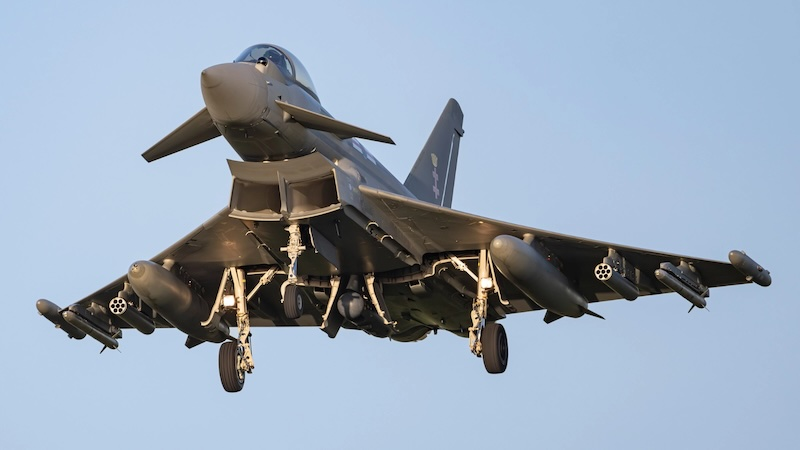
The UK has started long lead activity for the Typhoon Phase 4 Enhancement programme while Britain and its Eurofighter partners continue to finalise the schedule for P4E and integration of the ECRS Mk2 radar by the end of the decade.
The Ministry of Defence confirmed that work has commenced but stopped short of describing the complete upgrade package as being in fleet installation. Eurofighter, the NATO Eurofighter and Tornado Management Agency and the other core nations remain involved in establishing the delivery sequence.
P4E provides aircraft changes needed to introduce ECRS Mk2 alongside wider mission system improvements. Integrating a new radar into Typhoon affects more than the antenna because the sensor has to work with aircraft power, cooling, computing, displays, software and the systems that consume or distribute its data.
ECRS Mk2 uses an electronically scanned array and combines radar sensing with electronic warfare functions. The aircraft therefore has to support both the radio frequency hardware and the processing required to turn received signals into information that the mission system can use.
Power and thermal capacity form part of that integration because active radar electronics generate heat while drawing electrical power across changing operating modes. Cooling provisions and electrical interfaces need to support the sensor without reducing the margins required by other aircraft systems.
Software integration is equally important. Radar tracks, electronic warfare information and sensor controls have to appear correctly within the Typhoon mission system, while crew displays and controls need to present the new functions without creating separate operating paths for equipment that is intended to work together.
Long lead activity starts work whose procurement or manufacture would otherwise delay later integration. Components with lengthy supplier schedules, specialist manufacturing processes and engineering tasks that must be completed before assembly can begin are brought forward so they are available when the main modification sequence needs them.
Starting those activities does not fix the final aircraft delivery schedule. Typhoon is a multinational programme and common aircraft changes have to move through Eurofighter and NETMA alongside national requirements, industrial work shares and the configuration decisions of the partner nations.
The UK is developing ECRS Mk2 for Royal Air Force Typhoons, but the radar still has to be incorporated into the wider aircraft architecture managed through the multinational programme. Radar manufacture and aircraft modification can therefore progress on separate workstreams before converging at integration and test.
Ground integration allows engineers to find interface problems before modified aircraft enter flight test. Hardware connections, software builds, cooling performance and electromagnetic behaviour can be exercised in controlled conditions, reducing the amount of fault finding that has to be performed on an aircraft during a limited test sortie.
Flight testing then has to demonstrate radar operation across the aircraft’s operating environment. Vibration, temperature, manoeuvre, electromagnetic conditions and interaction with other mission systems can expose problems that are not visible on a laboratory rig, particularly when several sensors and transmitters operate at the same time.
Configuration control becomes more demanding once production radars, P4E hardware and aircraft software begin moving through different manufacturing and test stages. Each test aircraft and later each operational modification has to use a defined combination of hardware and software so that results can be traced to the configuration that produced them.
The government has committed to integrating ECRS Mk2 by the end of the decade, but it has not published a final P4E delivery schedule. The present status is therefore narrower: long lead activity is under way and the multinational programme is still determining the sequence that will bring the aircraft changes and radar together.
The next engineering milestones will come when the common schedule is fixed and P4E hardware begins moving from long lead procurement into installation, integration and flight test. Until then, commencement of long lead work protects parts of the programme timetable without removing the dependencies that remain across Eurofighter, NETMA and the partner nations.