IN Brief:
- A UK-developed 300N turbojet has completed flight testing and entered serial production.
- A larger 1,100N engine reached flight-ready status less than seven months after initial concept work.
- The programme spans a 30N-to-2,000N engine family supported by more than 40 UK suppliers.
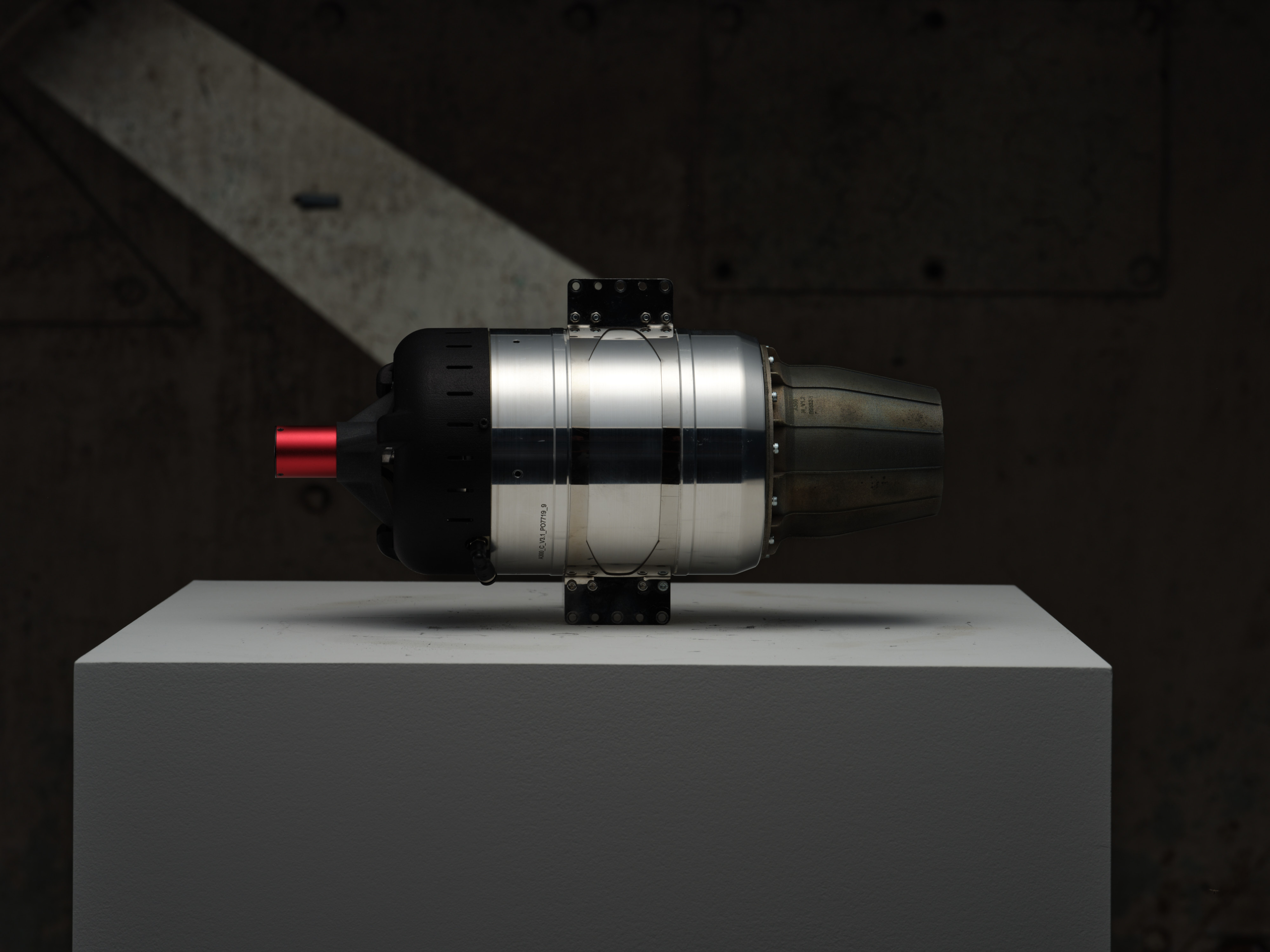
A UK Ministry of Defence programme with Alloyed has moved a 300N-class turbojet into serial production after flight testing, while a larger 1,100N-class engine has progressed from initial concept to flight-ready status in less than seven months.
The work has produced a family of engines spanning roughly 30N to 2,000N of thrust, intended to cover applications from smaller uncrewed aircraft to larger air systems. Alloyed is developing the engines with the Ministry of Defence’s Strategic Capabilities Office under a co-investment model combining government funding with matched company investment.
The 300N engine has completed flight testing and entered serial production in the UK. The 1,100N design provides the programme’s clearest development-speed measure, having moved from concept to a flight-ready engine in under seven months. Both sit within a modular family rather than operating as isolated demonstrators, providing a route to scale propulsion across different vehicle sizes and mission requirements.
Digital engineering and manufacturing sit at the centre of the programme. The engines have been designed, built, and tested in Britain using a UK-based digital design and modelling process intended to shorten development cycles for new engines and variants. The architecture is modular, allowing future changes to be introduced without automatically forcing a complete redesign of the propulsion system.
The development model is already tied to manufacturing rather than stopping at rapid prototyping. More than 60 engineering and advanced-manufacturing jobs have been created through the programme, with another 45 expected over the next 12 months as production increases. More than 40 UK suppliers are involved, most of them small and medium-sized businesses.
A usable small turbojet has to deliver consistent thrust, thermal behaviour, durability, fuel-system performance, manufacturing tolerances, and repeatable test results across production units. Moving one member of the family into serial production gives the programme a different industrial status from an experimental engine demonstrated only in development testing.
The 30N-to-2,000N spread also places demands on the underlying production approach because the same development methods are being applied across a wide performance envelope. Smaller engines can support lightweight uncrewed aircraft or expendable systems, while the upper end moves into applications where endurance, integration, thermal management, and airframe packaging become progressively more demanding. A common digital and modular approach can reduce engineering duplication while leaving each variant subject to its own test and qualification requirements.
The programme is intended to establish a sovereign propulsion capability, with design, manufacture, test, and sustainment retained domestically. Propulsion can become a pacing item when demand rises rapidly because engines combine specialised materials, precision manufacturing, controls, rotating hardware, and test infrastructure that cannot be expanded instantly after a platform programme is already under delivery pressure.
Alloyed’s background in advanced metals technology adds another manufacturing layer. Digitally driven materials and production methods can shorten iteration when design data, process parameters, and inspection requirements are linked closely enough to support repeatable hardware. The defence requirement begins when those methods move from small numbers of development engines to a production line expected to deliver consistent units at predictable cost and rate.
The programme has potential export relevance for allies seeking additional propulsion supply, although no export customer or production quantity has been announced. The Ministry of Defence has also not identified the air vehicles intended to use the engines, leaving the present programme focused on propulsion and industrial readiness rather than a named platform integration.
The co-investment structure shapes the industrial model. Instead of funding a conventional development contract in isolation, the Strategic Capabilities Office and Alloyed are sharing investment while building a design-and-production capability intended to remain available for future variants. Tooling, digital models, manufacturing knowledge, and supplier relationships can therefore be retained beyond the first engine rather than recreated for each subsequent requirement.
The next milestones are production rate, qualification of further thrust classes, and installation on defined air systems. The 300N engine has crossed into serial manufacture; the 1,100N version now has to convert its accelerated development cycle into flight evidence and, if successful, the same repeatable production discipline.