IN Brief:
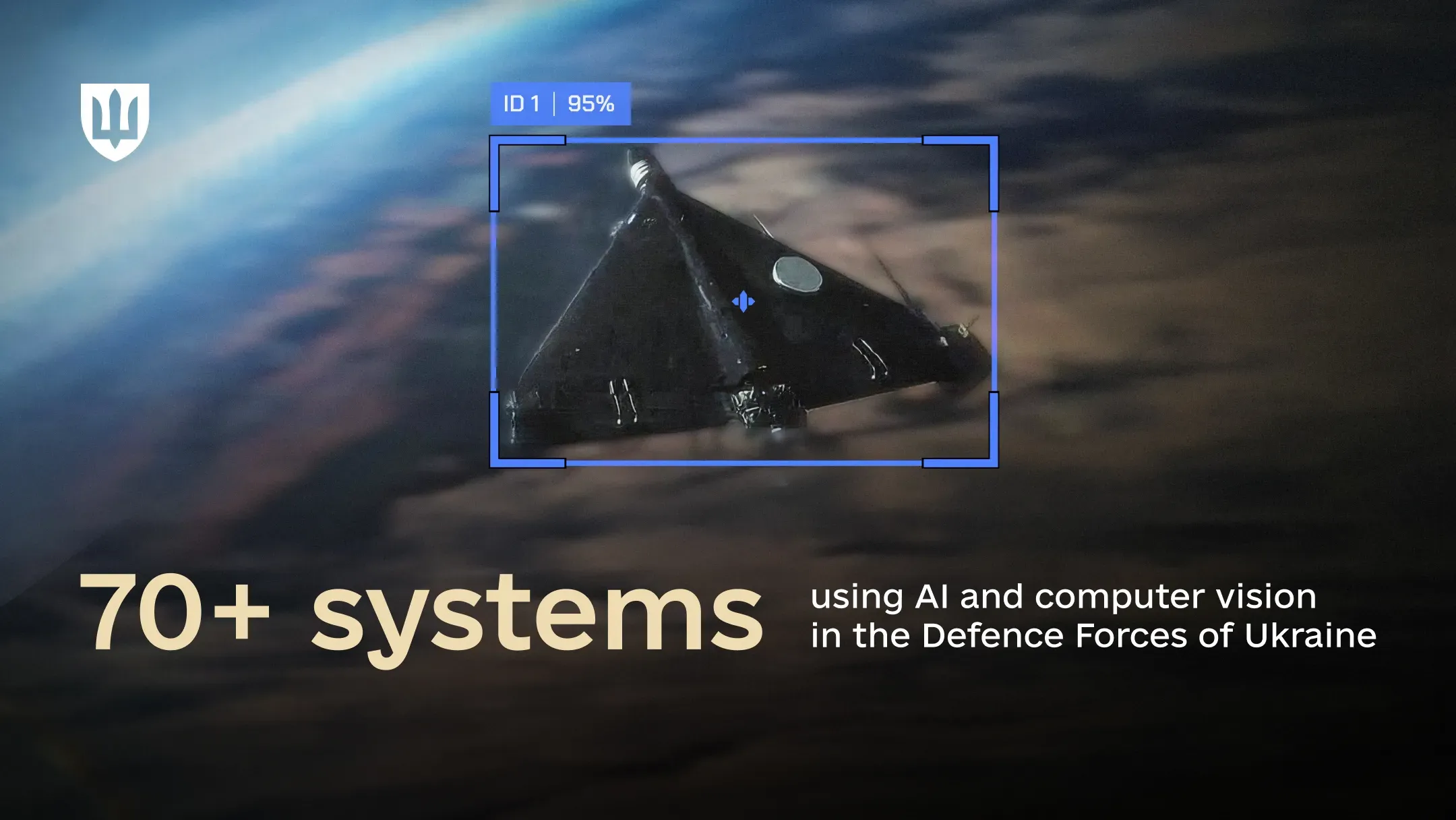
- Ukraine says its forces use more than 70 systems incorporating AI and computer vision.
- More than 200 Ukrainian companies produce AI-enabled drones, while Brave1 Market lists 46 AI solutions.
- Shared datasets and the A1 Defense AI Center are supporting broader development and testing.
Ukraine’s Ministry of Defence says its forces are already using more than 70 systems based on artificial intelligence and computer vision, while more than 200 Ukrainian companies are producing AI-enabled drones.
The figures show how far military AI has moved beyond isolated trials inside Ukraine’s defence-technology sector. Brave1 Market currently lists 46 AI solutions covering functions including target recognition, optical stabilisation, and automatic terminal guidance, while the ministry says it wants every frontline drone equipped with computer vision and AI capabilities.
One immediate requirement is navigation in environments where satellite positioning and communications are disrupted. Computer-vision algorithms can compare terrain and landmarks with uploaded maps to establish position without GPS, including by day and night. The ministry also describes systems that can recognise objects and continue a terminal approach after communication with an operator has been lost because of electronic warfare.
Ukraine states that the final decision on target selection and engagement remains with a human operator. That distinction is important as more navigation, detection, tracking, and guidance functions are delegated to software, because the degree of automation can vary substantially between systems that might otherwise be grouped together under the broad label of AI-enabled weapons.
The industrial challenge sits behind those functions. Computer vision depends on sensors, processors, software integration, models, and representative training data, and a large fleet puts pressure on all of them at once. A system that performs reliably on one airframe still has to be adapted to different cameras, flight dynamics, compute limits, payloads, and operating conditions when deployed across a heterogeneous drone base.
Ukraine is attempting to reduce part of that duplication through shared data infrastructure. More than 100 Ukrainian companies have gained access to Brave1 Dataroom, a secure environment containing structured datasets for training, validating, and fine-tuning military AI models. The datasets cover different targets, weather conditions, times of day, and sensor types, including visual and thermal imagery.
That common pool can shorten one of the most labour-intensive parts of machine-learning development. Developers need representative and accurately labelled data to test whether a model can recognise relevant objects under realistic conditions. Performance can deteriorate when the environment differs from the material used during training, so diversity in the dataset matters as much as its overall size.
The Ministry of Defence has also opened Avengers Labs to Ukrainian defence companies. The platform is built around an annotated dataset of five million battlefield frames, most sourced from the DELTA combat system, covering tanks, artillery, air-defence systems, infantry, Shahed drones, reconnaissance UAVs, and other targets.
The dataset is continually supplemented with new material, creating a route for operational data to feed back into model development. That cycle can accelerate adaptation, but it also increases the engineering burden around validation and configuration control. A model updated quickly still has to be tested sufficiently to establish how its behaviour has changed before it is trusted on another platform or mission.
The ministry launched the Defense AI Center, known as A1, in March to coordinate the wider adoption of artificial intelligence across the military and the department. Some strategic projects are already being tested by military units, adding an institutional layer to a technology ecosystem that has grown rapidly through drone development and operational demand.
Scale makes standardisation increasingly important. More than 200 producers create diversity and competition, but they also bring different flight controllers, cameras, processors, data formats, software baselines, and communications links. Without common interfaces or validation methods, the cost of integrating and maintaining AI can rise with every additional platform type.
There is a direct manufacturing consequence as well. If computer vision becomes a baseline requirement rather than a specialist capability, electro-optical sensors, thermal cameras, embedded processors, memory, power electronics, and ruggedised computing move into higher-volume procurement. Availability and qualification of those components then become part of the drone-production constraint.
Software supply also has to keep pace with hardware output. Models need updated training data, tested releases, secure distribution, and a controlled way to roll back changes when performance degrades. Large numbers of relatively inexpensive aircraft do not remove those requirements; they make them harder to administer across a fleet that may change configuration quickly.
Ukraine’s ambition to equip 100% of frontline drones with computer vision and AI is therefore larger than a software target. It requires data infrastructure, onboard compute, sensors, integration, operator procedures, human-control rules, and repeatable production to advance together.
The country already has a broad developer base and a substantial pool of operational data. The next industrial test is whether those assets can be turned into common, supportable capabilities that survive rapid manufacturing cycles and electronic warfare without every drone family becoming a separate AI integration programme.