IN Brief:
- Army Contracting Command is testing industry capacity for continuous M2A2 ODS-SA Bradley repair and sustainment.
- Potential suppliers must address vehicle restoration, legacy component sourcing, and training for Ukrainian mechanics.
- The sources-sought notice is a market survey rather than a solicitation or contract award.
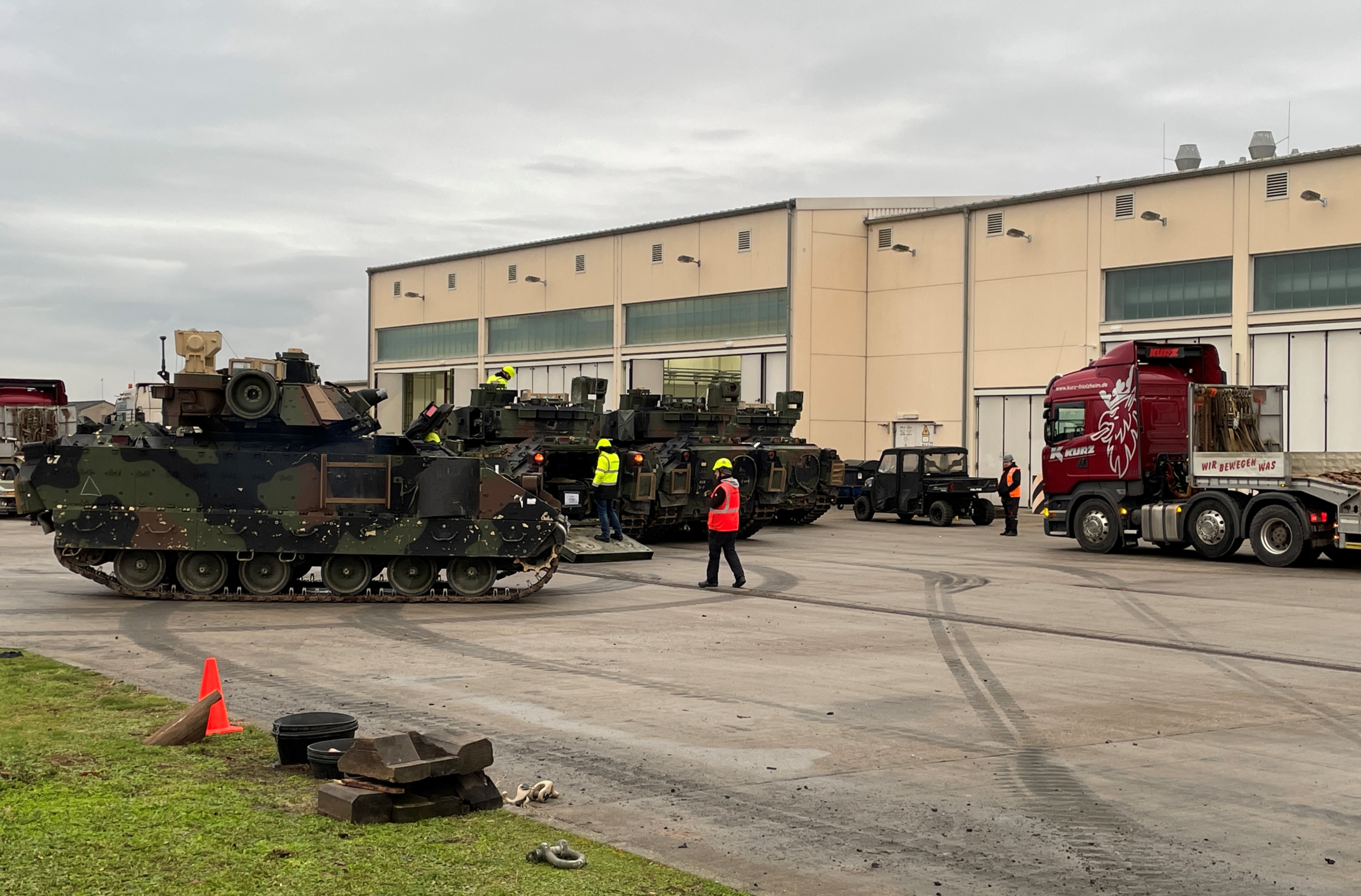
The US Army is testing industry capacity to provide continuous repair, validation, component procurement, and delivery support for M2A2 ODS-SA Bradley Fighting Vehicles used in assistance to Ukraine.
Army Contracting Command – Detroit Arsenal issued a sources-sought notice for the Bradley Fighting System and M88A2 recovery vehicle, asking potential suppliers to demonstrate whether they can support vehicle restoration and associated mechanic training. The notice is a market survey rather than a solicitation and does not itself create a new contract.
The requirement centres on returning M2A2 ODS-SA vehicles to fully mission-capable and safety standards while maintaining access to parts for a legacy platform. Interested companies were asked to show experience with heavy armoured vehicle integration, supply chain management, and the specific Bradley configuration, alongside a credible transition plan for taking on the work.
Obsolescence is one of the most difficult parts of that sustainment problem. The Army has highlighted legacy components including turret drive control units and transmission control modules, where original suppliers or production lines may no longer provide straightforward replacements. A repair programme can therefore depend on refurbished hardware, alternative sources, remanufacture, or controlled substitutions rather than simply ordering new parts from an established catalogue.
That creates an engineering burden beyond normal workshop maintenance. Any replacement or repaired component has to remain compatible with the vehicle’s electrical, mechanical, and control architecture, while technical data, test procedures, and acceptance criteria must be sufficient to establish that the restored vehicle meets the required configuration.
The Army is also seeking training support for Ukrainian military mechanics through the Advanced Mechanic Institute. Potential providers are expected to develop or deliver course material, lesson plans, tools, equipment, and other training resources, linking vehicle restoration to the ability of Ukrainian maintainers to sustain the fleet after the initial repair work is completed.
Training is particularly important for a legacy fleet because fault diagnosis can depend on platform-specific knowledge that is difficult to recreate from general automotive or armoured-vehicle experience. Maintainers need to understand the Bradley’s powertrain, turret systems, electronics, test equipment, technical publications, and approved repair limits, as well as the procedures for escalating faults that cannot be resolved locally.
A separate Army notice issued earlier in 2026 set out plans for Advanced Mechanic Institute 2.0, with training and technical support for Bradley and M88A2 systems on behalf of the Ukraine Management Office. That requirement was framed around field service representatives and training support, illustrating how the Army is treating mechanic development and vehicle sustainment as connected activities rather than independent programmes.
The current market survey adds the continuous repair and component-procurement dimension. That is important for any fleet operating outside the original US sustainment structure, because availability depends on more than access to a depot. Parts have to move through an international logistics chain, repair decisions need authorised technical data, and configuration records have to remain accurate as vehicles receive replacement assemblies from different sources.
Legacy electronics can be especially awkward. A discontinued control unit may contain components that are themselves obsolete, while replacing the complete assembly with a modern equivalent can require software changes, interface work, electromagnetic-compatibility testing, and renewed qualification. Repairing the original hardware can be faster, but only while specialist skills, parts, and test equipment remain available.
The M2A2 ODS-SA also sits within a wider Bradley family with several configurations in US and allied service. Common ancestry does not make every component interchangeable, and sustainment organisations have to control which parts, software versions, and modifications apply to each variant. Poor configuration discipline can create vehicles that are nominally the same type but increasingly difficult to support with one set of procedures and spares.
The Army’s use of a sources-sought notice allows it to test how much relevant capability exists outside the current support arrangement before choosing a contracting route. Respondents can show whether they hold the necessary technical expertise, supplier relationships, and restoration capacity, while the government can identify where proprietary data or incumbent knowledge may limit competition.
The exercise also provides a clearer view of industrial bottlenecks. If several suppliers can perform mechanical restoration but none can source a specific legacy control module, the constraint is no longer depot labour; it is component availability. Conversely, a well-stocked parts pipeline has limited value if there are too few trained technicians or test stations to return vehicles to service.
No vehicle quantity or new programme value has been attached to the market survey, and the Army has not committed to a competitive follow-on award. The immediate result is therefore information rather than procurement.
What follows will depend on the capability statements received and the contracting route selected by Army Contracting Command. For the Bradley fleet supporting Ukraine, the practical measure will be whether the sustainment system can keep repair capacity, obsolete-part sourcing, technical data, training, and configuration control aligned well enough to return vehicles to service without creating another maintenance backlog.