IN Brief:
- Quarterhorse Mk 2.1 reached Mach 1.21 during its third test flight.
- The aircraft is powered by a Pratt & Whitney F100 engine and forms part of Hermeus’ rapid iteration roadmap.
- The test strengthens the industrial case for reusable high-speed uncrewed aircraft built through short development cycles.
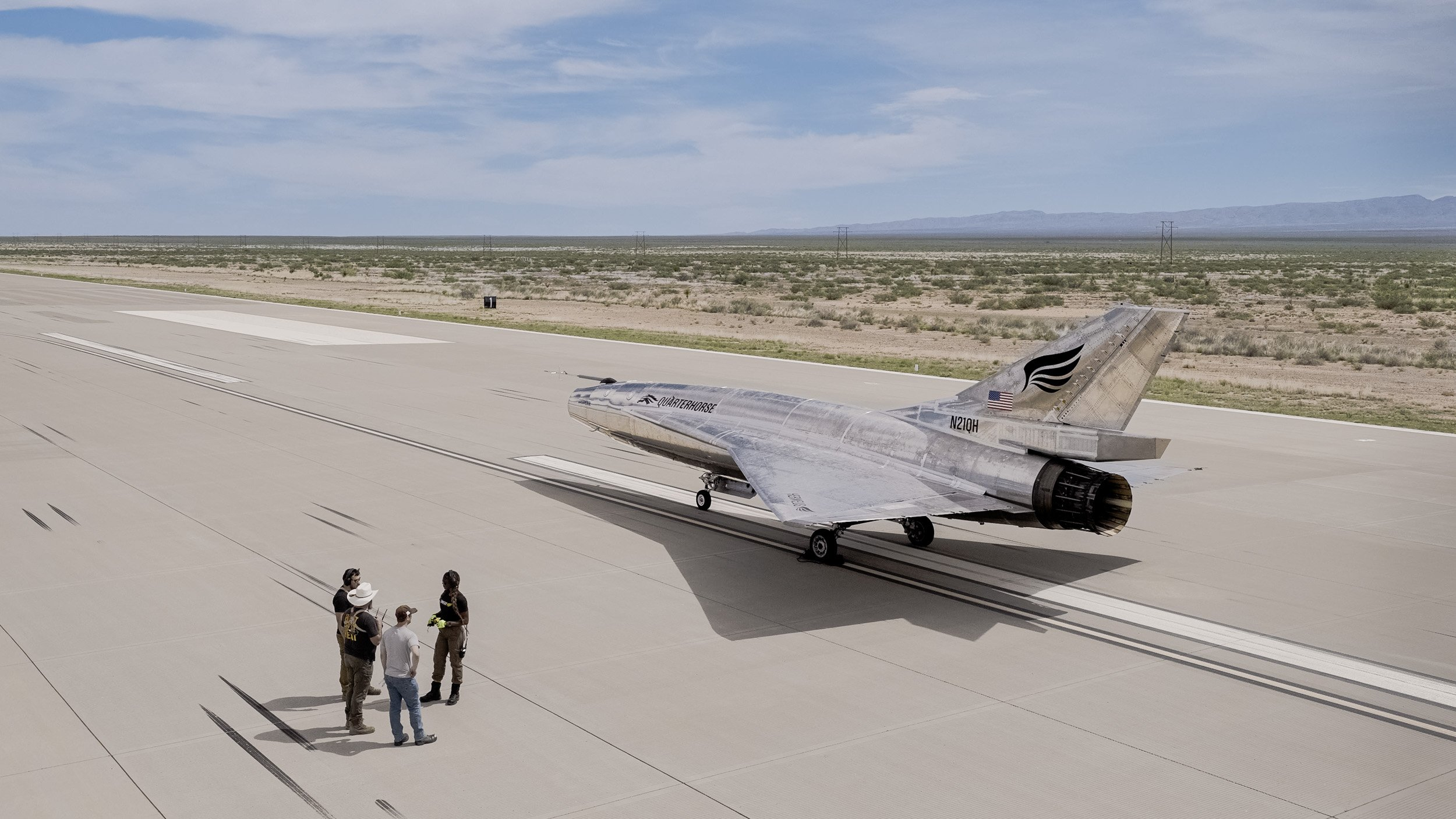
Hermeus has completed the first supersonic flight of its Quarterhorse Mk 2.1 unmanned aircraft, reaching Mach 1.21 during a test over White Sands Missile Range airspace.
The aircraft flew from Spaceport America and went supersonic on its third test flight. Quarterhorse Mk 2.1 is powered by a Pratt & Whitney F100 engine and is the first of three F-16-scale supersonic aircraft in the company’s current development sequence. The next vehicles, Mk 2.2 and Mk 2.3, are intended to push the design further as Hermeus moves towards sustained high-Mach flight.
The flight shows a privately developed unmanned jet moving through flight-test milestones at unusual pace. Quarterhorse Mk 2.1 flew supersonic less than three months after its first flight and under a year after the company’s Mk 1 aircraft made its maiden flight.
Although Quarterhorse is not a fielded military system, it sits inside a fast-growing defence technology area. The US and its allies are investing in high-speed weapons, hypersonic systems, uncrewed aircraft, decoys, and reusable test vehicles. Quarterhorse brings several of those themes together by generating high-speed flight data through a reusable unmanned platform.
High-speed flight is increasingly moving from isolated demonstration towards production planning. Work on hypersonics production pathways has shown how quickly the discussion shifts from aerodynamics to supply chains, materials, test capacity, and manufacturing repeatability. Hermeus operates in a different part of the high-speed ecosystem, but it faces a similar requirement to turn rapid development into disciplined production.
The use of the F100 engine is a pragmatic choice. A mature propulsion system removes one major development variable while allowing Hermeus to focus on airframe design, flight controls, autonomy, thermal behaviour, instrumentation, and test operations. In early high-speed aircraft development, reducing the number of unknowns can help sustain momentum.
The manufacturing model is central to the programme. Rather than building one heavily optimised demonstrator over a long development cycle, Hermeus is using successive aircraft to gather data and feed changes into the next build. That approach places heavy demand on digital engineering, supplier responsiveness, production tooling, configuration control, and test discipline.
Rapid iteration cannot bypass aerospace fundamentals. Supersonic unmanned aircraft still require robust structures, reliable flight controls, qualified materials, safe propulsion integration, and tightly managed range operations. Shorter cycles can expose design weaknesses quickly, but they can also magnify errors if manufacturing quality does not keep pace with development speed.
Quarterhorse also feeds into the debate around affordable high-speed capability. Historically, high-speed aircraft and missile systems have been expensive, specialised, and produced in limited numbers. A reusable unmanned aircraft that can be built and modified quickly could change the economics of propulsion testing, autonomy development, sensor work, and high-speed operations.
The aircraft’s scale is also relevant. An F-16-size unmanned platform sits between small expendable drones and large crewed aircraft. That class of vehicle could support test, training, strike, decoy, or sensor roles, depending on how the technology matures. Defence customers are already looking at more varied air fleets, combining crewed fighters with collaborative combat aircraft, attritable platforms, and specialised uncrewed systems.
The next development stages will be harder. Sustained high-Mach flight will introduce greater thermal and structural loads, while autonomy will need to mature beyond controlled test operations. Reusable high-speed aircraft also require maintenance and inspection regimes that do not erase the cost benefits of rapid production. If a vehicle is quick to build but slow to service, the operational case weakens.
Supply chain depth will become more important as Hermeus moves beyond individual demonstrators. High-speed aircraft place demand on metallic and composite structures, precision manufacturing, propulsion interfaces, flight-control actuators, thermal protection, sensors, instrumentation, and software. Even where existing engines are used, integration and support require a reliable industrial base.
Quarterhorse Mk 2.1 does not answer every question around high-speed unmanned aviation, but it gives Hermeus a meaningful flight-test milestone. The aircraft has crossed the supersonic threshold, and the company’s rapid-build model now faces the harder task of sustaining progress through more capable vehicles.
If that model holds, reusable high-speed aircraft could become a more practical part of defence technology development. The value would lie not only in a final platform, but in the ability to test, learn, manufacture, and modify at a tempo closer to the pace of modern threat development.