IN Brief:
- US budget planning includes a $1.85 billion line tied to foreign warship design and shipyard options.
- Japanese and South Korean yards are being examined as possible routes to expand naval output.
- Any move would raise integration, legal, survivability, and domestic industrial-base questions.
The United States is examining whether Japanese and South Korean shipbuilders could help expand naval warship capacity, with budget planning now pointing beyond exploratory analysis and toward more concrete procurement options.
The effort centres on future frigate and destroyer inventories, where allied yards and foreign designs are being assessed against US Navy requirements. American naval shipbuilding remains under pressure from slow major-combatant output, submarine production strain, maintenance backlogs, and limited workforce depth. Japanese and South Korean shipbuilders, by contrast, have demonstrated high-volume production, advanced naval engineering, and mature experience in complex surface combatants.
Any allied-yard route would still be far more complicated than buying hulls overseas. Major surface combatants require survivability standards, combat-system architecture, electromagnetic compatibility, shock qualification, classified integration, weapons interfaces, secure software baselines, and a supply chain able to meet American regulatory and security requirements. A foreign yard may be able to build ships quickly, but the US Navy must still control the combat system, certification route, and long-term support model.
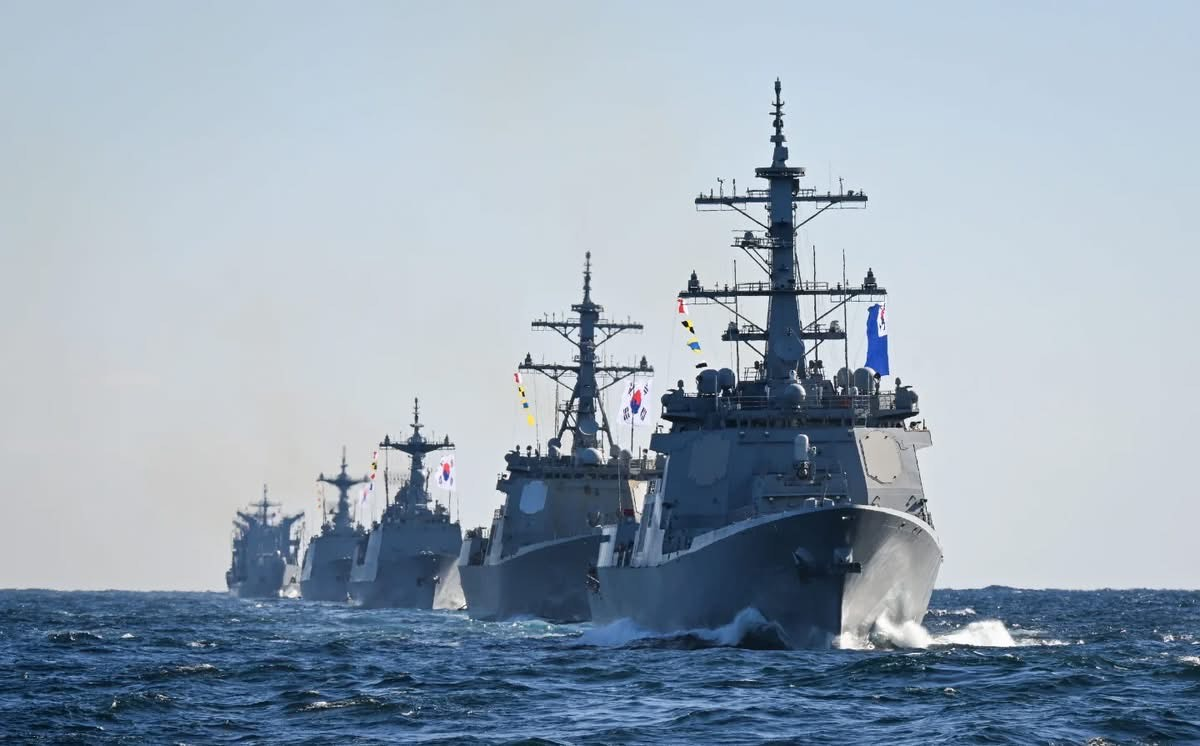
Japan and South Korea both operate Aegis-capable surface combatants, giving the concept technical credibility. The harder work begins when a design is adapted for US weapons, sensors, communications, damage-control standards, and software requirements. Design changes can be extensive enough to turn a mature ship into a heavily modified class, with cost and schedule risk moving from steelwork into integration.
That integration burden defines the manufacturing challenge. Allied yards may offer modular construction capacity, skilled labour, production discipline, and speed. The United States still has to decide where combat systems are installed, which suppliers provide radars and weapons, how classified work is handled, and how much construction can take place overseas without weakening the domestic industrial base.
The debate has been building for months. US studies Japanese and Korean shipyards for warship capacity examined the earlier study phase, when foreign shipyard expertise was being weighed against domestic production constraints. The latest budget signal sharpens the question by moving the discussion closer to acquisition architecture and away from a purely analytical exercise.
Domestic shipbuilders will watch the proposal closely. US yards have long argued that output can expand if programme stability, supplier funding, capital investment, and workforce pipelines improve. Their concern is that overseas construction could weaken political support for domestic recapitalisation. Naval leaders, however, face a capacity problem that cannot be solved quickly through traditional procurement alone.
A hybrid model may become the more realistic route. Foreign shipbuilders already have interests in US facilities, while allied capital and production expertise could support American yards without fully shifting construction abroad. Overseas yards might contribute modules, design work, early production learning, or selected ship classes, while sensitive combat-system integration remains under US control.
For Japanese and South Korean companies, the opportunity would be commercially attractive but demanding. US Navy work brings scale and long-term prestige, but also heavy compliance, export-control, cybersecurity, documentation, configuration-management, and quality-assurance requirements. Any yard entering that ecosystem would need to operate inside American standards for traceability, classified handling, supplier qualification, and lifecycle support.
The Indo-Pacific context gives the proposal additional force. The US wants more ships in the theatre where future naval pressure is most likely to concentrate, while two of the world’s strongest allied shipbuilding nations already sit in that region. Their geography, capacity, and experience make them obvious candidates for deeper industrial cooperation, particularly if Washington concludes that domestic yard expansion alone cannot deliver the required fleet size quickly enough.
The central question is whether warship production can become more internationally networked without losing sovereign control over combat systems, classified technology, and wartime repair capacity. Allied shipyards may relieve pressure on the US naval production base, but only if the model strengthens fleet output rather than creating another bespoke integration problem.