IN Brief:
- UTAC Special Vehicles has produced its 1,000th armoured vehicle at Millbrook.
- The company’s work spans ballistic and blast protection, hot-formed armour, and bespoke conversions.
- The milestone highlights demand for specialist protected mobility outside high-volume military vehicle programmes.
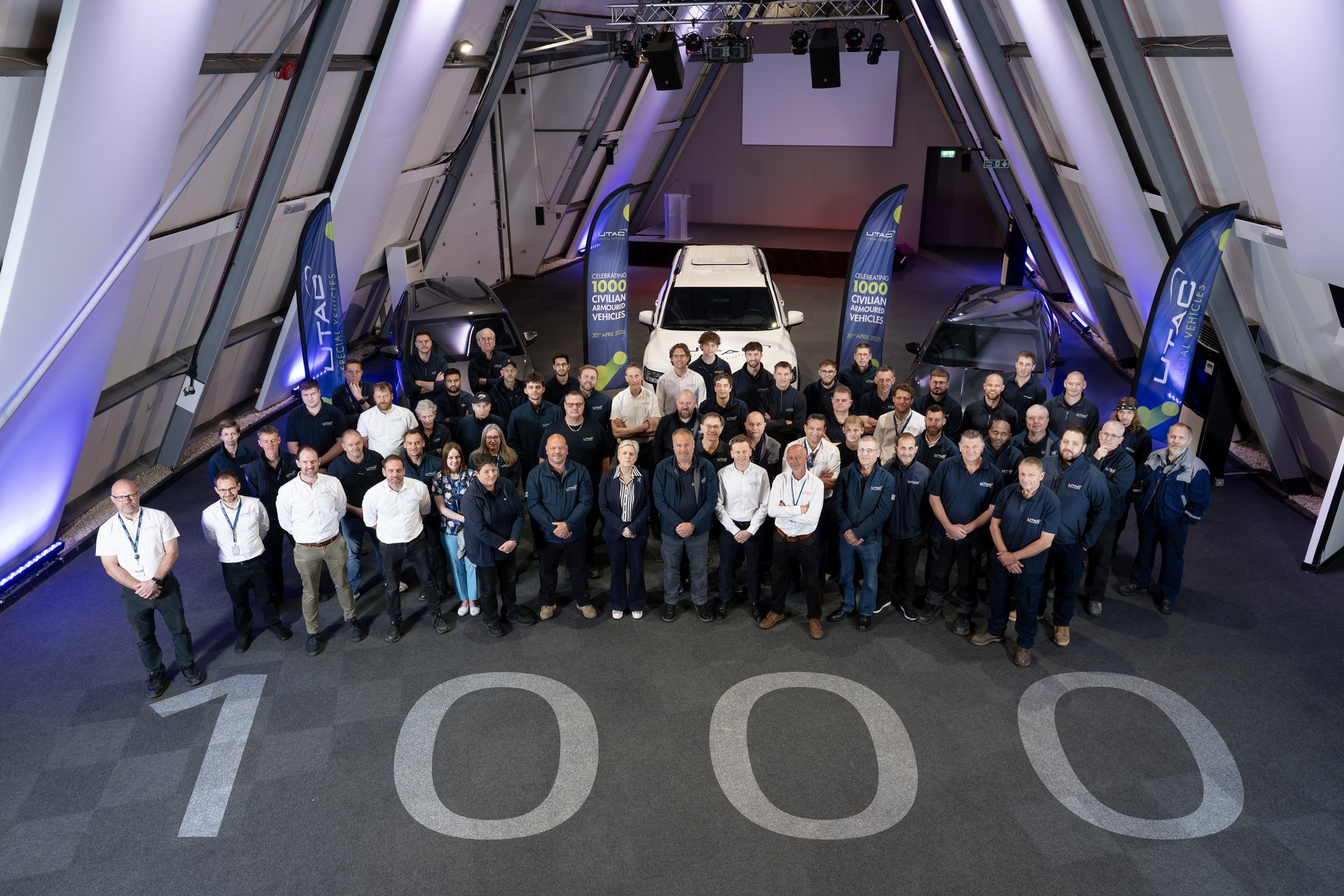
UTAC Special Vehicles has produced its 1,000th armoured vehicle at Millbrook in Bedfordshire, marking a notable milestone for the UK’s specialist protected mobility sector.
The business began armouring vehicles in 2012 and has since developed a portfolio spanning discreet protected vehicles, certified ballistic and blast protection, hot-formed armour, Toyota Land Cruiser-based conversions, Škoda platform work, and bespoke low-volume protected mobility. The milestone reflects a niche but strategically important part of the defence and security vehicle market: vehicles that are not always bought in large programme quantities, but require high assurance, engineering discipline, and repeatable protection standards.
Protected mobility manufacturing sits between automotive engineering and defence-grade survivability. A conversion must account for vehicle dynamics, payload growth, braking, suspension, powertrain cooling, door structures, glass thickness, occupant ergonomics, and certification against ballistic and blast threats. Adding armour is not simply an exercise in increasing mass. Every kilogram affects handling, durability, stopping distance, maintenance intervals, and component wear.
Low-volume armouring therefore demands disciplined production. Vehicles may begin life as commercial platforms, but the conversion process can involve structural reinforcement, armoured glass installation, protected fuel systems, run-flat systems, upgraded suspension, revised hinges and latches, protected battery compartments, and internal layouts that preserve usable space while meeting threat requirements. Customers may also need discreet visual signatures, forcing protection into the structure without obvious external change.
Millbrook gives the work a useful engineering setting. Vehicle protection benefits from access to proving-ground infrastructure, test tracks, environmental testing, and certification knowledge. For defence and security buyers, the ability to develop, test, validate, and iterate in one ecosystem reduces technical risk. For the UK industrial base, it preserves a capability that can be overshadowed by larger vehicle programmes.
The UK has long held expertise in protected mobility, from armoured fighting vehicle work to specialist conversions for diplomatic, government, police, military, and commercial security users. Current threat conditions continue to support demand. State instability, terrorism, organised crime, grey-zone activity, and overseas operating risk all sustain a market for vehicles that protect occupants without the footprint of a full military platform.
Specialist armouring also depends on the kind of material, fabrication, test, and certification capability mapped in Materials Map shows UK defence supply strength. Ballistic steel, composites, armoured glass, forming processes, and quality assurance sit behind the finished vehicle. Once those skills and supplier relationships are lost, they are difficult to rebuild quickly.
Production pressures are familiar across defence manufacturing. High-grade armour materials, ballistic glass, specialist fasteners, and certified protection packages can carry long lead times. Supply chains tighten quickly when conflicts, diplomatic demand, or domestic security requirements rise. Skilled labour is another constraint, because technicians need to understand both automotive assembly and defence-level quality, including the consequences of small deviations in installation, sealing, or fit.
The next generation of protected vehicles is also becoming more technically integrated. Physical protection increasingly has to accommodate secure communications, counter-surveillance equipment, electronic security, power management, fleet tracking, mission systems, and connected vehicle cybersecurity. A protected SUV or utility vehicle may need secure radios, protected wiring, sensors, data terminals, electronic countermeasures, and onboard power reserves alongside armour and glass.
That shift moves specialist armouring closer to systems integration. Buyers still want survivability, but they also want warranty control, serviceability, low downtime, and global support. Low-volume specialists must manage bespoke requirements without allowing every vehicle to become a one-off engineering project.
UTAC’s 1,000th vehicle is not a mass-production milestone in the conventional sense. It represents continuity in a sector where reputation, certification, and technical credibility matter more than annual output. For the UK defence and security industrial base, that retained engineering skill set remains valuable precisely because demand can rise suddenly and because protected mobility still relies on practical production knowledge, not just design intent.