IN Brief:
- Kongsberg has completed its acquisition of a 90% stake in US missile company Zone 5 Technologies.
- Zone 5 develops mass-producible interceptors including Rusty Dagger and White Spike.
- The acquisition strengthens Kongsberg’s position in affordable strike, air defence, and high-volume missile production.
Kongsberg has completed its acquisition of a 90% stake in US missile company Zone 5 Technologies, adding affordable mass-missile production to a portfolio already spanning air defence, strike systems, command and control, naval technology, and aerospace systems.
Zone 5 will continue operating as an independent subsidiary under founder and chief executive Thomas Akers and the existing management team. The transaction value has not been disclosed, but the strategic direction is plain: Kongsberg is adding a US manufacturing and design base in a market where allied customers are demanding more missiles, faster production, and lower unit costs.
Zone 5 designs and manufactures mass-producible interceptors, including Rusty Dagger long-range strike and White Spike air-defence missiles. The company has also been associated with US Air Force affordable missile initiatives, including the Family of Affordable Mass Missiles and the Extended Range Attack Munition effort.
The acquisition gives Kongsberg a stronger position in a market that is being reshaped by inventory pressure. High-end missiles remain essential, but recent conflicts have exposed the limits of relying only on expensive, complex weapons that take years to replenish. Air-defence interceptors, counter-UAS weapons, long-range strike systems, and attritable effects are increasingly assessed against production rate and stockpile depth as well as performance.
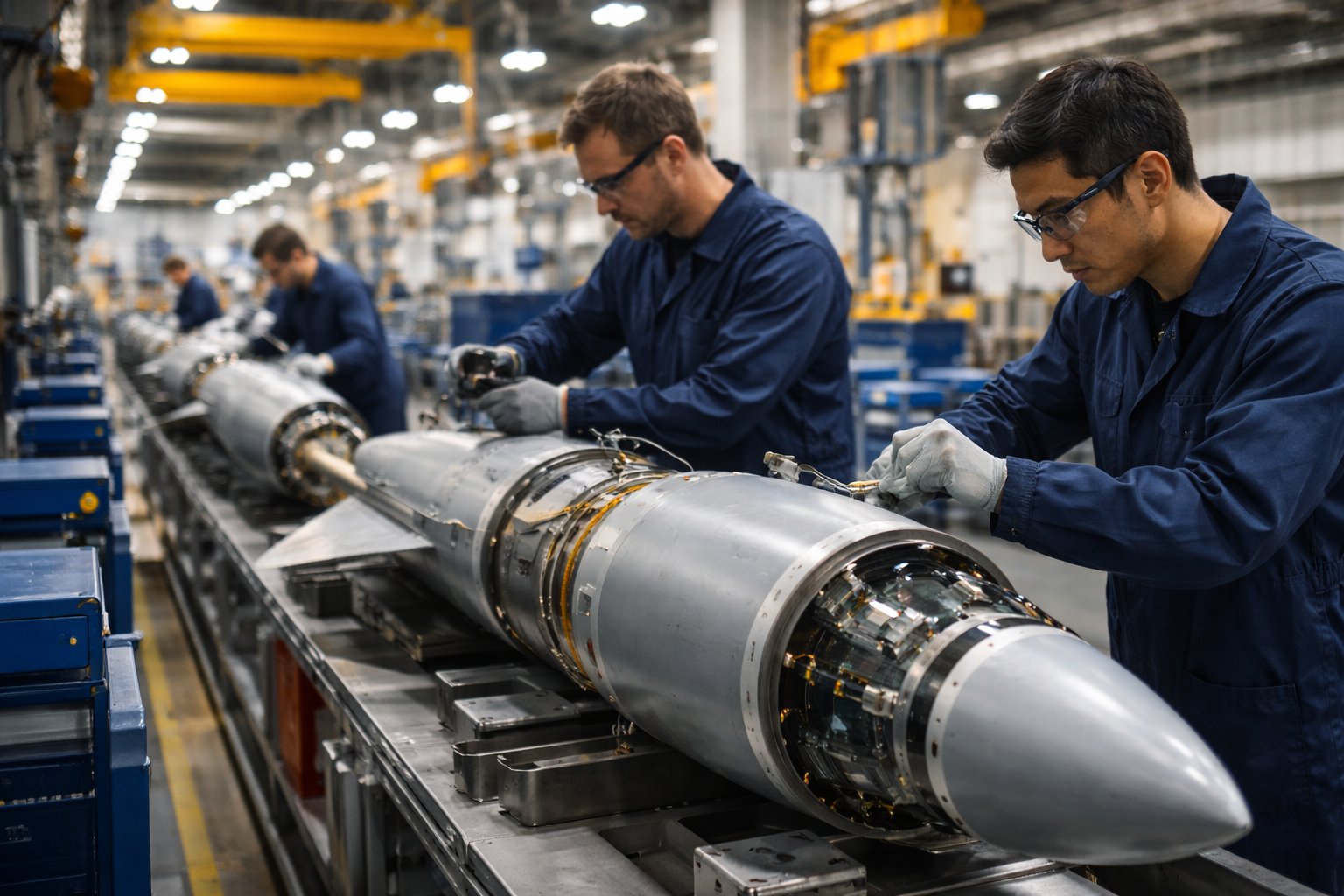
Missile manufacturing is constrained by more than final assembly. Rocket motors, seekers, warheads, actuators, batteries, navigation systems, energetic materials, casings, test equipment, containers, and qualified labour all create bottlenecks. Some of those components are already stretched across air defence, artillery rockets, anti-ship missiles, and long-range strike. A missile family designed for affordability and high-rate production can reduce pressure only if manufacturability is built into the design from the beginning.
Zone 5’s appeal lies in that approach. Affordable mass missiles require reduced part counts, modular designs, simplified assembly, repeatable testing, and supply chains that can support volume. They still need enough performance to survive electronic warfare, reach the target, and deliver a useful effect. Cheap missiles that fail operationally are not affordable; they simply move cost into the battlefield.
Kongsberg brings international scale, integration experience, and access to allied customers. Zone 5 brings a US industrial footprint and product lines aligned with Washington’s push for lower-cost strike and air-defence capacity. Together, the companies gain a stronger route into transatlantic missile demand at a point when European and US customers are trying to rebuild stockpiles.
The acquisition also fits Kongsberg’s wider investment in autonomous and distributed defence systems. Its work with DRASS on underwater autonomy points to the same corporate interest in systems where sensors, autonomy, production depth, and integration converge. Zone 5 adds a missile layer to that pattern.
The broader industrial environment is moving in the same direction. The UK’s air-defence manufacturing debate, from Sky Sabre replenishment pressure to directed-energy and interceptor production, shows how allied governments are looking for ways to defeat drones and missiles without exhausting premium stockpiles. Zone 5 operates directly in that affordability gap.
Maintaining the company’s independent structure may help preserve its development speed. Large defence groups often acquire small missile or drone companies for agility, then slow them down through process, compliance, and integration layers. Kongsberg will need to add quality, export control, programme discipline, and international sales support without dulling Zone 5’s rapid-production culture.
The US footprint is also important. Missile supply chains are strategically sensitive because production allocation becomes political when inventories are under pressure. A European-headquartered group with a US subsidiary can help bridge allied demand, but it must manage export controls, security restrictions, intellectual property, and national procurement priorities carefully.
Scaling will be the harder test. More affordable missiles still require factory investment, qualified suppliers, test ranges, inspection capacity, energetic-materials supply, and a workforce able to move from prototype batches to repeatable production. Customer orders must be stable enough to justify that expansion, because intermittent procurement rarely produces genuine manufacturing depth.
For Kongsberg, Zone 5 strengthens the company’s position across strike, air defence, and counter-UAS markets. For allied defence buyers, the acquisition adds another industrial route toward missiles that can be bought in quantity rather than preserved for only the highest-value targets.
The deal reflects a market adjustment that is likely to continue. Defence ministries want advanced weapons, but they also need enough weapons. Kongsberg’s purchase of Zone 5 is a direct move into the space between exquisite capability and industrial mass, where the next phase of missile competition is already taking shape.