IN Brief:
- MBDA and Ukrainian Armor have signed an MoU covering deep-strike and counter-UAS capability development.
- The partnership could lead to joint production programmes and a future joint venture.
- The agreement reflects growing European interest in Ukrainian battlefield-tested design cycles and manufacturing flexibility.
MBDA and Ukrainian Armor have signed a memorandum of understanding to explore cooperation on deep-strike and counter-unmanned aerial systems, linking one of Europe’s major missile houses with a Ukrainian company shaped by high-intensity war production.
The agreement establishes a framework for long-term collaboration, including joint initiatives, knowledge sharing, development projects, and potential joint production programmes. The companies have identified deep strike and counter-UAS as the first areas of focus, with a possible joint venture also under consideration.
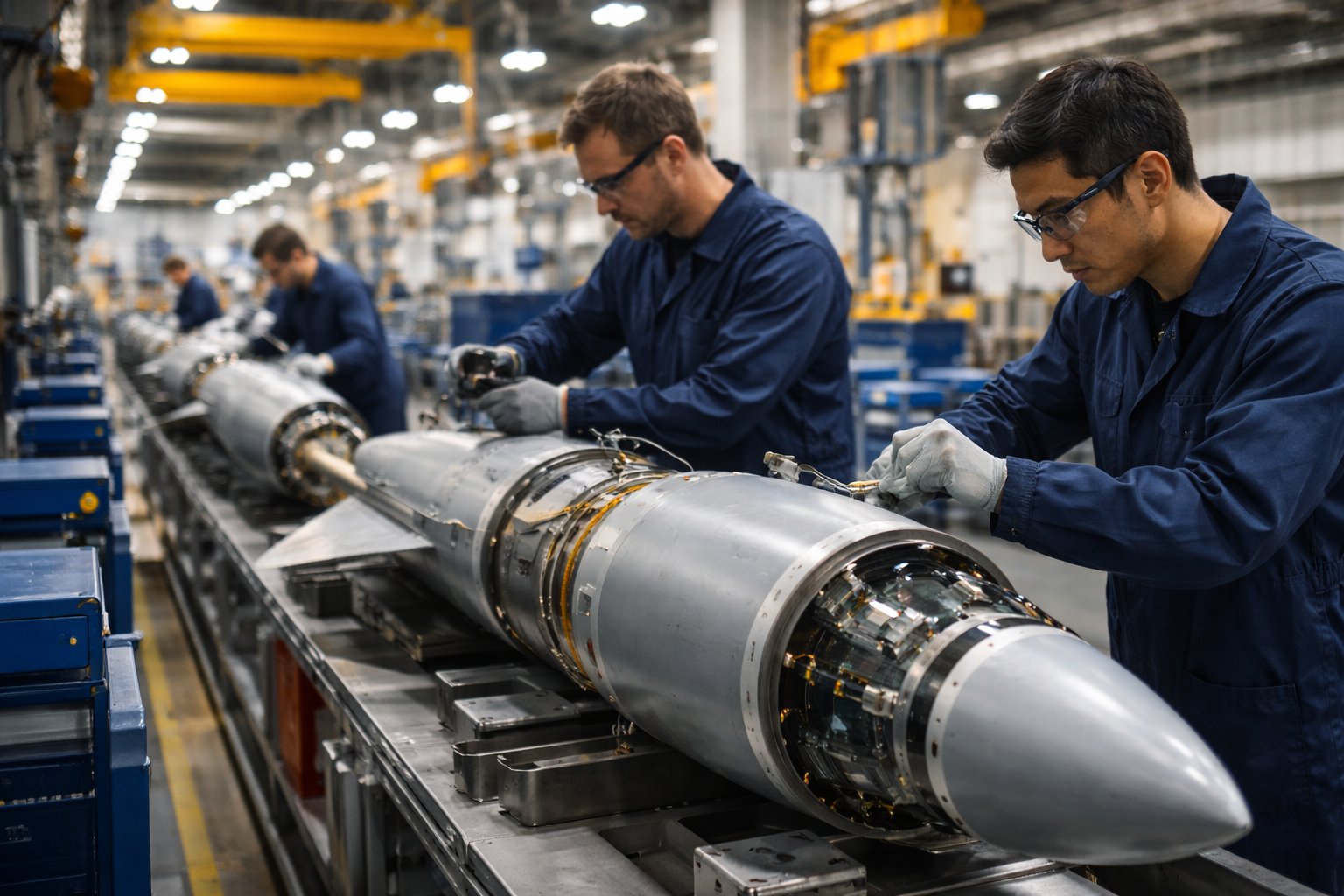
Ukrainian Armor brings experience across armoured vehicles, mortar systems, ammunition, artillery shells, unmanned systems, and related components. MBDA brings missile-system design, integration, production, and support expertise across European and allied markets. Together, the companies are moving into capability areas where battlefield demand, unit cost, software iteration, and production speed are now inseparable.
Deep-strike weapons are no longer judged only by range, warhead, and accuracy. Buyers are looking more closely at production rate, storage life, launch flexibility, resilience against electronic warfare, target-update options, and the ability to replenish stocks during sustained use. Counter-UAS systems face similar pressure, as armed forces try to defend against cheap drones without draining inventories of expensive interceptors.
Ukraine has forced the industrial pace. Equipment that looks credible in trials can be exposed quickly by jamming, weather, operator improvisation, and adversary adaptation. Systems that survive that environment tend to improve quickly because feedback loops are short and unforgiving. Established European primes bring certification, engineering depth, export discipline, and production assurance, while Ukrainian manufacturers bring direct exposure to fast-moving battlefield requirements.
The partnership sits alongside Ukraine’s wider movement from emergency adaptation toward structured defence-industrial cooperation. The country’s expanded presence at Eurosatory showed how Ukrainian companies are using battlefield experience to build export and partnership routes, while Fire Point’s interceptor work has highlighted the drive to turn urgent wartime missile development into scalable production.
Counter-UAS is likely to be the more immediate industrial test. The market is crowded with radars, jammers, effectors, electro-optical sensors, acoustic systems, command software, and kinetic interceptors, yet many armies still lack coherent layered protection. Manufacturers must increasingly deliver the entire kill chain, from detection and classification to engagement, replenishment, and operator training.
Deep strike brings a different burden. Long-range weapons require propulsion, guidance, navigation, warheads, airframes, mission planning, testing, secure software, energetic materials, and launcher integration. Small changes to range, payload, or guidance can alter production complexity. Scaling those systems therefore requires more than clever design; it requires stable suppliers, qualified materials, test infrastructure, and enough orders to keep production lines warm.
A future MBDA-Ukrainian Armor programme would need to handle export controls, intellectual property, secure data exchange, classified testing, component qualification, distributed manufacturing, and wartime sustainment. Those issues can slow cooperation if they are handled late, but they can also create a stronger industrial model if designed into the partnership from the start.
Europe’s defence industry is under pressure to absorb wartime lessons without turning every requirement into a bespoke, slow-moving programme. Ukraine has shown how quickly users can adapt when equipment is available in quantity. European defence ministries, however, still need systems that can be certified, insured, exported, maintained, and integrated into allied command structures. MBDA and Ukrainian Armor sit on opposite sides of that tension, which is precisely why the partnership has weight.
Production economics will shape the outcome. Deep-strike systems and counter-drone interceptors must be affordable enough to buy in useful numbers, but robust enough to survive contested conditions. That balance affects material choice, electronics, propulsion, seeker complexity, warhead design, launcher compatibility, and testing. Premium systems still have a role, but they cannot carry the entire burden of modern missile warfare.
If the cooperation advances into joint production, it could offer Europe a route to combine established missile engineering with Ukrainian battlefield iteration. That would give both companies a stronger position in a market where demand is rising, stockpiles are thin, and governments increasingly want systems that can move from design improvement to production faster than legacy procurement cycles allow.
The MoU is an early-stage step, but it reflects a wider industrial adjustment. Europe’s missile and counter-UAS sectors are being pulled towards scale, affordability, and speed, while Ukraine’s manufacturers are seeking the partnerships needed to turn wartime development into durable capacity. Deep strike and drone defence are likely to remain among the first places where that adjustment becomes visible.