IN Brief:
- Fire Point has completed a controlled flight test of the FP-7.X missile.
- The missile is planned as the future interceptor for the Freyja air-defence architecture.
- The programme reflects Ukraine’s push to turn wartime missile development into scalable production.
Ukraine’s Fire Point has completed a controlled flight test of the FP-7.X missile, advancing an effort to build a domestic interceptor that could form the kinetic element of the future Freyja anti-ballistic missile system.
The FP-7.X is described as an interceptor variant of the FP-7 missile family and is intended to provide a lower-cost route into ballistic missile defence. The test demonstrated controlled manoeuvring flight rather than a complete intercept, but it marks progress for a Ukrainian company already associated with high-volume long-range drone production and the Flamingo cruise missile. The programme sits at the intersection of missile manufacturing, air-defence architecture, radar integration, guidance software, and wartime industrial scaling.
Ukraine’s requirement is severe and immediate. Russian ballistic missiles and air-launched weapons continue to place intense pressure on Ukrainian air defences, while Patriot interceptors and other high-end systems remain expensive, scarce, and dependent on external supply. A domestic interceptor would not remove that dependence quickly, but it could change the long-term equation if it can be manufactured at lower cost and sufficient volume.
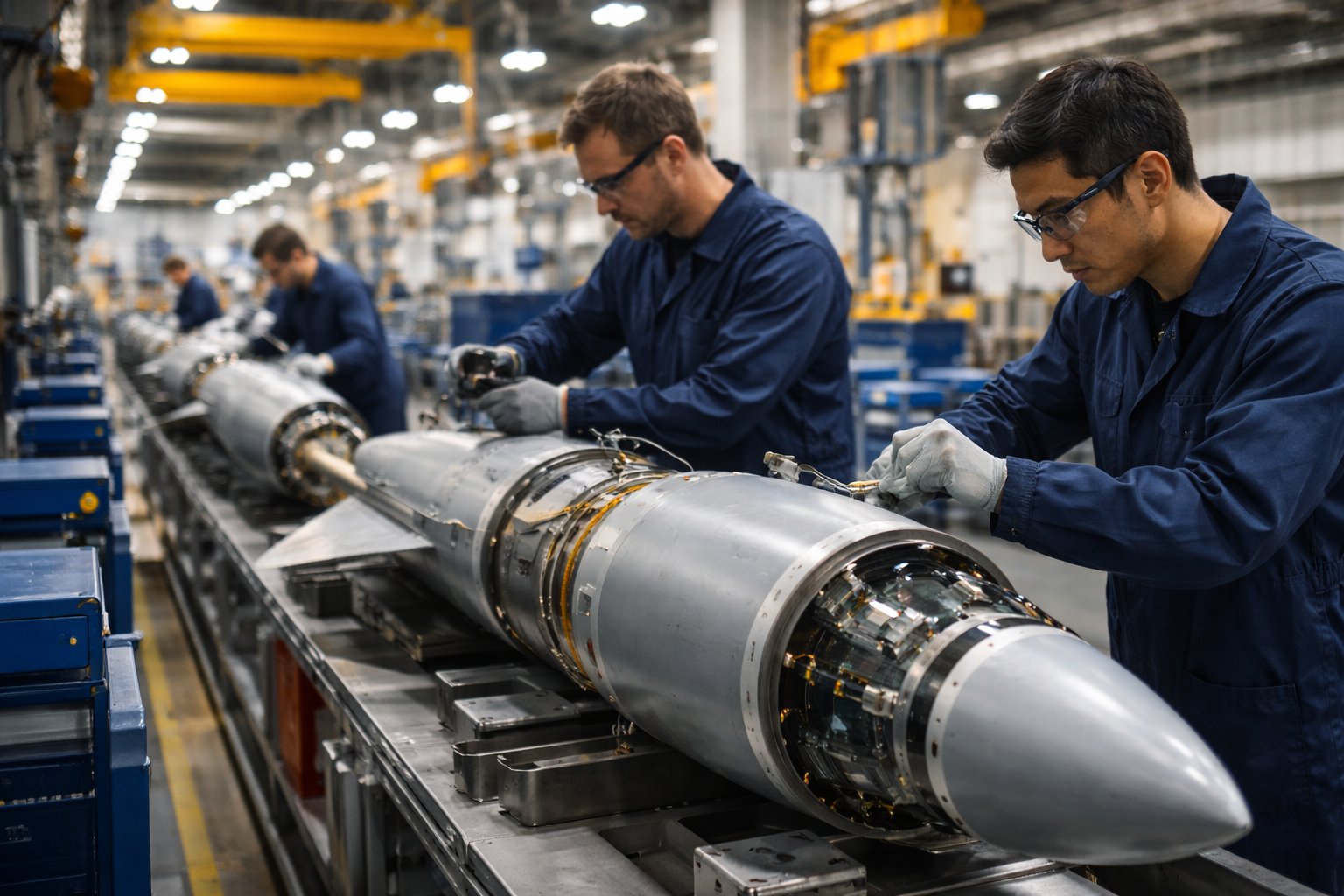
The engineering burden is substantial. A ballistic missile interceptor must accelerate rapidly, survive high aerodynamic loads, manoeuvre with precision, and receive or generate reliable targeting data under compressed engagement timelines. The missile body, propulsion, control surfaces, actuators, power systems, and guidance electronics all need tight production consistency. Composite structures can reduce weight and improve performance, but they create additional manufacturing demands around materials, curing, inspection, and quality assurance.
The missile is only one layer of the architecture. Freyja would require radar, targeting, communications, launch systems, fire-control software, command logic, and cybersecurity. A credible interceptor must be paired with detection, classification, tracking, engagement planning, launcher reliability, and battle-management integration. Each element needs suppliers, testing, documentation, and sustainment if the system is to move beyond a promising development pathway.
Ukraine’s wartime defence industry has shown remarkable speed, but ballistic missile defence is less forgiving than drone production. Long-range one-way attack drones can be built at scale using a mixture of commercial, modified, and purpose-built components. Interceptors demand tighter tolerances, higher acceleration, faster decision cycles, and more sophisticated guidance. Cost reduction is essential, but the engineering standard cannot be softened if the system is expected to defeat ballistic threats.
That tension defines much of Ukraine’s industrial position. The country needs cheaper and more numerous systems while operating against targets that demand advanced engineering. Fire Point’s work illustrates the shift from emergency wartime manufacturing toward more formal complex-weapons production. It also explains why European participation in radar, target-seeking, communications, and subsystem support could become central if the programme matures.
European air defence is already facing a production bottleneck. Britain’s work across Skyhammer, DragonFire, and other air-defence manufacturing pathways shows how quickly the sector is moving from capability demonstration to questions of production volume, test infrastructure, and supply resilience. Ukraine faces the same industrial challenge under far harsher conditions: build faster, build cheaper, and build while absorbing operational attack.
A maturing Freyja system could create a hybrid production model. Ukraine may provide missile development speed and wartime iteration, while European companies contribute specialised radar, electronics, seekers, communications, or command subsystems. That would mirror a wider pattern in which Ukrainian companies develop quickly and external partners strengthen the parts of the system that require mature manufacturing capacity, certification, or deep subsystem expertise.
Major technical hurdles remain. A controlled flight is not a successful intercept, and the programme still has to demonstrate target acquisition, mid-course control, terminal guidance, launcher performance, radar integration, engagement timing, and system-level reliability. It must also move from prototype activity to repeatable production. The distance between a missile that flies and a missile that can be manufactured, stored, deployed, and fired reliably is large.
Even with those caveats, FP-7.X is a serious industrial signal. Ukraine is not only consuming Western air-defence equipment; it is trying to build elements of the next generation. If the programme progresses, it could give European defence manufacturers a new partnership model around interceptor production, subsystem integration, and air-defence volume. Demand for credible interceptors is rising across Europe. The harder question is whether industry can produce enough of them before scarcity becomes the dominant feature of continental air defence.