IN Brief:
- Ukraine’s Eurosatory 2026 presence is expected to rise from around 10 companies in 2024 to about 80.
- The display will centre on drones, electronic warfare, missiles, long-range strike, and wartime production systems.
- The expansion reflects Ukraine’s shift from emergency battlefield iteration toward a more visible defence-industrial export model.
Ukraine’s planned expansion at Eurosatory 2026 marks a sharp change in the country’s defence-industrial profile, with around 80 companies expected to exhibit in Paris compared with roughly 10 at the previous edition.
The scale of the delegation reflects more than a larger national stand. Ukraine’s defence sector has spent more than four years under the pressure of high-intensity war, forcing drones, electronic warfare, missiles, sensors, software, repair networks, and production cells to evolve quickly. Eurosatory gives those companies a platform to present battlefield-tested systems to a wider procurement and partnership market.
The display is expected to focus on unmanned systems, missiles, electronic warfare, and equipment shaped directly by the war with Russia. Those are the areas where Ukraine has built a distinctive industrial approach: rapid design cycles, short feedback loops from frontline users, dispersed manufacturing, frequent software changes, and a willingness to alter hardware faster than traditional procurement systems usually allow.
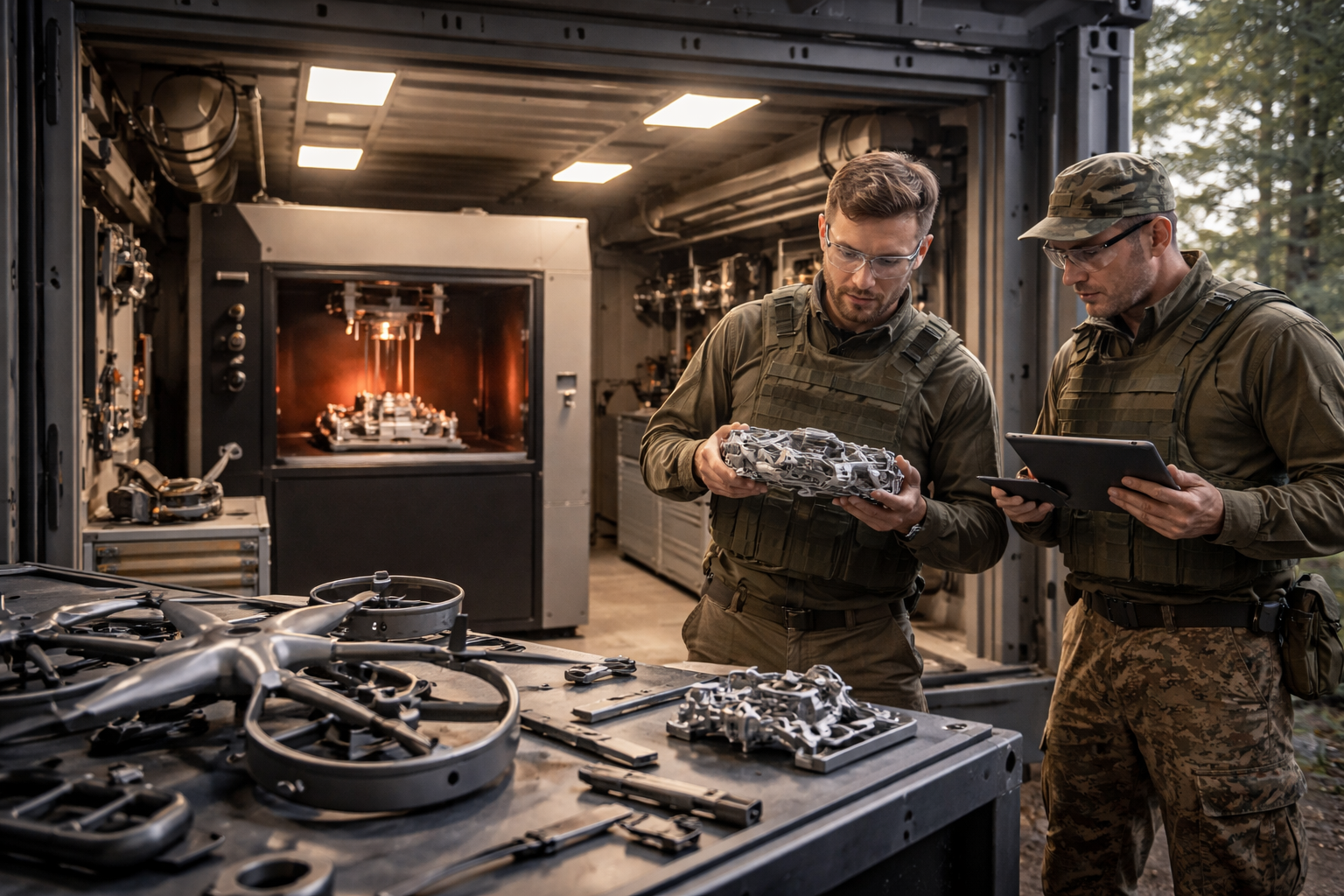
Ukraine’s development model has often moved in the reverse direction to peacetime acquisition. Systems have been improvised, tested in combat, modified by users, scaled through distributed workshops, standardised where possible, and then pulled toward more formal production. That approach is uneven, but it has created a body of practical engineering knowledge that many Western companies are now trying to understand.
The same wartime-industrial shift is visible in Ukraine’s interceptor and drone production work. Fire Point test advances Ukraine interceptor production effort showed how local companies are pushing into more complex air-defence and strike systems, while Ukrainian drone order shows scale of FPV production model highlighted the country’s ability to turn relatively cheap components into large-volume battlefield capability.
Eurosatory 2026 will test whether that experience can translate into export products, licensed production, industrial partnerships, and investment. Wartime performance carries weight, but international customers still need documentation, quality assurance, cybersecurity, repeatable manufacturing, training packages, spares, export compliance, and through-life support. A drone that works for a Ukrainian frontline unit is not automatically ready for a foreign procurement framework.
The transition from wartime iteration to controlled production will be demanding. Ukrainian companies will need configuration management, supplier stability, production testing, software version control, electromagnetic compatibility, munitions safety, and maintenance support. Export buyers will also want confidence that systems can integrate with NATO command networks, datalinks, logistics processes, and security requirements.
Electronic warfare presents a particularly strong opportunity. Ukraine’s RF environment is among the most demanding in the world, with rapid adaptation on both sides. Systems able to detect, jam, spoof, or survive in that environment will attract attention, but they also require disciplined production. Antennas, amplifiers, power supplies, rugged enclosures, processors, and software-defined radio architectures must be built consistently if they are to move beyond urgent wartime batches.
Long-range strike and missile systems bring further production pressure. Range, accuracy, survivability, and payload claims have to be backed by propulsion reliability, guidance quality, warhead integration, production throughput, storage safety, and test evidence. Export customers will be drawn to Ukraine’s operational experience, but they will still look for manufacturing continuity while the war continues.
The broader European context strengthens Ukraine’s position. Traditional defence manufacturers are under pressure to lift artillery, drone, missile, air-defence, and electronic-warfare output, yet many remain constrained by slow contracts, limited lines, and fragile sub-suppliers. Ukraine’s model offers speed, distributed production, and user-led iteration, although it remains harder to govern under peacetime procurement rules.
Partnership may prove more productive than imitation. Ukrainian manufacturers bring combat data, fast engineering cycles, and field feedback. Established primes bring certification, export compliance, systems integration, production engineering, finance, and global support networks. Strong post-war products are likely to emerge where those strengths meet rather than where either side tries to dominate the other.
Ukraine’s enlarged presence in Paris will therefore be a test of industrial maturity. If its companies can show repeatability, integration discipline, and supportability, they will move beyond wartime improvisation and into the European defence-manufacturing supply base with a credibility that few peacetime demonstrations can match.