IN Brief:
- AM General and Kalyani Strategic Systems are partnering on next-generation mounted artillery.
- The work centres on Kalyani’s MArG 155mm architecture and exportable wheeled gun systems.
- The partnership reflects rising demand for mobile, lower-footprint artillery able to displace quickly after firing.
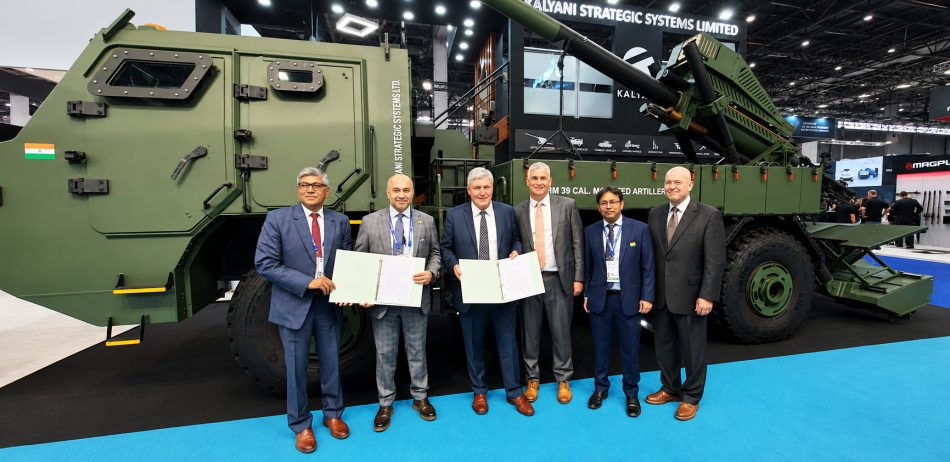
AM General and Kalyani Strategic Systems have formed a strategic partnership to develop and market next-generation mounted artillery systems, linking US vehicle-manufacturing experience with Indian gun-system engineering as demand rises for mobile fires.
The partnership is focused on compact, ruggedised, all-terrain mounted artillery solutions for international customers. Kalyani’s MArG 155mm architecture sits at the centre of the work, bringing a 52-calibre gun system onto a high-mobility vehicle platform with automated loading support, onboard fire control, and a design emphasis on rapid displacement after firing.
Modern artillery demand is being shaped by a harsh battlefield cycle. Counter-battery radars, drones, loitering munitions, and precision strike systems have made static firing positions increasingly vulnerable, while high-intensity warfare continues to consume guns, barrels, ammunition, and crews at scale. Wheeled mounted artillery gives armies a route between traditional towed guns and heavier tracked self-propelled systems.
For manufacturers, a mounted gun is not simply a cannon placed on a truck. A 155mm weapon creates severe recoil, vibration, heat, and structural load, all of which must be absorbed by the vehicle architecture without degrading accuracy, mobility, or crew safety. Suspension, stabilisation, hydraulics, ammunition storage, fire-control software, power systems, and chassis reinforcement have to work as one engineered product.
Kalyani brings artillery production, metallurgy, and gun-system design experience from India’s expanding defence-industrial base. AM General brings military mobility experience, international customer relationships, and a supplier ecosystem familiar with rugged tactical vehicles. Together, the companies are aiming at export markets where buyers want Western-compatible systems without the cost, weight, or support burden of heavier artillery options.
The market conditions are favourable but unforgiving. Armies want systems that can shoot and move quickly, but they also want affordable ammunition compatibility, barrel replacement routes, reliable digital fire control, maintainable hydraulics, and training packages that can be absorbed without years of force restructuring. A wheeled gun that performs well in a demonstration still has to prove it can survive sustained firing cycles and poor operating conditions.
Land fires are also becoming more digitally connected. Work on networked targeting and digital fires shows how artillery is being pulled into faster sensor-to-shooter loops. Mobile guns must therefore integrate navigation, communications, battle-management data, and automated laying systems rather than operate as isolated platforms.
For India, the partnership supports a wider push to move from licensed production and domestic supply toward defence exports. Indian industry has been expanding its role across artillery, armoured vehicles, missiles, electronics, and naval systems, with international market access now becoming a more explicit objective. A US partner gives that ambition a broader commercial and support route.
For AM General, the arrangement gives access to a mature artillery architecture at a moment when the mobile fires market is expanding. US and allied militaries are reassessing how to generate fires across dispersed theatres, including areas where heavy tracked systems may be difficult to deploy or sustain. Wheeled artillery cannot replace every form of gunfire support, but it is increasingly attractive where roads, dispersed firing points, and rapid relocation define the mission.
Production will remain the decisive test. Gun barrels require specialist metallurgy and machining. Recoil systems must remain reliable over repeated firing cycles. Fire-control software has to integrate with vehicle systems and wider tactical networks. Ammunition handling must be safe, fast, and practical under stress. Each subsystem carries failure modes that can undermine the whole platform.
Export customers will also scrutinise delivery schedules and support structures. The artillery market is crowded with systems that look credible on paper, yet procurement decisions increasingly hinge on whether companies can build at pace, provide spares, support training, and guarantee industrial resilience. In the current fires market, the production plan is part of the capability.
AM General and Kalyani have entered one of the most competitive areas in land defence with a proposition aligned to where demand is moving: lighter than tracked self-propelled guns, more survivable than towed artillery, and built around mobility as a core requirement rather than an optional feature.