IN Brief:
- Allison Transmission will supply 4040 MX transmissions for BAE Systems Hägglunds CV90 MkIV vehicles.
- The $250m order is the first production platform award for the 4040 MX transmission.
- The deal highlights how engines, drivetrains, and electronic controls can shape armoured-vehicle production capacity.
Allison Transmission has secured a $250m order to supply 4040 MX transmissions for BAE Systems Hägglunds CV90 MkIV infantry fighting vehicles, placing drivetrain production at the centre of Europe’s armoured-vehicle expansion.
The order is the largest tracked defence award in Allison’s history and marks the first production platform contract for the 4040 MX. Deliveries are expected to begin in 2028, with an additional option valued at around $50m. The transmission has been developed from Allison’s 3040 MX family, with higher power ratings, updated electronic controls, and a design intended to fit within the same spatial envelope.
That compact power growth is central to modern armoured-vehicle engineering. Upgraded platforms are being asked to carry more protection, heavier sensors, active-protection equipment, electronic systems, communications, and weapons, while hull dimensions remain largely fixed. A transmission that supports higher power without forcing a major redesign can unlock capability growth across the vehicle.
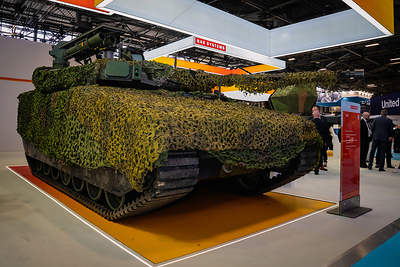
The CV90 MkIV is the latest generation of BAE Systems Hägglunds’ infantry fighting vehicle family, already used across multiple European fleets. As demand for tracked armour rises, the health of sub-tier supply chains becomes increasingly important. Vehicle orders may be placed by governments and assembled by primes, but engines, transmissions, armour, optics, turrets, radios, electronic components, and skilled labour determine how quickly platforms can actually be delivered.
Transmission supply is a core mobility issue. A tracked infantry fighting vehicle must climb, pivot, accelerate, brake, and manoeuvre under load while carrying troops, armour, weapons, ammunition, sensors, and mission systems. The drivetrain determines how effectively engine power becomes tactical mobility, particularly when vehicle weight rises through successive upgrades.
The 4040 MX is being integrated with the CV90 MkIV’s powerpack and electronic architecture, including work with the Scania engine. That integration reflects the way modern transmissions have moved beyond purely mechanical assemblies. Electronic controls, diagnostic interfaces, software behaviour, and vehicle health monitoring now form part of the production and sustainment package.
Europe’s armoured-vehicle build-up is vulnerable to bottlenecks in exactly these areas. Political decisions can move quickly, while industrial systems take longer to respond. Gearboxes, powerpacks, turret systems, armour materials, and specialist electronics all require production slots, testing, certification, and supplier coordination. A delay in one subsystem can disrupt final assembly even when demand and funding are clear.
Component-level capacity is becoming increasingly relevant across land systems. As militaries modernise heavier ground fleets, production depends on suppliers that rarely receive the same visibility as prime contractors. Transmissions, engines, suspension systems, fire-control electronics, and cooling systems are not peripheral; they determine whether a vehicle can absorb new capability without sacrificing reliability.
Sustainment adds another layer. The CV90 family has a large installed base, and new MkIV production will sit alongside upgrade, repair, and spares demand for existing fleets. A transmission family with continuity from earlier systems can simplify elements of training and maintenance, although higher power and updated controls still require careful support planning.
The order also points to a wider shift in the tracked-vehicle market after years of uneven demand. Europe’s security environment has restored attention to mobility, protection, and firepower at scale. Infantry fighting vehicles must now carry heavier electronic architectures, more protection, and increasingly complex mission systems while retaining tactical mobility across difficult terrain.
Allison gains a stronger position in tracked combat vehicles through the 4040 MX award, while BAE Systems Hägglunds secures a key element of CV90 MkIV production. For European customers, the deal shows what armoured-vehicle expansion requires beneath the visible platform level: investment in drivetrain capacity, controls integration, test regimes, spares, and long-term support.
The CV90 may be the headline vehicle, but the production story runs through transmissions, engines, electronic controls, and integration testing. Europe’s tracked-vehicle ambitions will advance only as quickly as those supply chains can move.