IN Brief:
- New Zealand has joined the US-led Project Arcadia command-and-control initiative.
- The work supports shared AI-enabled battlefield data and allied decision-support systems.
- The production challenge sits in secure software, data governance, and interoperability at scale.
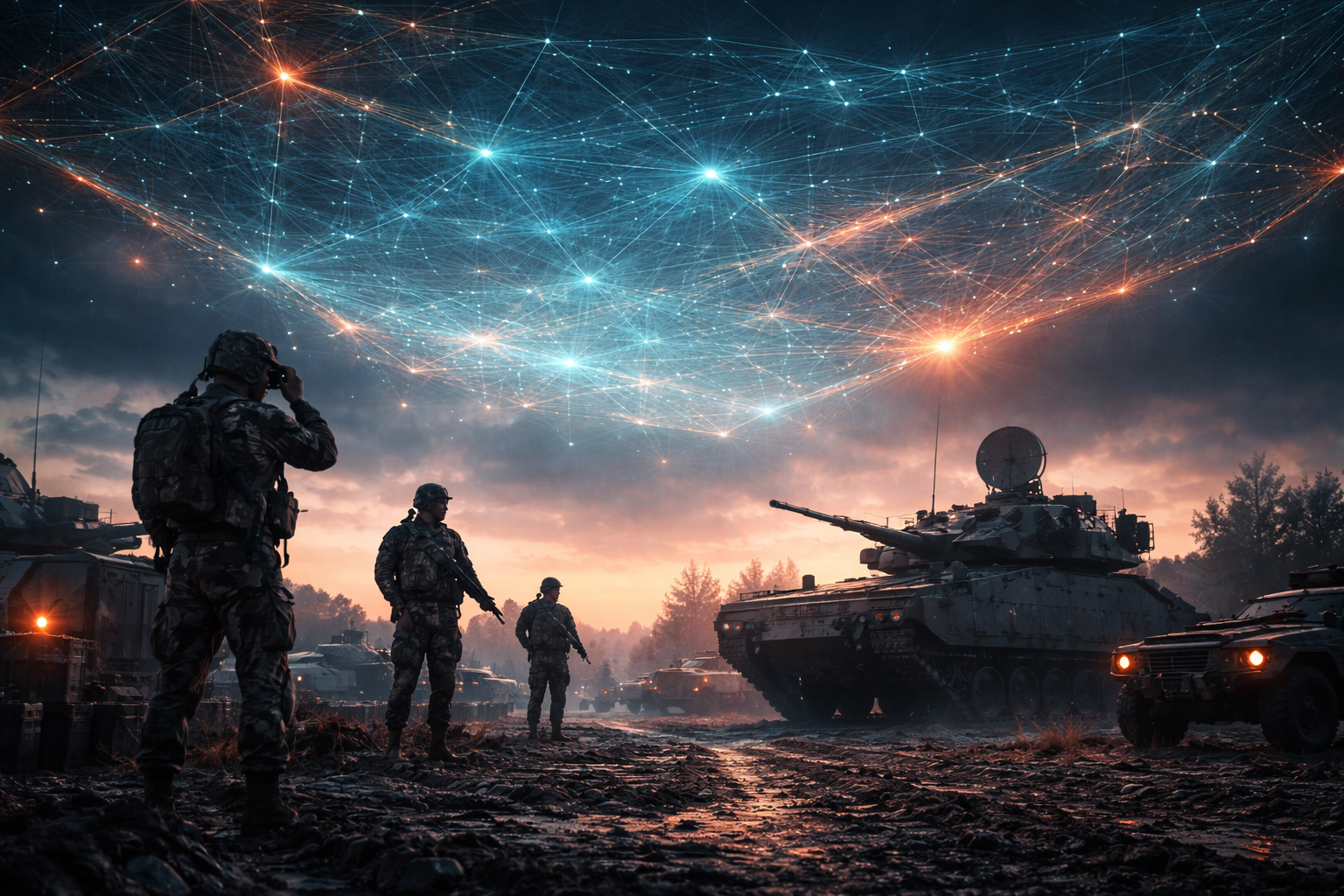
New Zealand has joined the US-led Project Arcadia initiative, adding another Five Eyes participant to an allied command-and-control effort built around shared battlefield data, AI-enabled decision support, and secure multinational software architecture.
The programme reflects a shift in how defence capability is being produced. Instead of centring only on aircraft, ships, vehicles, or weapons, allied forces are trying to build the digital layer that allows those assets to share data, coordinate effects, and shorten decision cycles. For New Zealand, participation creates a route into a wider command ecosystem while placing fresh demands on its own cyber, software, data, and procurement capacity.
Project Arcadia has no single production line, but it still has an industrial base. The work stretches across secure cloud infrastructure, software development, data engineering, cyber assurance, modelling, interface control, training, and classified network integration. Capability has to be built repeatedly, tested against operational scenarios, updated safely, and supported through changing security requirements.
The Five Eyes structure adds weight to the effort because the United States, United Kingdom, Australia, Canada, and New Zealand already operate through close intelligence and military relationships. Shared command software could improve coalition planning and operational tempo, yet it also raises difficult questions about data ownership, classification, sovereignty, and auditability. Allied integration cannot simply mean unrestricted access to every national dataset.
For New Zealand, those questions are particularly sharp. Smaller defence forces can gain disproportionate value from access to shared architectures, but they also have fewer people and less industrial depth to support specialised sovereign systems. Participation in Arcadia may reduce duplication, while still requiring Wellington to define which data it contributes, which services it consumes, and how national control is maintained when coalition systems operate at speed.
The country’s broader defence acquisition debate already spans more traditional capability areas, including maritime aviation and anti-submarine warfare. Digital command architecture sits alongside those procurement choices rather than apart from them. Future aircraft, ships, sensors, and headquarters will be judged partly by how well they can exchange data through allied networks.
AI-enabled C2 depends first on the quality of the underlying information. Models require clean, trusted, well-labelled data, and commanders need confidence that outputs are explainable, auditable, and protected from manipulation. In a defence environment, corrupted data can be as dangerous as no data at all. The industrial task therefore includes data governance, security engineering, and continuous testing, not just application development.
Cyber resilience is equally central. A command system that connects allied users across multiple domains becomes an attractive target. Suppliers must build software that can survive intrusion attempts, degraded communications, contested electromagnetic conditions, and classification boundaries. Accreditation processes must move fast enough to support iterative delivery without lowering security standards.
For industry, the market created by Arcadia is less about selling a finished application than sustaining an evolving software architecture. Defence software needs cleared developers, secure DevSecOps pipelines, test environments, operational feedback loops, and integration personnel who understand both military workflows and modern software production. Procurement rules built around long, fixed requirements can struggle in that environment.
The production pressures are different from those in aircraft or missiles, but they are still production pressures. A software factory has to deliver usable increments, manage configuration, patch vulnerabilities, maintain documentation, support users, and preserve interoperability across national systems. Open architectures and common standards can help, but they do not remove the need for disciplined engineering.
New Zealand’s participation also points to the future value of platform data. A sensor, ship, aircraft, missile battery, or land vehicle will lose relevance if it cannot feed secure, machine-readable data into a wider command system. Hardware suppliers that treat connectivity as an afterthought will find their equipment harder to integrate into coalition operations.
The talent base may be the limiting factor. Cyber specialists, AI engineers, data scientists, and secure software developers are in demand across the civil economy as well as defence. Smaller nations must either build enough domestic expertise to remain intelligent customers or risk becoming dependent on larger allies and prime contractors for the core logic of command.
Arcadia’s next phase will be judged by delivery discipline. Participation announcements are simple; turning shared concepts into accredited, interoperable, and resilient software is harder. New Zealand’s entry shows that even smaller defence forces are being drawn into the industrialisation of AI-enabled command, where the most important production output is not a vehicle or weapon, but trusted operational decision infrastructure.