IN Brief:
- Anduril and PGZ plan to produce Barracuda-500M cruise missiles in Poland.
- WZL-2 in Bydgoszcz is expected to host assembly and production activity.
- The project supports Poland’s push for local long-range fires manufacturing capacity.
Anduril Industries and Polska Grupa Zbrojeniowa plan to establish Polish production of Barracuda-500M cruise missiles, giving Warsaw a new industrial route into long-range precision strike as European governments continue to rebuild munitions capacity.
The plan is expected to centre on Wojskowe Zakłady Lotnicze No. 2 in Bydgoszcz, where assembly and production activity for the surface-launched Barracuda variant would be located. The missile is being promoted as a lower-cost, scalable long-range weapon, with a range of more than 500 nautical miles and a 100lb-class warhead. A Polish production model drawing heavily on European components would also fit the funding and sovereignty pressures now shaping EU defence procurement.
Poland’s interest is easy to understand. Warsaw has become one of Europe’s most active defence buyers, but procurement volume alone does not create sovereign military-industrial resilience. Local missile production brings a different kind of value, including assembly skills, supplier development, test capacity, maintenance knowledge, and greater control over availability during a crisis.
The war in Ukraine has exposed the weakness of stockpiles built around small numbers of expensive precision weapons and limited production surge capacity. European militaries now want range and accuracy, but also inventory depth. That combination pushes industry toward designs that can be built faster, with fewer bottleneck components, and with enough modularity to support future variants.
Barracuda’s appeal rests on producibility. Cruise missiles have traditionally depended on specialised suppliers for engines, guidance systems, actuators, airframes, batteries, seekers, warheads, datalinks, and control surfaces. A lower-cost design still has to meet military reliability standards, but it aims to reduce the cost and complexity that have limited inventory growth across many NATO arsenals.
PGZ’s role gives the project a wider Polish industrial purpose. The group sits at the centre of national defence production, and its involvement could help move Poland from user to producer in a missile category that is likely to remain in high demand. For WZL-2, which already sits inside Poland’s military aerospace ecosystem, the programme could bring together airframe work, electronics integration, quality assurance, and secure production methods.
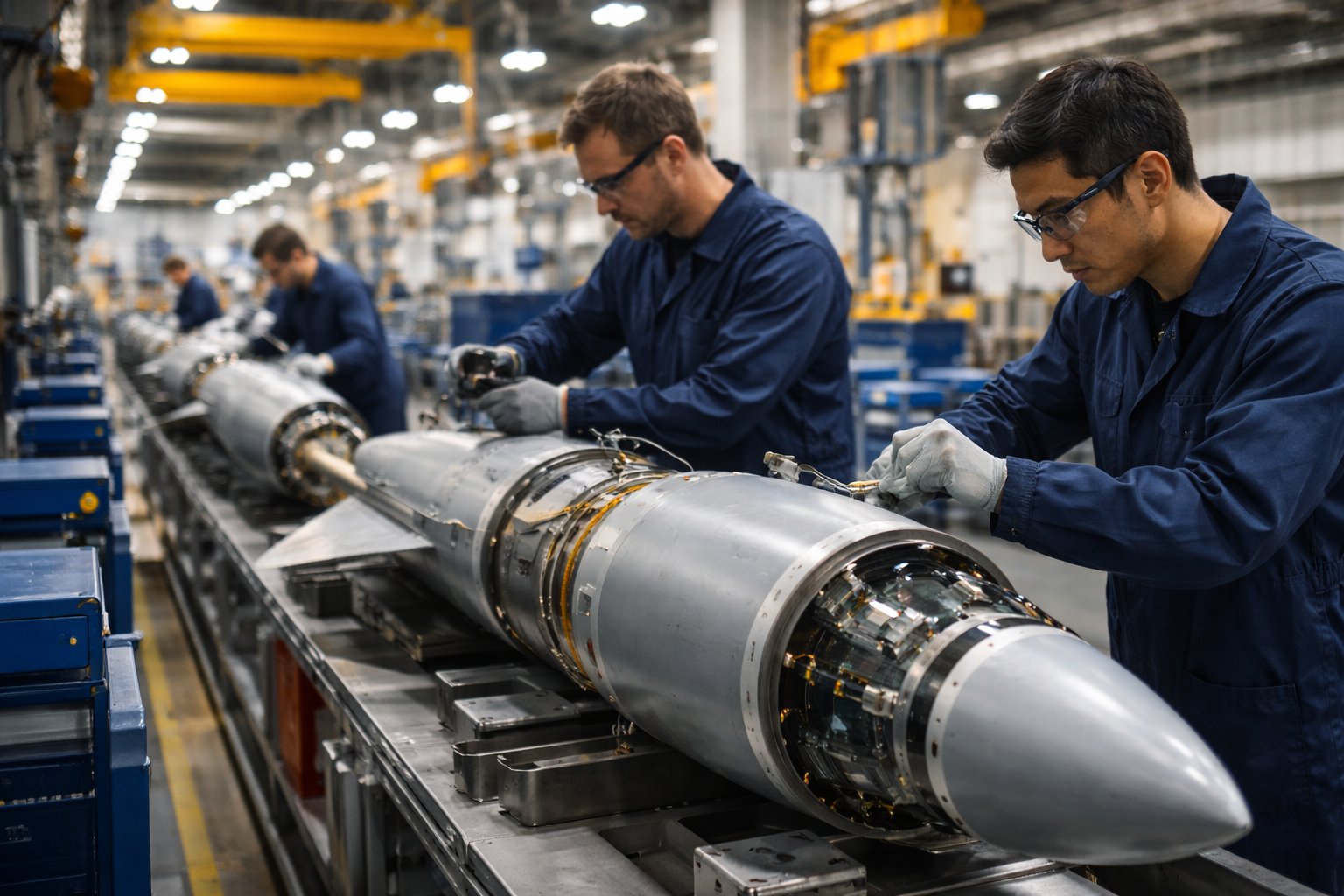
Missile manufacturing is unforgiving. Energetic materials, warhead safety, engine handling, guidance calibration, environmental testing, storage containers, and transport procedures all require tight process control. A plant may be able to assemble airframes relatively quickly, but rate production depends on a supplier network able to deliver critical components at repeatable quality. Those suppliers are often the real limiting factor.
Poland’s deep-fires activity also sits within a broader NATO effort to expand launcher options, missile families, and cross-border industrial capacity. European armies are increasingly asking whether one launcher architecture can support multiple effectors, whether domestic industry can participate in replenishment, and whether stocks can be expanded without relying entirely on US production slots. Interest in launcher concepts that can accommodate different munitions, including Korean-origin systems adapted for NATO users, reflects a search for depth as much as range.
Anduril’s presence adds a further layer to the project. The company has built its reputation around faster development cycles, autonomy, software-heavy systems, and production models that challenge traditional prime-contractor pacing. Establishing cruise missile output through a state-owned Polish industrial partner will test whether that approach can work inside European certification, funding, export-control, and procurement frameworks.
For Poland, the strategic logic is direct. Long-range strike strengthens deterrence, but imported weapons can be limited by foreign production schedules, export approvals, and competing allied demand. Domestic production does not eliminate those dependencies, especially where key components remain foreign, but it can improve leverage and shorten parts of the replenishment chain.
The European component content will be closely watched. If the programme can draw on local or regional suppliers for structures, electronics, warheads, propulsion elements, containers, or support equipment, it may qualify more easily for European industrial support. If it remains dependent on non-European bottlenecks, the sovereignty argument will weaken.
Qualification will be the decisive phase. A missile factory cannot be judged by the signing of a production agreement; it must prove repeatable assembly, safe handling, environmental performance, flight reliability, and configuration control. Test firings, supplier audits, and rate-production planning will determine whether the Polish Barracuda plan becomes a genuine industrial capability.
Warsaw has the demand signal, the strategic pressure, and the defence spending profile to support such a project. The hard work now lies in converting that demand into a missile line that can produce at useful scale, with enough local content to make the industrial promise more than final assembly.