IN Brief:
- NNSA has completed certification of planned B61-13 canned subassemblies three months ahead of schedule.
- The work took place at the Y-12 National Security Complex and supports the B61-13 nuclear gravity bomb programme.
- The milestone highlights production tempo, certification capacity, and quality assurance inside the US nuclear weapons enterprise.
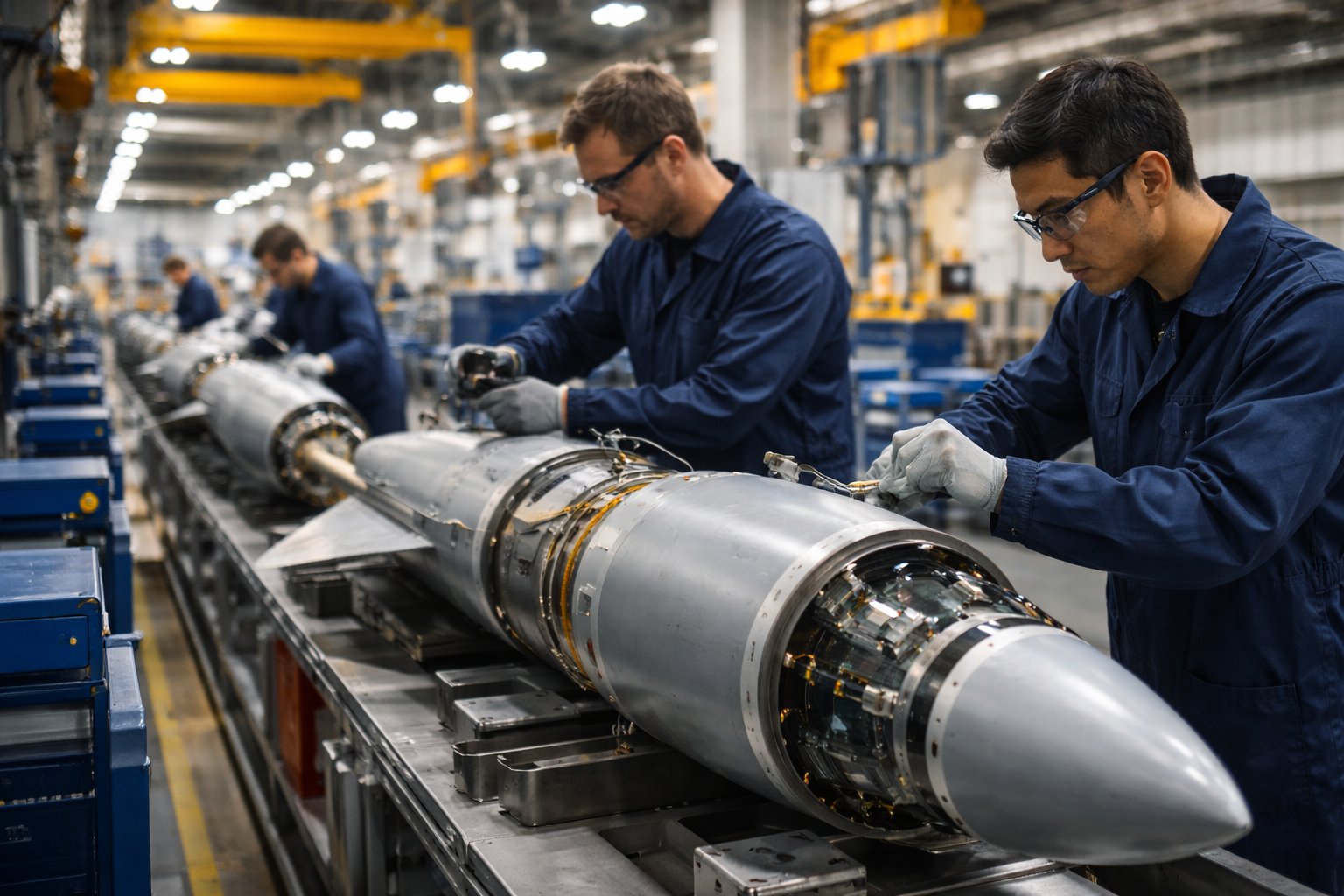
The US National Nuclear Security Administration has completed diamond stamping of all canned subassemblies planned for the B61-13 nuclear gravity bomb in the current fiscal year, finishing the work three months ahead of schedule at the Y-12 National Security Complex.
The milestone is a production and certification marker rather than a final weapon delivery announcement. In a modern two-stage thermonuclear weapon, the canned subassembly contains the secondary-stage capsule and other parts sealed inside a thin metal container. Diamond stamping confirms that the component has met the required certification process and is approved as war reserve quality.
The B61-13 is intended for delivery by US strategic bomber aircraft and forms part of a wider modernisation effort aimed at hard and deeply buried targets. NNSA completed the first B61-13 unit in May 2025, almost a year ahead of the original target and less than two years after the programme was announced. The newer variant incorporates safety, security, and accuracy features from the B61-12 while adding a higher-yield option.
The industrial issue sits in timing and certification. Nuclear weapons production is not comparable with conventional munitions manufacture. Each component moves through demanding material controls, quality assurance, security, documentation, and certification processes. Completing planned canned subassemblies ahead of schedule points to a production enterprise being asked to move faster while maintaining tightly controlled standards.
That balance is difficult. Nuclear modernisation programmes depend on specialised facilities, restricted materials, cleared workforces, ageing infrastructure, high-reliability inspection, and a limited supplier ecosystem. The production system cannot simply surge in the way a conventional ammunition line might. Capacity is shaped by unique processes and by the need to preserve certification confidence.
The B61-13 also sits within a broader US nuclear weapons modernisation portfolio. NNSA is executing six ongoing warhead modernisation programmes, all reported to be on or ahead of schedule. That portfolio places heavy pressure on sites such as Y-12 and Pantex, as well as on laboratories, component suppliers, transport, and qualification infrastructure.
Strategic deterrence has a manufacturing base. Public discussion often focuses on aircraft, submarines, missiles, and policy, but the industrial reality includes precision components, metallurgy, containment structures, non-nuclear parts, electronics, certification procedures, and secure facilities that must perform to extremely narrow tolerances.
The B61-13’s rapid schedule highlights the tension between strategic urgency and industrial conservatism. Nuclear weapons programmes must move slowly enough to protect safety and reliability, but fast enough to meet changing deterrence requirements. Compressing those timelines places pressure on every step of the enterprise, from component production and inspection to final assembly and stockpile certification.
There are parallels with other high-end defence production problems, even if the nuclear domain is unique. Modern missiles, advanced air-defence interceptors, submarines, and hypersonic systems all depend on specialised bottlenecks that cannot be expanded instantly. Nuclear weapons add additional layers of security, certification, and national command sensitivity.
The B61-13 programme also shows how modernisation can reuse previous design and production work. Shared safety, security, and accuracy features with the B61-12 reduce some development risk and allow the newer variant to draw on existing modernisation pathways. That kind of reuse is central to any accelerated programme where certification burden is high.
The manufacturing burden still remains. Every variant requires its own configuration control, component quality checks, documentation, and certification evidence. War reserve quality is a production status, not a policy phrase, and reaching it depends on a disciplined chain of material handling, assembly, inspection, and approval.
The same capacity question runs across the wider defence industrial base. Whether the product is a canned subassembly, an interceptor missile, a frigate gearbox, or a counter-drone effector, governments are increasingly judging industrial performance by speed, resilience, and confidence in delivery. Strategic programmes expose that judgement most sharply because tolerances are lower and consequences are higher.
The B61-13 milestone will remain politically sensitive because of the weapon involved. Industrially, it shows a defence production system being pushed to reduce timelines inside one of the most controlled manufacturing environments in the world.
Nuclear deterrence may be measured in doctrine and delivery systems, but it still depends on certified components leaving secure production processes on time.