IN Brief:
- Honeywell Aerospace is expanding ITAR-free defence product development for European and APAC markets.
- Around 1,000 engineers in Poland and the Czech Republic are working on non-ITAR technologies.
- The move reflects growing demand for components that avoid re-export restrictions on US-controlled technology.
Honeywell Aerospace is expanding development of defence products designed outside US International Traffic in Arms Regulations, as European defence programmes place greater value on export-control freedom alongside technical performance.
The company is using engineering capacity in Poland and the Czech Republic to develop non-ITAR technologies for European and Asia-Pacific customers. Around 1,000 engineers across those two countries are being tasked with work that supports local defence strategies and reduces reliance on restricted US-origin technology. A new ITAR-free product for the international defence sector is expected to be revealed at Farnborough.
European customers have a direct reason to care. Defence systems containing sensitive US components can carry re-export restrictions, creating political and operational constraints when countries want to sell, transfer, upgrade, or support equipment through third-party programmes. As European defence spending rises, those restrictions are becoming more visible inside procurement decisions.
Designing ITAR-free does not mean replacing one component at the end of production. It often means redesigning around alternative suppliers, different qualification routes, new documentation, altered software controls, and a separate compliance architecture. Export-control status becomes a design constraint from the earliest stage of engineering rather than a legal check added after the platform has been built.
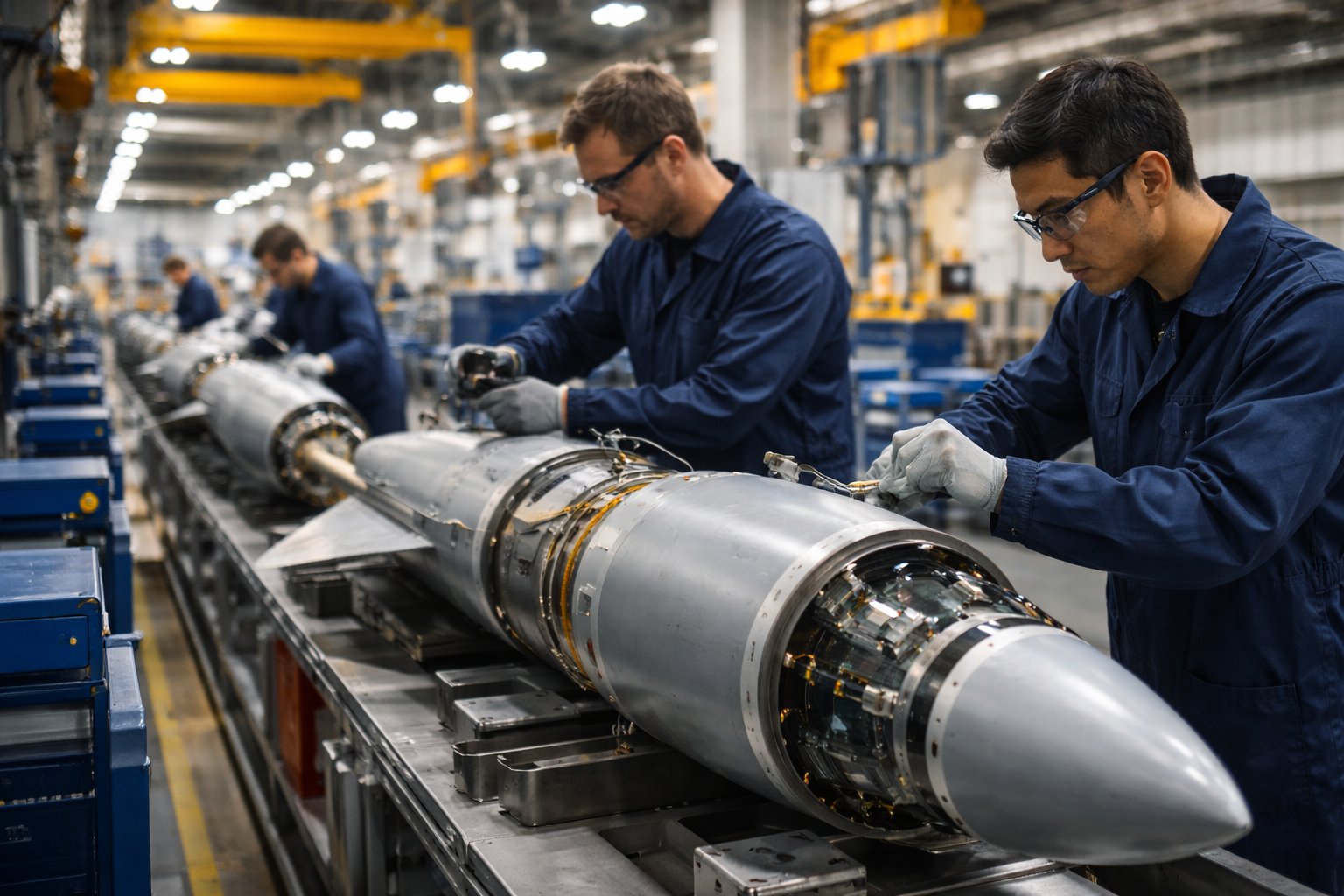
Honeywell’s defence portfolio includes navigation systems and actuators for missiles, among other aerospace and defence subsystems. These are exactly the kinds of components that sit deep inside larger platforms, making export-control exposure difficult to remove once a system architecture is fixed. If a missile, aircraft subsystem, or naval weapon component is built around restricted technology, later substitution can become expensive, slow, and technically risky.
European prime contractors and defence ministries are therefore pushing export-control questions upstream. They want suppliers that can offer capability without creating downstream sovereignty problems. This is not only about US-European politics; it is about production resilience, support flexibility, and the ability to move equipment between allied users without avoidable licensing delay.
The same logic sits behind Germany’s effort to secure more national control around Tomahawk cruise missiles. Long-range strike capability becomes far more attractive when production, maintenance, and integration can be brought closer to the customer’s own industrial and political framework. Honeywell’s work takes that question down to subsystem level, where the export status of components can determine the freedom of the entire platform.
Subsystem sovereignty is less visible than final assembly, but often more decisive. Navigation units, actuation systems, inertial sensors, processors, power electronics, and software modules can determine whether a platform can be exported, upgraded, supported, or modified without external permission. European industrial strategy has spent years discussing autonomy at platform level; the harder work sits inside the bill of materials.
Honeywell’s acquisition of Civitanavi strengthens that direction by giving the company a route into non-ITAR navigation technology. Inertial navigation, resilient positioning, and guidance-adjacent systems are now central to missiles, uncrewed platforms, electronic warfare environments, and GPS-denied operations. If those technologies can be designed and scaled outside ITAR restrictions, they become more attractive to customers building sovereign or exportable platforms.
The market pressure is likely to grow. European rearmament is increasing demand for air defence, long-range fires, precision munitions, airborne sensors, and platform upgrades. Each category requires high-reliability components with long support lives. Suppliers able to offer qualified, export-flexible subsystems can move earlier into programmes, particularly where governments are trying to avoid dependence on a single national approval chain.
Honeywell will still need to prove that ITAR-free products carry the same technical credibility as restricted alternatives. Customers will expect performance, compliance clarity, secure supply, documentation, and through-life support. Establishing that credibility takes engineering discipline and a supplier base that can withstand scrutiny.
For Europe, the development points to a sharper definition of sovereignty. It is no longer enough to assemble a system in-country if key components remain controlled elsewhere. The next phase of defence industrial policy will reach further down the supply chain, into inertial sensors, actuators, control systems, electronics, and software-defined functions.
Honeywell’s European engineering push gives that shift a practical form. Rearmament is not only measured in factories, shipyards, and missile orders. It is also measured in the export status of small components buried deep inside the systems those factories are trying to build.