IN Brief:
- EOS has received a $5.7 million Mission Syracuse contract to develop the R400 SLINGER counter-UAS capability.
- The system combines a remote weapon station, machine gun, and laser-guided rocket for kinetic drone defeat.
- Manufacturing and sustainment will remain in Australia, strengthening sovereign counter-drone capacity.
Electro Optic Systems has been selected under Australia’s Mission Syracuse to develop the R400 SLINGER counter-uncrewed aerial systems capability, giving the Australian Defence Force a domestic route into kinetic drone defence.
The $5.7 million contract sits inside the Advanced Strategic Capabilities Accelerator’s Mission Syracuse programme, which is accelerating counter-drone technologies for Australian service use. The award brings total investment under Mission Syracuse to $37.4 million and follows earlier work with AIM Defence and SYPAQ Systems on directed-energy and interceptor-drone technologies.
Built around EOS’s remote weapon station architecture, R400 SLINGER is designed to defeat small and medium drones using a machine gun and an advanced laser-guided rocket. Its value sits in the attempt to industrialise a complete response layer that can detect, track, engage, and then be supported through an Australian supply chain rather than treated as another imported defensive add-on.
Australia has allocated up to $22 billion over the decade for drone, counter-drone, and autonomous systems technologies through its 2026 Integrated Investment Program. That long-range budget line gives Mission Syracuse more weight than the initial contract value suggests, because the programme sits inside a broader shift from buying isolated counter-drone systems toward building a national base able to refresh sensors, effectors, software, and platform interfaces as threats change.
EOS already gives the programme an Australian manufacturing foundation. The company designs, engineers, and manufactures much of its remote weapon systems portfolio domestically, which gives R400 SLINGER a stronger sovereign production case than imported C-UAS systems assembled around foreign-controlled components. For Australia, that supply-chain control is becoming central as drone threats develop faster than conventional procurement cycles can comfortably absorb.
The production burden will sit in repeatability as much as performance. Remote weapon stations require precision mechanical structures, stabilisation, sighting systems, power management, software control, ammunition handling, environmental hardening, and verification against moving aerial targets. Adding a laser-guided rocket shifts the engineering load again, requiring safe integration of guidance, launch, fire-control logic, and storage procedures into a system originally associated with mounted direct fire.
R400 SLINGER also reflects the wider counter-drone market’s movement away from single-solution thinking. Electronic attack, jamming, and high-end air-defence interceptors each have roles, but none provides a complete answer to the spread of small, cheap, and adaptable drones. Kinetic systems with a lower cost per engagement, sufficient accuracy, and the ability to sit on mobile or fixed platforms are now drawing serious procurement attention.
The same production race is visible in the growing demand for turreted counter-drone weapons, where EOS orders have already pointed to pressure across sensors, weapon stations, control electronics, and effectors. Australia’s Mission Syracuse contract follows that pattern, but with a clear sovereign layer attached.
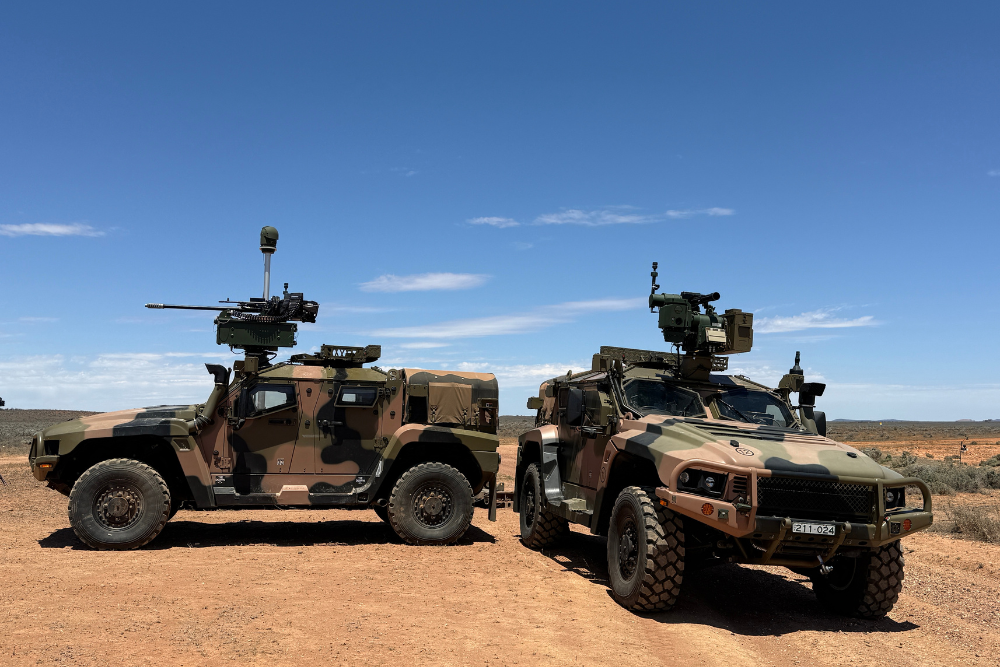
Platform integration will also shape the programme. EOS has shown Slinger mounted on Hawkei protected mobility vehicles, reflecting the way counter-drone systems are moving onto tactical vehicles rather than remaining static base-protection assets. Australia’s work around Bushmaster Mulga has already shown how protected mobility is being reframed as a mission-systems base, with armoured vehicles valued as carriers for sensors, communications, autonomy, and effectors, not only as protected transport.
Mission Syracuse therefore becomes a practical test of Australia’s ability to compress development, integration, manufacture, and support into a faster industrial loop. Counter-drone technology cannot be treated as a one-time purchase. Drone airframes, datalinks, autonomy, swarm behaviours, and attack profiles will continue to change, and the countermeasure stack needs enough local engineering control to change with them.
For EOS, the award opens a route from established remote weapon station production into a more specialised counter-UAS role. For Australia’s defence industrial base, it sharpens the question of whether domestic companies can turn prototype agility into sustained production capacity before drone threats move again.