IN Brief:
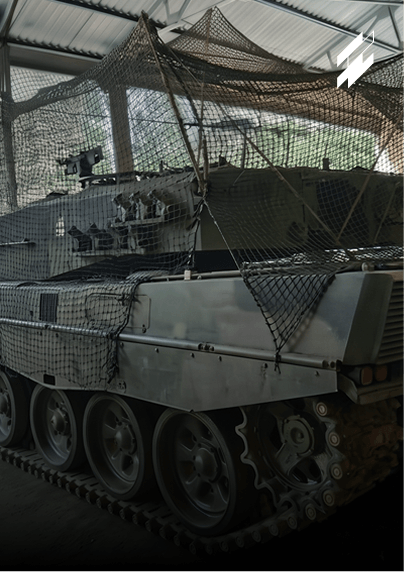
- MKU’s Anti Drone Net System uses lightweight netting to disrupt small drones before they reach a protected vehicle or position.
- Materials, stand-off geometry, attachment design, and environmental testing will govern its effectiveness.
- Modular panels could provide a comparatively inexpensive and readily replaceable final layer within wider counter-UAS architectures.
MKU has introduced a passive anti-drone net system intended to shield armoured vehicles, equipment, and fixed positions from small uncrewed aircraft without drawing on missiles, ammunition, or electronic-warfare capacity.
Developed within the company’s Kavro survivability portfolio, the system suspends a lightweight barrier above and around the protected asset so that an approaching drone is caught, deflected, or destabilised before it reaches the underlying structure. The concept adds a final physical layer beneath radar, radio-frequency detection, jamming, guns, and guided interceptors rather than attempting to replace them.
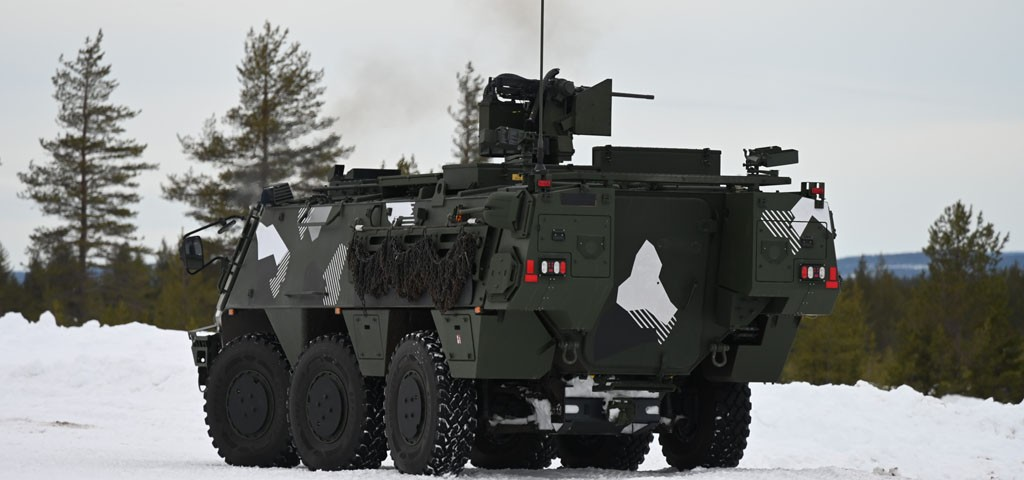
Installed over a vehicle, the net has to preserve enough stand-off distance to prevent a trapped aircraft, battery, or explosive payload from contacting the hull. It must also leave hatches, optics, antennas, remote weapon stations, and maintenance points usable, since a protection system that obstructs normal operation can quickly become a liability.
Although the principle is simple, repeatable military production is not. Net material needs controlled tensile strength, consistent aperture dimensions, resistance to tearing, and enough elasticity to absorb an impact without collapsing onto the platform below. Those properties must remain stable after prolonged exposure to ultraviolet light, heat, cold, rain, dust, fuels, lubricants, and rough handling.
Mounting hardware carries an equally important burden. Supports must keep the barrier clear of the vehicle while tolerating vibration, acceleration, braking, cross-country movement, and repeated installation. They must also avoid creating dangerous snag points, excessive aerodynamic drag, or loads that damage attachment points already supporting armour and mission equipment.
Different drone designs will complicate qualification. A lightweight quadcopter with exposed rotors may be relatively easy to entangle, while a heavier aircraft with reinforced propellers, greater momentum, or a nose-mounted charge could behave very differently. Steep diving attacks, low horizontal approaches, and attempts to enter through gaps around the vehicle will all require separate test conditions.
A credible validation programme will therefore need more than a staged interception. Trials should vary aircraft mass, speed, rotor arrangement, attack angle, payload type, stand-off distance, and environmental exposure, while also examining what happens after the drone is caught. Burning batteries, damaged motors, and live energetic material create secondary hazards that the barrier and vehicle crew must be able to manage.
MKU brings an established production base to the problem, with more than 400,000 sq ft of manufacturing capacity across India, Germany, and the United Arab Emirates, supported by in-house ballistic and environmental testing. The anti-drone net consequently sits inside a mature armour and survivability business rather than an isolated counter-UAS venture.
That background should help with material control, documentation, and environmental qualification, although textile and structural production at useful scale will still require a disciplined supply chain. Fibre specification, coatings, connectors, poles, and fasteners all need to remain interchangeable if damaged sections are to be replaced quickly in the field.
Field repair may become the strongest argument for the system. A modular arrangement built from standard panels and supports could allow crews to remove a damaged section and install a replacement without returning the vehicle to a depot. In that model, replenishment depends on relatively conventional manufacturing capacity rather than the availability of seekers, rocket motors, or complex guidance electronics.
Britain’s own work on Skyhammer, DragonFire, and layered air-defence production illustrates how counter-UAS architectures are spreading across several price and performance bands. Passive barriers occupy the least technologically elaborate end of that spectrum, but their economics become attractive when active systems are scarce, saturated, unsuitable for use nearby, or reserved for more demanding targets.
The concept also reflects a broader change in land-platform design. Vehicles are being fitted with electronic detectors, jammers, remote weapon stations, active protection, camouflage, overhead armour, and physical screens that were never part of their original weight, power, or space assumptions. Every addition competes for structural capacity and complicates maintenance.
Manufacturers will therefore need to treat passive anti-drone equipment as an integrated survivability package rather than an improvised accessory. Attachment loads, weapons arcs, sight lines, crew escape, transport clearances, and recovery procedures should be resolved during design and qualification, not left to field units.
The net will remain an imperfect defence. Determined attackers can alter approach profiles, increase aircraft mass, or seek gaps around the protected area, while any overhead structure can restrict visibility and movement. Yet the spread of improvised cages and screens has already established operational demand for engineered alternatives with known material properties and repeatable installation methods.
MKU’s system gives that demand a formal product route. Its commercial prospects will depend on whether the company can manufacture it cheaply, prove it across representative threats, and supply replacement sections faster than the drones it is intended to stop.