IN Brief:
- Frankenburg has selected BAE Systems’ BlackThorn warhead for its Mark I interceptor.
- A five-year Roxel agreement covers rocket-motor design, development, integration, and supply.
- The partnerships add demanding energetic-material, safety, qualification, traceability, and production-capacity requirements.
Frankenburg Technologies has selected BAE Systems and Roxel UK as key subsystem partners for the Mark I, bringing British warhead and propulsion capability into the Estonian company’s compact air-defence missile.
BAE Systems’ BlackThorn warhead will provide the interceptor’s terminal effect, while a five-year agreement with Roxel covers motor design, development, integration, and supply. Two of the missile’s most safety-critical and tightly regulated elements will consequently sit within established UK industrial organisations.
Mark I is designed principally to defeat Class I to Class III uncrewed aircraft. The missile is approximately 0.65 metres long and weighs less than 2kg, allowing it to operate from relatively compact land, maritime, and potentially airborne launch installations.
Its dimensions support a low-cost and high-volume proposition, although they leave little space for inefficient packaging. The motor, warhead, guidance equipment, control system, power source, structure, and fuze must fit inside a small body while preserving range, manoeuvrability, safety, and lethality.
Frankenburg is participating in the UK’s Low-Cost Air Defence Effectors activity and plans to establish further British work through its FieldFoundry model during 2027. The BAE and Roxel agreements give that plan a more defined production base.
Low cost meets energetic-material discipline
Missiles are difficult to industrialise cheaply because many of their most expensive processes are determined by safety rather than component value. Rocket propellant must be mixed, cast or formed, cured, inspected, stored, transported, and integrated under controlled conditions. Motor cases, nozzles, initiators, and insulation need full traceability and repeatable performance.
Roxel’s responsibility extends well beyond supplying a cylinder that produces thrust. Motor pressure, ignition behaviour, temperature range, vibration response, and burn characteristics must match the missile’s mass, aerodynamics, control authority, and engagement envelope. Design changes elsewhere can require renewed propulsion testing even when the motor itself remains largely unchanged.
Warhead integration creates similar interdependence. BAE’s BlackThorn has been developed around a common and scalable warhead architecture, but Mark I still requires specific mechanical, electrical, and safety interfaces. Its fuze must initiate at the correct point in an engagement, while the warhead must generate an effective fragment pattern against small, fast, and sometimes lightly constructed targets.
The UK low-cost interceptor competition is already broadening as armed forces seek weapons able to defeat drones without consuming missiles designed and priced for aircraft or cruise-missile targets. Frankenburg’s partnerships place Mark I within that industrial race, although cost will be judged across the whole system.
Launchers, radar or other sensors, command software, power, communications, reload handling, training rounds, and maintenance all contribute to the defended-site cost. A cheap interceptor paired with complex infrastructure or highly specialised crews may offer less economic advantage than its unit price suggests.
Volume production will test Britain’s energetic-materials supply chain. Roxel supports several missile programmes while European customers are demanding higher output. Compact motors use less material than larger weapons, but high annual quantities can still consume substantial capacity across chemical ingredients, cases, nozzles, insulation, curing, and inspection.
BlackThorn production will draw upon similar constrained resources across explosives processing, metalwork, fuzing, and final assembly. Common components could improve purchasing and throughput when configurations remain controlled, but divergent customer requirements would weaken those gains.
Frankenburg will also need to resist uncontrolled specification growth. Additional range, larger warheads, new seekers, or platform-specific interfaces can increase cost quickly and delay qualification. Successful low-cost weapons generally rely on clear performance boundaries and a stable production baseline.
Quality assurance cannot be reduced in proportion to price because each missile contains a motor and warhead that may remain stored for years before use. Lot acceptance, environmental testing, shelf-life surveillance, software control, and serial traceability remain necessary even for comparatively inexpensive rounds.
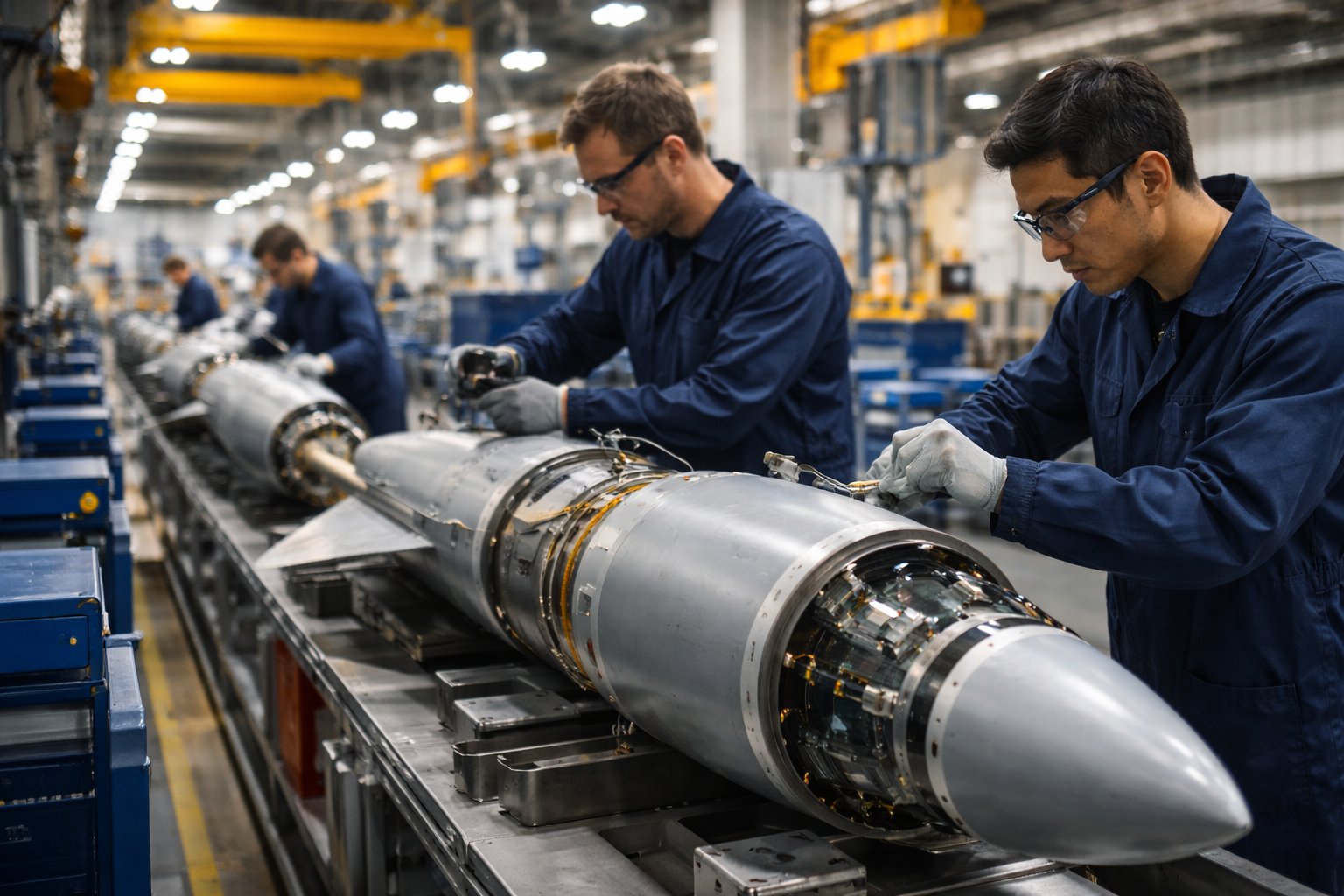
Factory output will depend upon the rhythm between subsystem suppliers and final assembly. Warheads and motors arriving in uneven batches can create inventory queues or leave integration teams idle, while late engineering changes may strand already completed components.
The partnerships give Mark I access to mature UK capability and place BAE Systems and Roxel within a rapidly expanding counter-drone market. They also provide a practical test of whether established missile-industry controls can be adapted to lower-cost, higher-volume output.
Counter-drone development is no longer short of designs. The industrial requirement is a line capable of delivering motors, warheads, electronics, launchers, and complete rounds at a rate that reflects the number of targets. Mark I now has important parts of that line identified; qualification and production engineering must preserve its economics.