IN Brief:
- The RAAF has funded an $11.4 million software correction package for aircraft already delivered.
- Six flight-control behaviours identified during testing are included in the development and verification scope.
- Completion is scheduled for February 2028, after Australia received its fourteenth P-8A in May 2026.
Boeing has received an $11.4 million contract to develop, test, and deliver enhanced digital flight-control software for Royal Australian Air Force P-8A Poseidon aircraft already in service. The work is intended to correct a defined group of autopilot deficiencies recorded during developmental and operational testing, rather than introduce a new mission capability or airframe modification.
The US Naval Air Systems Command order covers aircraft-loadable software described in the contract notice as a “black label” release. Work will be carried out in Tukwila, Washington, and is scheduled for completion in February 2028. Australian cooperative funds for the full contract value were obligated when the order was placed. The order was not competed.
The listed deficiencies span several flight-control behaviours. They include the way altitude-acquire mode captures a selected level, a placard-speed exceedance linked to delayed autothrottle retard, pitch oscillations during climb and descent, an unexpected change from altitude-acquire to vertical-speed mode after a speed-command adjustment, slow autothrottle response, and tuning of the available margin around selected bank limits. The notice does not describe any accident, fleet grounding, or immediate restriction arising from those findings.
Correcting the issues is nevertheless a substantial engineering task. Flight-control changes on a military derivative of a commercial airliner require tightly controlled software configuration, extensive simulation, regression testing, and confirmation that a correction in one mode does not produce an unintended effect elsewhere. The delivery package must also be compatible with aircraft already accepted by the RAAF, which makes fleet configuration and installation planning part of the practical challenge even when the physical hardware remains unchanged.
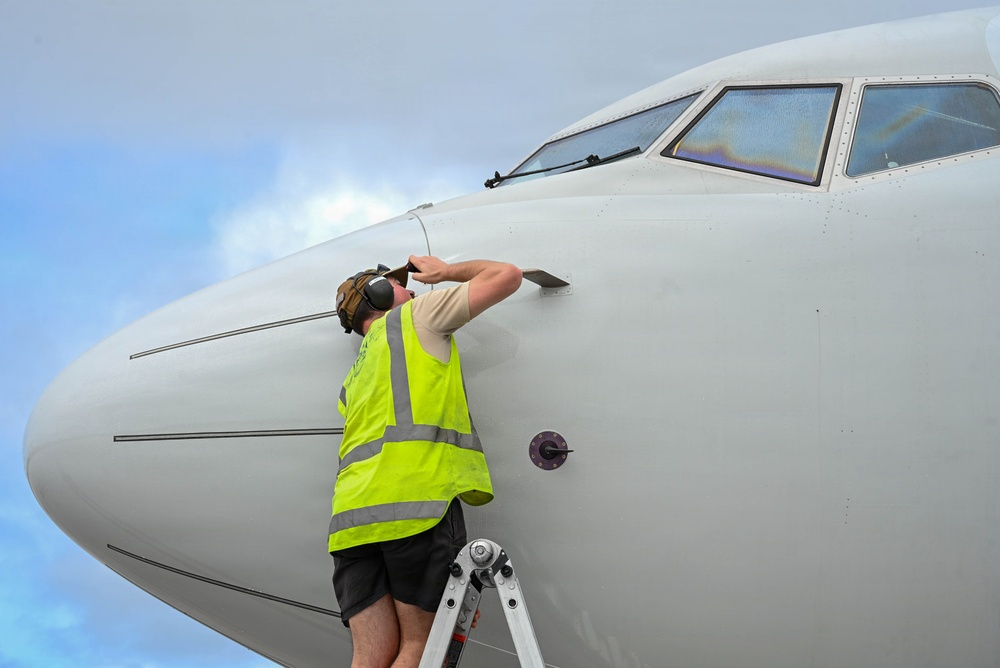
Australia completed the planned build-up of its 14-aircraft P-8A fleet when the final aircraft arrived in May 2026. The Poseidon combines a 737-based airframe with mission systems for anti-submarine warfare, maritime surveillance, intelligence collection, and long-range patrol. A software correction applied across a completed fleet therefore sits within the less glamorous but unavoidable phase of operating a mature capability: identified behaviours must be traced, corrected, verified, distributed, and sustained across aircraft that are already supporting training and operational commitments.
The contract also shows how software has become a continuing part of aircraft airworthiness and availability rather than a one-off element of initial development. Autopilot and autothrottle logic interacts with pilot inputs, sensor data, flight-envelope protections, and mode annunciation. Even where an issue appears narrow, the evidence required to clear a revised build can include laboratory work, engineering analysis, simulator activity, and flight testing under representative conditions.
Boeing remains responsible for the platform’s design baseline, linking the correction to the wider certification and support system around the P-8A. A revised flight-control build must be identified against each aircraft configuration, distributed through controlled maintenance channels, and retained in technical records. The $11.4 million order is narrow, but it forms part of the continuous engineering needed to keep a mature fleet within approved handling and performance limits.
The programme office has not disclosed the sequence in which individual aircraft will receive the software, the number of test flights required, or whether the release will be installed during planned maintenance periods. It has also not stated whether the same software behaviour affects P-8 aircraft operated by other customers. The funding and stated scope apply specifically to delivered Australian aircraft, so any wider fleet action would require separate confirmation.
The February 2028 completion date gives Boeing and the RAAF time to move from software design through verification and delivery. Flight-control assurance must balance the speed of correction against evidence that the revised build behaves predictably across the aircraft’s operating envelope. The programme must produce an approved, supportable software configuration for a fleet expected to remain in service for many years.
Australia’s completed fleet also makes configuration discipline more visible. Aircraft may enter maintenance with different mission-system loads, approved modifications, or software histories, and the flight-control release has to be introduced without losing traceability. Technical publications, installation instructions, test records, and aircrew information must move with the software. These products determine whether the correction is adopted consistently across the fleet or becomes another branch in the configuration baseline.
The six listed behaviours span altitude capture, autothrottle response, pitch stability, mode logic, and bank-limit tuning. Verification therefore has to cover each correction and the interaction between modes across changes in speed, altitude, and aircraft configuration. A fix that improves one behaviour but alters another transition would not close the requirement, so regression evidence must accompany the aircraft-loadable release.