IN Brief:
- Cambridge Aerospace has raised $300 million at a $3.4 billion valuation, taking total funding since 2024 above $630 million.
- Skyhammer production is targeted at 2,500 interceptors a month by the end of March 2027, while Starhammer is expected to reach the market next year.
- The company is also bringing more propulsion work in-house through its Nightstar solid rocket motors and a planned manufacturing site in Norfolk.
Cambridge Aerospace has raised $300 million as the British defence technology company prepares to increase interceptor production, expand its propulsion capability, and turn rapid weapon development into a higher-volume manufacturing operation.
The Series C round values the company at $3.4 billion and takes total capital raised since its formation in 2024 to more than $630 million. The new funding is being directed towards the Skyhammer and Starhammer interceptor families, along with a deeper in-house manufacturing base intended to reduce dependence on external missile supply chains.
Skyhammer provides the most immediate production test. Cambridge Aerospace is already manufacturing the interceptor and is targeting output of 2,500 units a month by the end of March 2027. The weapon is designed to counter drones and cruise-missile-class threats, giving the company a route into the increasingly important market for air-defence systems whose unit economics are better suited to repeated attacks by relatively inexpensive targets.
The UK Ministry of Defence announced its intention to buy Skyhammer missiles and launchers in April, describing the interceptor as having a range of 30km and a maximum speed of 700km/h. Deliveries were due to begin in May, with the procurement also covering integration, technical support, and training.
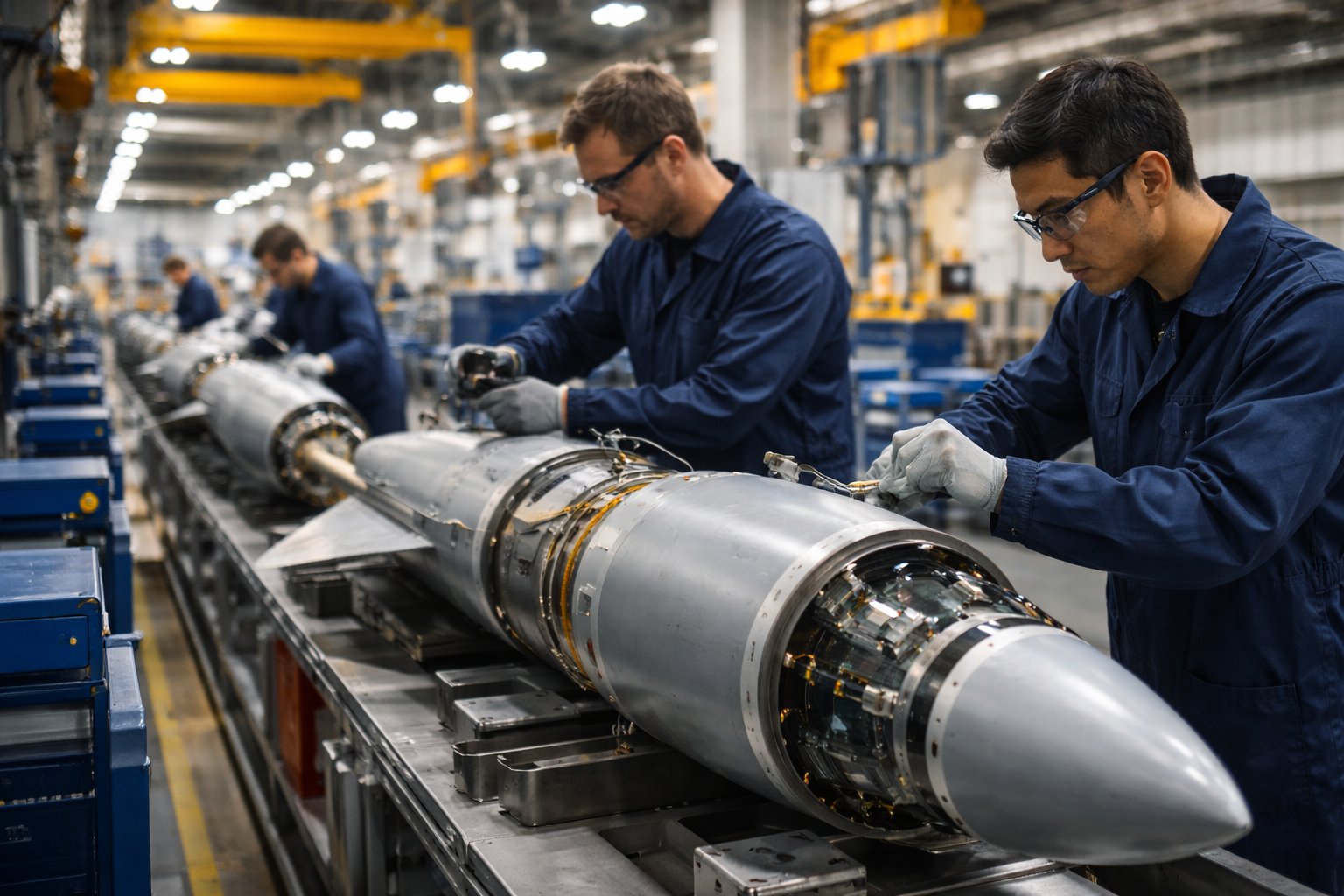
That operational demand puts manufacturing rather than prototype performance at the centre of the next phase. A development programme can tolerate hand-built assemblies, frequent engineering intervention, and configuration changes between vehicles. A line expected to produce thousands of interceptors every month needs qualified suppliers, controlled processes, repeatable assembly, reliable inspection, stable software and hardware baselines, and enough test capacity to prevent acceptance becoming the limiting factor.
Missile production is particularly sensitive to mismatched capacity. Guidance electronics, propulsion, structures, actuators, energetic materials, warheads, batteries, launch equipment, packaging, and final test all have to arrive at compatible rates. Expanding final assembly alone does little if a single specialist component remains available only in hundreds rather than thousands.
Cambridge Aerospace is attempting to control more of that equation internally. The company is developing Nightstar solid rocket motors and plans a new manufacturing facility in Norfolk, with the stated ambition of creating very large European propulsion capacity. Bringing rocket-motor production closer to the missile programme could remove one external constraint, although it also transfers a highly specialised manufacturing responsibility directly into the business.
Solid rocket motors require more than conventional factory space. Energetic materials demand controlled processing, specialist buildings, safety separation, environmental management, inspection, batch traceability, and rigorous qualification. Increasing propulsion output can therefore involve substantial civil infrastructure and regulatory work alongside investment in machinery and labour.
The attraction is greater control of rate and design iteration. Where propulsion, structures, electronics, and final assembly sit inside a more closely connected engineering organisation, changes can potentially move from design into production without waiting for several independent suppliers to realign their processes.
The risk is that vertical integration creates new internal bottlenecks. Rocket motors, guidance hardware, additive-manufactured structures, software, and final assembly all have to mature at compatible rates. Moving a constraint from an external supplier into a new company-owned factory still leaves it as a constraint if yield, qualification, or staffing cannot keep pace.
Cambridge Aerospace is also using additive manufacturing and software-led production methods in an effort to reduce part counts and shorten manufacturing cycles. Those techniques can simplify tooling and accelerate design changes, but defence customers still need evidence that parts produced at higher rates remain equivalent to the configuration that passed qualification and firing trials.
That makes production test particularly important. A missile leaving a higher-volume line still has to meet acceptance criteria for electronics, propulsion interfaces, navigation equipment, actuators, software, and other critical functions. Test equipment itself has to scale with output, otherwise an efficient assembly operation simply creates a queue of finished weapons waiting to be accepted.
The workforce will have to expand around the same problem. Cambridge Aerospace employs around 250 people, mostly in the UK, while building activity in several overseas markets. Production engineering, quality, supplier management, maintenance, safety, and manufacturing operations need to grow alongside the teams developing the weapons themselves.
Skyhammer’s economics also matter because the wider air-defence market is being pulled in two directions. Armed forces still need high-performance interceptors for complex aircraft and missile threats, but they also require much larger magazines for drones and other lower-cost targets. Using premium interceptors against every incoming unmanned aircraft is difficult to sustain when the defensive weapon costs many times more than the threat.
Cambridge Aerospace is trying to occupy that gap with a product designed around faster development and higher-volume manufacturing. Starhammer gives the company a route into a higher-performance tier, while Nightstar propulsion could give both programmes greater control over one of the most constrained parts of missile production.
The funding round provides the capital needed to pursue that industrial model. The more useful measure now is whether the company can turn a 2,500-per-month Skyhammer target into stable output without allowing supplier qualification, rocket-motor production, acceptance testing, or configuration control to become the new pace-setter.