IN Brief:
- University of Alaska Fairbanks has received a $499 million Army IDIQ covering geophysical nuclear-proliferation detection science and engineering.
- UAF operates the Defense Department-designated Geophysical Detection of Nuclear Proliferation University Affiliated Research Center.
- The centre’s work includes seismic and infrasound monitoring, treaty-verification research, and methods intended to detect smaller events from greater distances.
University of Alaska Fairbanks has received a $499 million US Army indefinite-delivery, indefinite-quantity contract for scientific and engineering capabilities focused on the geophysical detection of nuclear proliferation.
The contract supports an approved University Affiliated Research Center and runs to 6 August 2031. Work locations and funding will be determined as individual orders are placed, meaning the $499 million figure is a contract ceiling rather than money committed immediately to a single research project.
The award considerably expands the contracting route available for a specialised capability UAF has developed through its Geophysical Institute. The university operates the Geophysical Detection of Nuclear Proliferation UARC, whose mission is to support the Department of War and wider interagency community through early detection and analysis of nuclear proliferation using geophysical phenomena.
UAF’s Wilson Alaska Technical Center and Alaska Earthquake Center carry out part of that work using seismic and infrasound monitoring. The technical objective is not simply to recognise large nuclear detonations, whose signals can be comparatively obvious, but to improve the ability to detect and assess smaller events and to do so at increasing distances.
That requirement reflects the geography of proliferation monitoring. Sensors cannot be positioned beside every location of interest, particularly in denied areas, leaving monitoring organisations dependent on weak signals that may have travelled hundreds or thousands of kilometres before reaching an instrument.
Seismic systems measure energy transmitted through the ground, while infrasound arrays detect very low-frequency atmospheric pressure waves. Both can provide evidence associated with explosions, but each also records natural and industrial activity that can resemble parts of the same signal.
The analytical problem is therefore one of discrimination as much as detection. Earthquakes, quarry blasts, mining activity, volcanic events, storms, aircraft, vehicles, and other sources can generate data that monitoring systems have to classify accurately before analysts can decide whether an event warrants further examination.
UAF researchers have described reducing detection thresholds as an explicit objective. Detecting smaller events from farther away requires improvements in sensor performance, array geometry, signal processing, models of wave propagation, and methods for combining observations from several instruments.
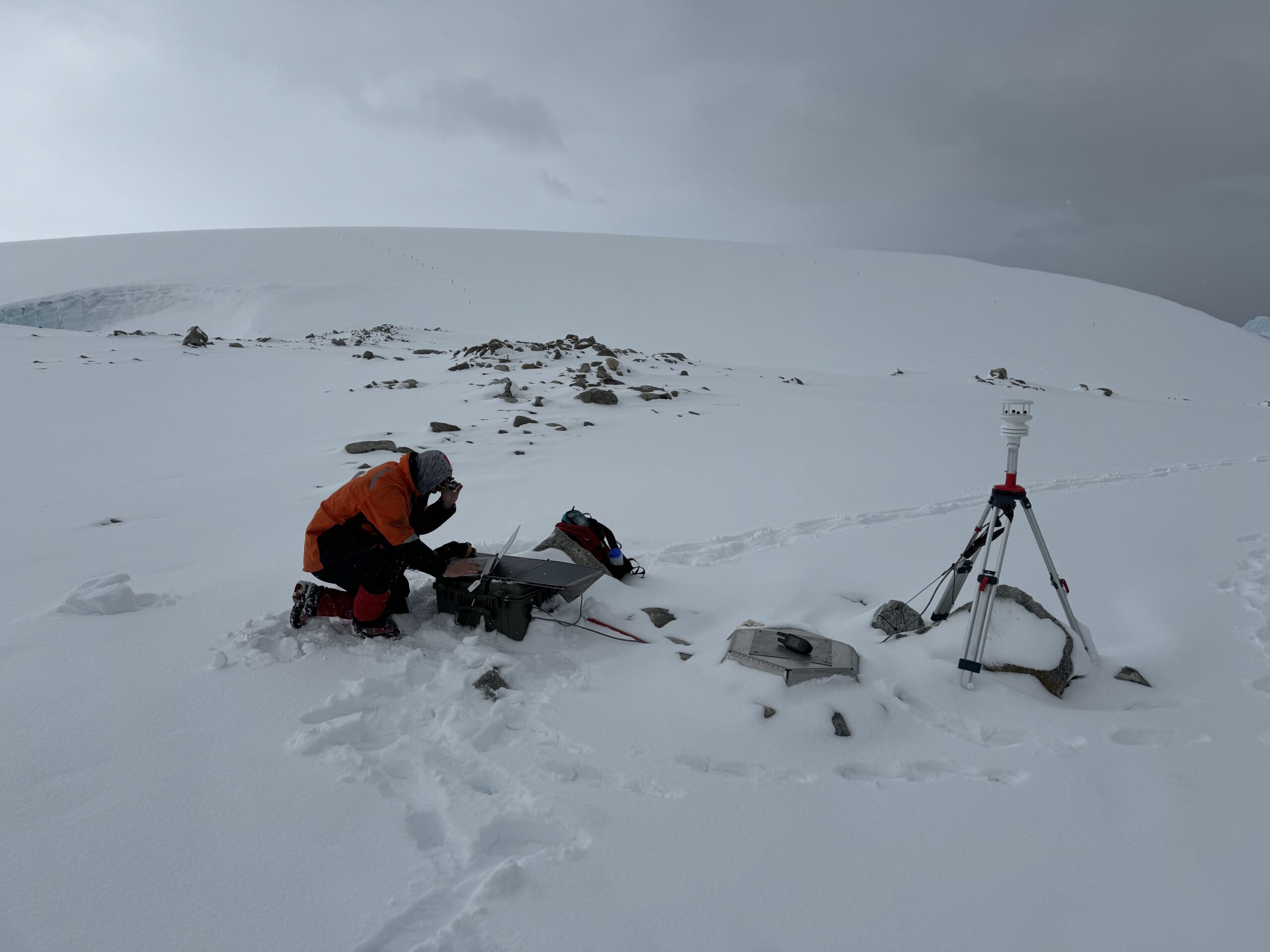
The Wilson Alaska Technical Center operates seismic and infrasound arrays worldwide in support of nuclear-proliferation monitoring. Remote stations impose their own engineering requirements because equipment has to maintain calibration, power, communications, timing, and environmental protection in locations where physical maintenance can be difficult and expensive.
A failed sensor does more than create a local maintenance problem. Gaps in a distributed monitoring network can reduce the ability to locate an event accurately or compare signals recorded from different directions, making reliability and communications part of the detection problem itself.
Processing capacity has become increasingly important as these networks generate large amounts of data. Automated methods can help identify candidate events, compare waveforms, and reduce the volume analysts must examine manually, although the resulting systems still need sufficient transparency and validation for national-security decisions.
The UARC structure is designed to preserve expertise of this type over long periods. University Affiliated Research Centers provide the government with enduring access to specialist scientific and engineering capabilities that would be difficult to recreate through isolated short-duration research contracts.
UAF received its original defence UARC designation for geophysical nuclear-proliferation detection in 2018. Earlier contracting established a much smaller ceiling, while the latest $499 million IDIQ provides a considerably larger vehicle for placing work through 2031 as individual requirements arise.
That does not mean all subsequent orders will be devoted to building new sensors. Research can include modelling, data processing, algorithm development, test and evaluation, field instrumentation, signal characterisation, treaty-verification techniques, and scientific analysis around the physical signatures associated with nuclear activity.
The technology has applications beyond a single monitoring mission. UAF has demonstrated that the same seismic and infrasound expertise used for nuclear-explosion monitoring can be applied to detecting vehicles and aircraft, illustrating how advances in sensors and signal processing can migrate between national-security problems.
The industrial base around such research is less visible than a missile or aircraft production line, but it still depends on specialist instrumentation, communications, computing, rugged electronics, precision timing, field logistics, and software. Improvements developed through the UARC can create requirements for those technologies while also extending the performance of equipment already deployed.
Skills retention is equally important. Seismology, atmospheric acoustics, nuclear-test phenomenology, signal analysis, and remote monitoring are specialist disciplines that cannot be rebuilt quickly after experienced researchers and technical staff disperse.
The Army’s $499 million contract gives the government a long-duration route to that expertise rather than a guarantee of expenditure. Its value will ultimately be measured through individual task orders and whether UAF can push detection thresholds lower, reduce uncertainty around difficult signals, and keep a global monitoring capability technically credible as both sensing technology and proliferation challenges evolve.