IN Brief:
- NUSHIP Hunter has reached keel-laying at the Osborne Naval Shipyard in South Australia.
- The Type 26-derived programme combines Australian combat-system requirements with a growing domestic shipbuilding supply chain.
- Sea trials for the first ship are currently planned for 2031, ahead of delivery in 2032.
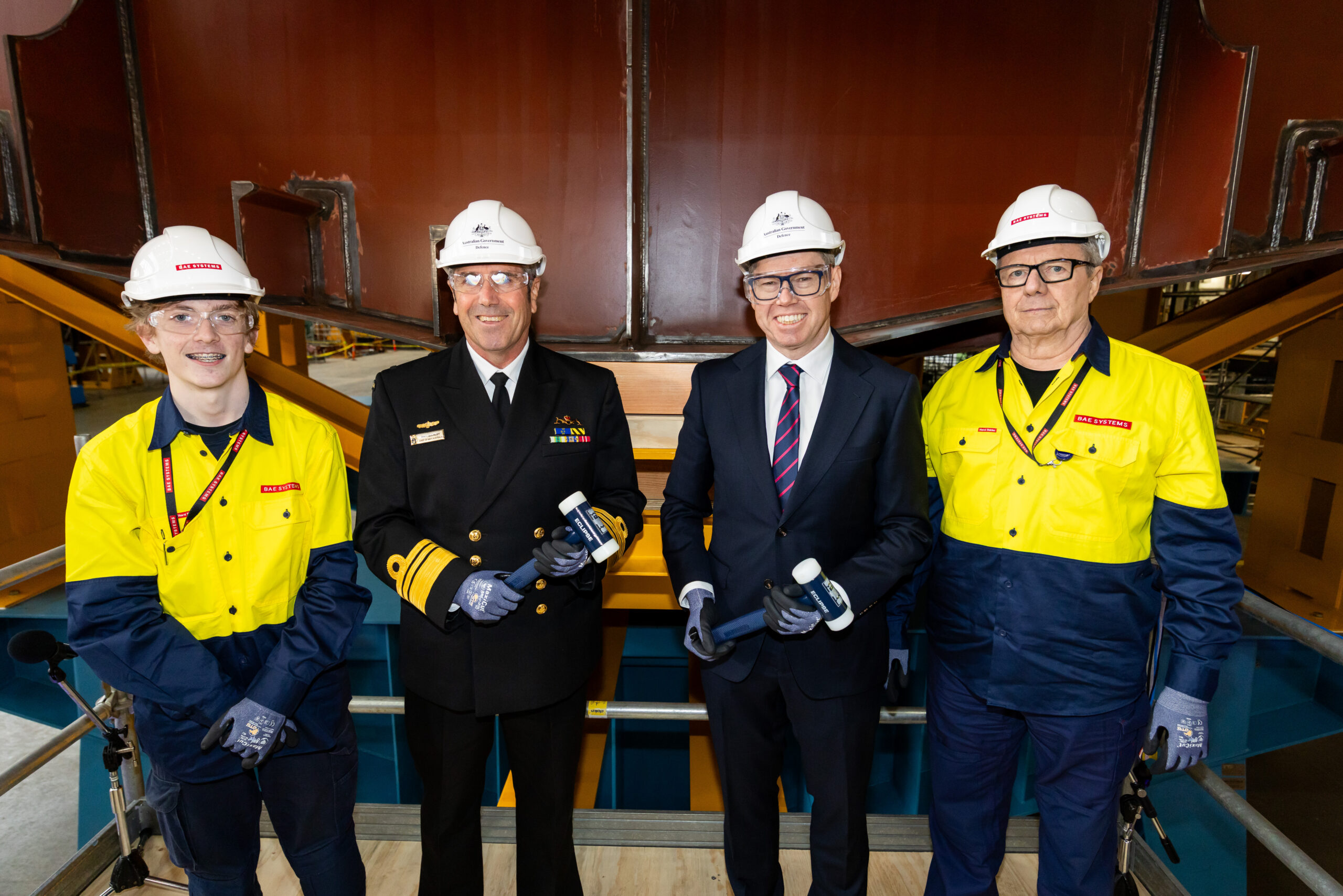
BAE Systems Australia has laid the keel of NUSHIP Hunter at the Osborne Naval Shipyard in South Australia, marking another construction milestone for the first of six Hunter-class anti-submarine warfare frigates planned for the Royal Australian Navy. Shipbuilders joined Defence Industry Minister Pat Conroy and Chief of Navy Vice Admiral Matthew Buckley for the ceremony, which placed a coin beneath two blocks forming part of the ship’s keel. Those sections will now be joined with further blocks as the hull structure takes shape.
The programme moved from prototyping into construction when steel was cut for the first ship in June 2024. Hunter is derived from BAE Systems’ Type 26 Global Combat Ship but has been modified for Australian requirements, including national combat-system, sensor, and support arrangements. That makes the build a substantial integration programme as well as a shipyard production exercise.
BAE Systems says the class is being developed around anti-submarine warfare, with a design intended to combine low acoustic signatures, advanced sonar, and integrated weapons and sensors. Australia’s configuration includes national equipment and interfaces that differ from the Royal Navy’s City-class frigates and Canada’s Type 26-derived programme. The shared design lineage creates common manufacturing opportunities, but it does not remove the need to manage national configuration carefully.
Osborne has spent several years preparing for that task. Prototype blocks were used to develop fabrication methods, tooling, workforce skills, production sequencing, and quality processes before work moved onto the operational ships. Errors in drawings, interfaces, access, or production sequence become progressively more expensive once later ships are already moving through the yard.
The keel ceremony also comes as the Australian supply chain takes on a larger share of Hunter-related manufacturing. BAE Systems says the programme is expected to create or sustain more than 5,000 jobs across the company and its wider Australian defence supply chain over its life, including up to 1,000 apprentice and graduate roles. Suppliers are contributing fabricated structures, cabling, propulsion-related equipment, and other ship systems rather than limiting local content to final assembly.
Some of that capability is already extending beyond the domestic programme. Melbourne-based Marand Precision Engineering, for example, has won additional work on MT30 gas-turbine acoustic enclosures and ship-interface systems after manufacturing equivalent equipment for Hunter. That Type 26 propulsion work provides an early example of an Australian supplier using qualification on the local frigate programme to compete for work across the wider ship family.
Repeated work across related programmes can improve manufacturing economics, but only where configuration is controlled. The Australian, British, and Canadian ships share a reference design while carrying different combat systems, sensors, weapons, standards, and support arrangements. A supplier can reuse processes, tooling, and experience, yet still has to verify that each interface and acceptance requirement matches the customer receiving the equipment.
First-of-class block construction also puts pressure on dimensional control and outfitting sequence. Large modules have to arrive at erection with pipework, cabling, foundations, and structural interfaces aligned closely enough to avoid expensive correction after joining. The more outfitting that can be completed before blocks are combined, the less congested the later shipboard work becomes, but that only works when design data and material availability are stable.
That discipline becomes more demanding as construction overlaps. Australia plans to cut steel for the second Hunter during 2026 and the third in 2028, while the first ship is currently scheduled to begin sea trials in 2031 ahead of delivery in 2032. Later hulls will therefore enter production while engineering lessons from the lead ship are still emerging, forcing the yard to decide which changes can be incorporated quickly and which must wait for later builds.
The six-ship programme also sits within a broader restructuring of Australia’s surface fleet. The government reduced the planned Hunter class from nine ships to six in 2024 while retaining it as the navy’s principal high-end anti-submarine warfare frigate. Osborne remains central to the policy of continuous naval shipbuilding, so production performance on Hunter carries consequences beyond the delivery date of a single class.
The programme is now moving into the stage where industrial performance becomes easier to measure. Block completion, outfitting quality, rework levels, system integration, and the spacing between successive hulls will provide harder evidence than design reviews or workforce projections. With NUSHIP Hunter’s keel now in place and the second ship due to enter the sequence, Australia’s naval industrial strategy increasingly depends on whether Osborne can turn first-of-class learning into repeatable production.