IN Brief:
- Germany’s defence minister has backed procurement of a fourth Class 424 fleet intelligence vessel.
- Three ships are already under construction, with the third reaching keel-laying several months ahead of schedule.
- The 130-metre class will support the German Navy and Cyber and Information Domain Service from 2029.
Germany is preparing to seek approval for a fourth Class 424 fleet intelligence vessel, extending a programme that already has three ships under construction and potentially enlarging the future maritime intelligence fleet beyond the original contracted quantity.
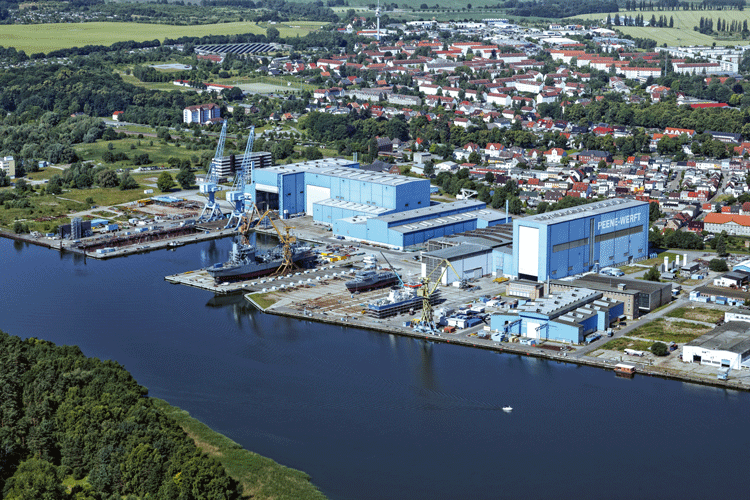
The announcement accompanied the keel-laying of the third vessel at Rheinmetall’s Peene-Werft shipyard in Wolgast. Defence Minister Boris Pistorius said the budget proposal for a fourth ship is moving towards parliamentary consideration, meaning the additional vessel remains a planned procurement rather than a completed contract.
The third ship reached keel-laying several months ahead of schedule, while work on the second vessel is also under way at Wolgast. Rheinmetall began steel cutting for the third hull earlier in 2026, bringing all three ships in the existing programme into production before the latest proposal to expand the class.
Class 424 is intended to replace Germany’s ageing Oste-class fleet intelligence ships with approximately 130-metre platforms carrying a new generation of sensors and mission systems. The vessels are designed for maritime intelligence collection and will be operated jointly by the German Navy and personnel from the Cyber and Information Domain Service, reflecting the close relationship between naval operations and electromagnetic-spectrum intelligence.
The ships will monitor and analyse activity across the electromagnetic environment, contributing information to a wider operational picture across sea, air, and land domains. Detailed mission-system configurations are less public than the hull programme, but the class is being built around modern intelligence-gathering requirements rather than replacing the existing Oste vessels on a like-for-like basis.
Current plans call for the new ships to begin entering service from 2029. That timetable places considerable weight on industrial execution at Wolgast because intelligence vessels combine conventional naval construction with specialised sensor installation, secure communications, power distribution, cooling, electromagnetic compatibility, and mission-system integration.
Structural completion alone therefore says relatively little about delivery risk. A hull can be assembled on schedule while complex outfitting, software integration, sensor acceptance, harbour trials, and classified mission-system work continue to determine when the ship becomes operationally useful.
A fourth vessel would also change the production calculation. Extending a class while the first ships are still in build can preserve supplier continuity and reduce the disruption associated with restarting specialist production after a gap, provided parliamentary approval and contracting arrive early enough to keep design, material, and workforce planning aligned.
That is particularly relevant for equipment produced in small quantities. Intelligence vessels are not built at frigate or patrol-vessel volumes, so specialist suppliers can face long intervals between orders for secure electronics, bespoke integration work, specialist antennas, and low-volume components. An additional hull can extend the period over which programme-specific industrial capability remains active.
Rheinmetall’s position in the programme has also changed during 2026. The group completed its acquisition of Naval Vessels Lürssen earlier this year, bringing Peene-Werft and other naval facilities into Rheinmetall Naval Systems. NVL employed around 2,100 people at the time of the acquisition and brought established military shipbuilding, maintenance, and maritime-autonomy capability into a group previously better known for land systems, ammunition, sensors, and air-defence technology.
Class 424 is consequently an early test of how that enlarged naval business performs on a programme where schedule and systems integration carry as much weight as basic ship construction. The early start to work on the third vessel is encouraging, but another ship would require the industrial base to sustain that cadence through structural assembly, outfitting, mission-system work, trials, and acceptance.
The procurement case also reflects a change in Germany’s stated force requirement. Rheinmetall says the updated capability profile now calls for four fleet intelligence vessels, while three are presently being built. That gives the proposed fourth hull a clearer programme rationale than a speculative option for extra capacity, although the parliamentary process still separates the requirement from a firm shipbuilding order.
Timing will determine how much industrial continuity Germany can preserve. A decision taken while the existing build sequence is still active can allow material orders, specialist labour, design data, and supplier commitments to flow into another hull. A prolonged gap would weaken that advantage and increase the risk of having to reconstitute parts of the programme later.
For the Wolgast yard, a fourth vessel would extend a workload now sitting inside Rheinmetall’s broader push into naval systems. For the Bundeswehr, the more important test will be whether the expanded requirement can be converted into another integrated intelligence ship without disrupting delivery of the first three.
With entry into service beginning from 2029, the programme is already moving from design and early fabrication into the more demanding phase where shipbuilding, electronics, and classified mission systems have to converge on the same schedule. Parliamentary approval for a fourth hull would add volume, but it would also increase the premium on maintaining the production rhythm now being established at Peene-Werft.