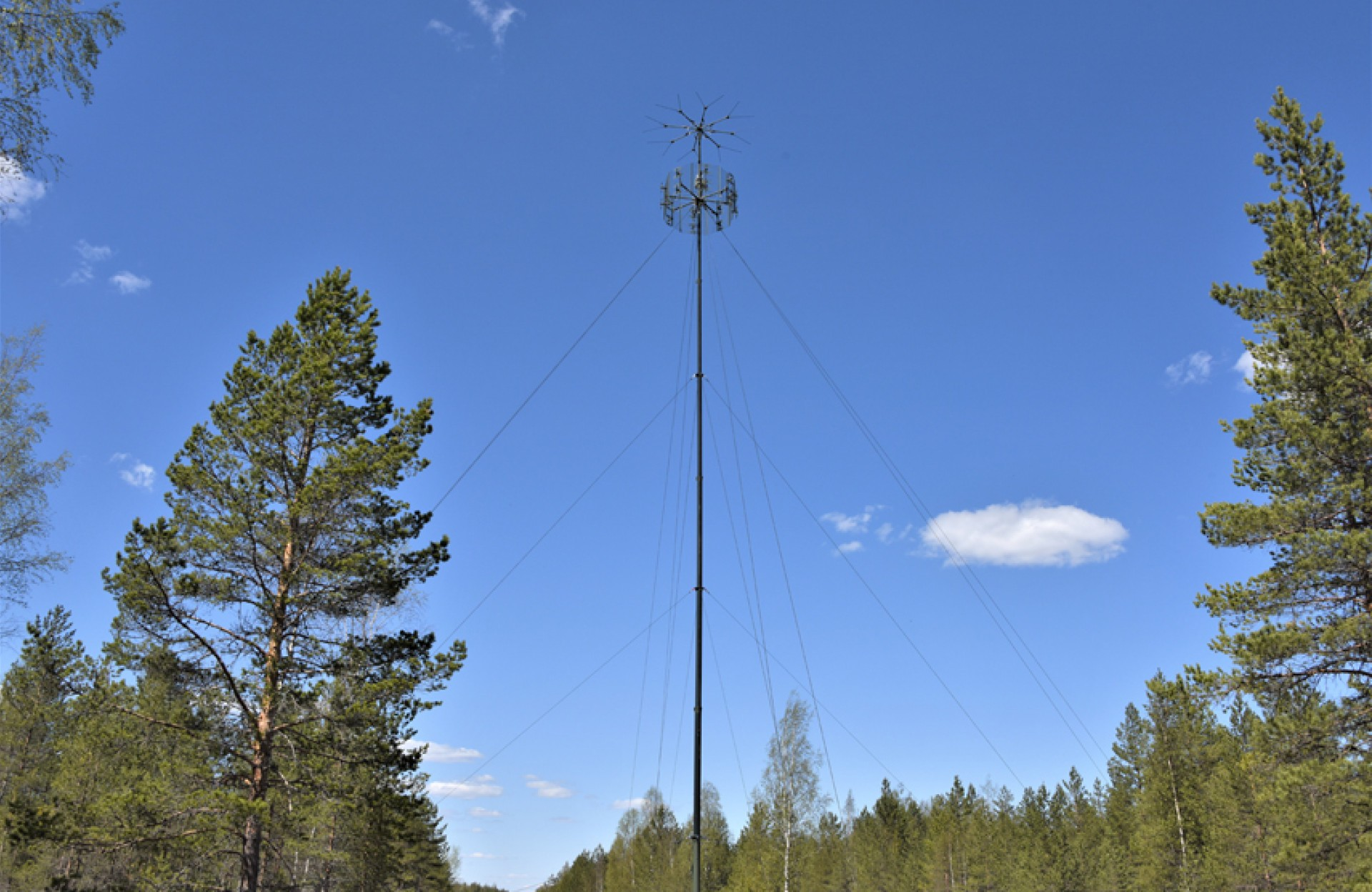
IN Brief:
- An undisclosed European NATO member has ordered multiple Patria MUSCL passive-radar sensor stations.
- MUSCL uses existing broadcast transmissions to detect targets without emitting a conventional radar signal.
- The package includes spares, training, and support intended to accelerate operational deployment.
Patria has secured an agreement to deliver its MUSCL passive radar system to an undisclosed European NATO member, supplying several sensor stations together with spare parts, training, and support for operational deployment.
The order gives the customer a networkable air-surveillance system that detects targets without transmitting its own conventional radar signal. MUSCL instead uses existing radio and digital-television broadcasts as illuminators of opportunity, measuring energy reflected from aircraft and other aerial targets and processing those returns to create tracks.
That operating principle gives passive radar a different electromagnetic signature from an active surveillance radar. Because the MUSCL receiver listens rather than transmitting a high-power radar waveform, the system does not advertise its position in the same way to electronic-support receivers or anti-radiation weapons while still contributing to an air picture.
Patria describes MUSCL as suitable for standalone and networked operation, with transportable and fixed configurations available. Multiple stations can be combined for wider coverage and multistatic geometry, while standard interfaces allow track information to be distributed into command-and-control systems rather than remain inside a proprietary sensor console.
Current technical material lists compatibility with FM and DVB-T/T2 broadcast signals, 360-degree or sector coverage, and simultaneous tracking of more than 100 targets. Patria gives an air-picture update interval below one second and maximum detection ranges of up to 250–300km depending on target type and deployment conditions.
The target-specific figures are more useful because passive-radar performance is shaped by transmitter geometry, terrain, target characteristics, and available broadcast infrastructure. Patria lists typical fighter-aircraft detection below 150km, helicopter detection below 80km where terrain can become the limiting factor, and more than 10km against NATO Class 1 mini and small UAV targets.
MUSCL is also intended to operate against low-altitude and low-observable targets, where lower-frequency civilian broadcast transmissions and multistatic geometry can complement conventional radar coverage. It is not a replacement for an active air-surveillance radar: active systems retain advantages in controlled waveform generation, precision, update management, and dedicated operating modes, while passive systems add a sensing layer that is harder to locate through its own emissions.
That characteristic becomes more valuable as air-defence networks are expected to remain available under persistent electronic surveillance. A large active radar can provide excellent coverage but inevitably creates an electromagnetic signature. Distributing passive receivers offers another route to maintain track information, fill low-level coverage gaps, or cue other sensors without keeping every active transmitter continuously radiating.
The customer has not been identified and Patria has not disclosed the contract value, number of sensor stations, delivery timetable, or exact configuration. The inclusion of multiple stations, however, indicates an operational surveillance network rather than a single evaluation unit, while the accompanying spares, training, and support package puts fielding and sustainment inside the acquisition.
System integration will determine how much value those stations provide. Patria’s current documentation lists interfaces including Eurocontrol ASTERIX and MIL-STD-3011 JREAP-C, allowing track data to move into a broader recognised air picture. A passive sensor that cannot exchange information quickly with command systems, active radars, effectors, and electronic-warfare assets would have limited use in a layered defence network.
Patria has been extending the same passive-sensing approach into a wider portfolio. The company introduced its WISPR passive counter-battery radar earlier this year and also markets CATCHR for electronic-support and intelligence missions, creating several products built around detecting activity without relying solely on conventional transmitting sensors.
MUSCL is also due to be demonstrated with CATCHR at EW Live 2026 in Estonia, monitoring airspace over Estonia and southern Finland while providing real-time situational awareness without transmitting radar signals. That work gives Patria another setting in which to demonstrate how passive tracks can be combined with other electronic-support data rather than assessed in isolation.
For the unnamed customer, the procurement adds a sensor type that can sit alongside existing air-defence radars rather than replace them. Deployment choices will depend on transmitter geometry, terrain, local broadcast coverage, network connectivity, and the quality of data fusion with other sensors already in service.
The industrial work now moves from demonstration towards delivery, integration, operator training, and sustainment. Multiple stations have to be produced in a consistent configuration, commissioned in the customer’s network, and supported with enough spares and technical knowledge to remain useful after the initial installation team leaves.
Passive radar has spent years being discussed as a complement to active surveillance. A multi-station NATO order provides a more concrete measure of progress: the technology is moving into fielded infrastructure, where availability, network integration, and track quality will matter considerably more than the novelty of detecting an aircraft without transmitting at it.