IN Brief:
- AFSOC says the AGM-190A Havoc Spear met its requirements during a combat evaluation conducted in spring 2026.
- The 200lb-class missile has demonstrated a stand-off range exceeding 400 nautical miles during C-130 testing.
- Leidos says added Huntsville manufacturing capacity could support production of up to 15,000 missiles annually.
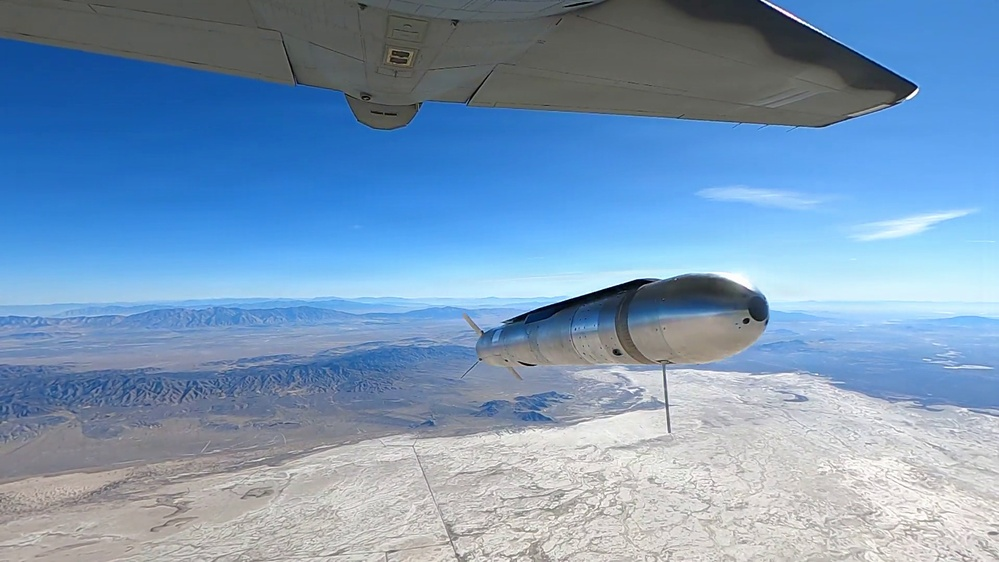
Air Force Special Operations Command says the AGM-190A Havoc Spear has met its requirements for broader operational use following a combat evaluation, moving the compact cruise missile beyond development testing as Leidos expands manufacturing capacity for higher-rate production.
The evaluation took place during spring 2026 using an AFSOC aircraft in a test configuration and was intended to establish whether the weapon could deliver the accuracy, reliability, and mission performance required of an operational system. AFSOC has now described the missile as ready for wider use across special-operations and potentially conventional aircraft.
Havoc Spear is a roughly 200lb-class weapon built around a modular airframe and open-system software architecture. Earlier testing from a C-130 demonstrated a stand-off range exceeding 400 nautical miles, giving the comparatively compact missile reach usually associated with substantially larger air-launched weapons.
The AGM-190A designation was assigned by the US Air Force in February before AFSOC publicly introduced the Havoc Spear name in May. At that point, the programme was moving from rapid development towards a longer-range precision-effects role; the latest evaluation adds an operational milestone and increases the importance of production, platform integration, and unit cost.
AFSOC’s plans are not limited to one aircraft type. Officials have discussed integrating the missile across additional special-operations and conventional platforms while supporting multiple launch methods, making the weapon’s relatively small size and open architecture important to the programme’s wider utility.
Each new aircraft still introduces physical and software integration work. Electrical interfaces, structural loads, environmental limits, stores management, mission planning, release behaviour, and safety have to be demonstrated for the individual platform even where the missile itself remains unchanged.
Leidos has designed Havoc Spear around modular hardware and an open software architecture so that payloads and mission functions can be adapted without redesigning the entire weapon. That can reduce development effort between configurations, but it does not remove the qualification burden attached to carrying and releasing a weapon from a new aircraft.
The programme is now moving towards an industrial problem affecting many current missile projects: converting a lower-cost design into sustained volume without allowing propulsion, guidance electronics, energetics, component supply, qualification, or final acceptance testing to constrain production.
Leidos has added manufacturing capacity in Huntsville, Alabama, and says the facility could support production of up to 15,000 Havoc Spear missiles annually. That figure represents production capability rather than a declared procurement quantity, but it is far above the low-rate output usually associated with an emerging precision weapon.
Unit cost is linked directly to that production model. AFSOC officials have placed current low-rate cost at roughly $600,000 per missile, while Leidos has discussed a target between the mid-$200,000 range and about $350,000 at full-rate production.
Higher volume alone does not guarantee that reduction. Supplier commitments, component standardisation, tooling, production learning, automated test, yield, and the proportion of hardware shared across variants will determine how far manufacturing cost falls as output increases.
Havoc Spear is already influencing another Leidos weapons programme. The company’s Low-Cost Containerized Munition uses technology and manufacturing approaches derived from the AGM-190A while scaling the concept into a larger ground-launched weapon, with an agreement covering an initial 3,000 missiles and production planned from 2027.
Shared components and manufacturing processes can create useful economies if the programmes genuinely use the same suppliers and equipment. They can also place additional pressure on propulsion, electronics, materials, and test capacity where several programmes attempt to increase output simultaneously.
The AFSOC decision shifts Havoc Spear further towards that production challenge. Development quantities can tolerate specialist assembly, heavy engineering intervention, and manually intensive acceptance procedures; a weapon intended for widespread use across several platforms requires a manufacturing system able to produce controlled configuration and predictable reliability at much higher rates.
The missile’s comparatively low mass also affects the wider aircraft integration problem. A smaller weapon can allow an aircraft to carry more rounds within a given payload limit, but larger load-outs increase demands on launcher interfaces, mission planning, communications, target allocation, and stores-management software.
AFSOC’s evaluation demonstrates that the weapon has crossed another programme threshold, but operational availability will depend on manufacturing and integration advancing alongside it. Huntsville capacity, lower unit cost, and additional aircraft clearances have to develop together if Havoc Spear is to become the high-volume stand-off capability its production model anticipates.
The next steps are consequently less about proving that one missile can reach a target than demonstrating that thousands can be built to the same configuration, accepted at predictable cost, and integrated across enough aircraft to make the installed production capacity operationally relevant.