IN Brief:
- Northrop Grumman and the US Air Force assembled all Sentinel stages, propulsion elements, shroud, and associated components vertically at Vandenberg.
- The four-month Pathfinder exercise included cross-country component transport, stacking, de-stacking, crane operations, and interface verification.
- The first-flight critical design review has also been completed, supporting a planned Sentinel flight test during 2027.
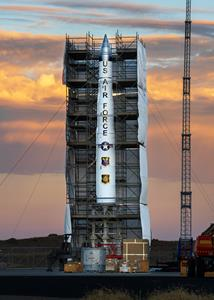
Northrop Grumman and the US Air Force have fully assembled an inert Sentinel intercontinental ballistic missile in its operational vertical orientation at Vandenberg Space Force Base, completing a Pathfinder exercise intended to prove that the missile can be transported, stacked, integrated, and handled safely ahead of flight testing.
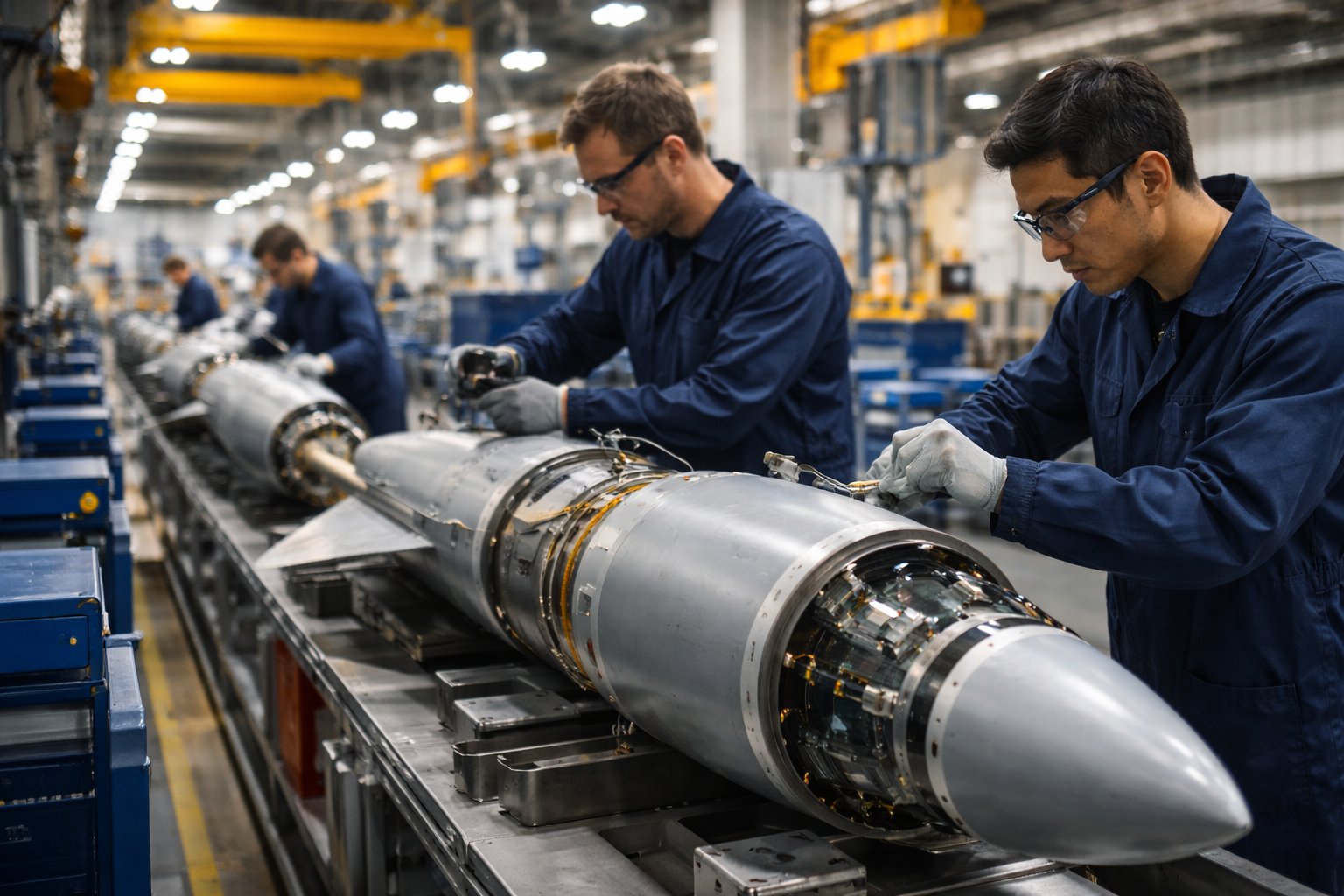
The milestone brought every missile stage, propulsion element, shroud, and associated component together in a complete configuration on the test pad. Engineers subsequently de-stacked the inert missile as part of a four-month campaign that exercised the physical processes required to move hardware from suppliers and production sites through to an assembled launch vehicle.
That distinction matters because Sentinel is substantially more than a missile-development programme. Replacing Minuteman III requires the US Air Force to introduce a new weapon, launch infrastructure, command-and-control systems, transport equipment, maintenance processes, and supporting facilities across a dispersed operational network while keeping the existing deterrent continuously available.
The Vandenberg work therefore tested an industrial and logistical sequence rather than simply confirming that individual missile stages fit together. Components were transported from locations around the US, handled with specialised equipment, positioned using mobile cranes, connected in operational sequence, and subjected to interface verification before the complete stack was dismantled.
Northrop says the operation demonstrates that the defined assembly processes can be executed on the test pad and provides a baseline for the live-flight configuration planned for 2027. The Air Force’s 719th Test Squadron and Northrop have also completed the critical design review for the first flight test, covering design maturity, hardware testing, safety, performance, and schedule readiness.
Sentinel is intended to replace the Minuteman III force and ultimately place around 400 missiles on operational alert. Initial capability is planned for the early 2030s, with the wider weapon system expected to support the US ground-based strategic deterrent for decades afterwards.
The programme has undergone substantial acquisition restructuring as cost, infrastructure, and schedule pressures became clearer. That has increased the importance of reducing uncertainty through physical prototypes and demonstrations before construction and deployment proceed at full scale.
Vertical integration is one of the less conspicuous activities capable of creating disproportionate disruption when problems are found late. A missile may be valid in its digital design and its propulsion stages may function individually, yet field assembly can still fail because lifting fixtures interfere with hardware, transport constraints have been underestimated, connections cannot be reached in the required sequence, or tolerances accumulate across several large assemblies.
Performing the complete stack with inert hardware allows those problems to surface without combining every engineering risk with the hazards and restrictions of live propulsion. It also allows technicians to validate work instructions, crane movements, ground equipment, inspection points, and communication between different teams.
Transport is similarly important. Sentinel hardware will have to move between industrial sites, test facilities, maintenance locations, and operational bases under tightly controlled environmental and security conditions. Northrop has previously tested mission-critical transport systems over long road movements, while the Vandenberg campaign extended that work into the sequence ending with a fully integrated missile.
The wider programme is also prototyping a redesigned launch-silo tube and developing the Launch Support System, a digital command-and-control architecture that has already passed its own critical design review. Those elements illustrate the scale of the undertaking: producing a flightworthy missile is only one part of replacing a distributed operational weapon system.
Manufacturing maturity will become increasingly prominent as the programme approaches flight test. Northrop says the Sentinel industrial team includes more than 10,000 people across multiple sectors, with propulsion, electronics, structures, facilities, transport equipment, and software moving through overlapping test and qualification cycles.
That supply network has to move from development hardware into controlled production without losing configuration discipline. A change introduced to address a flight-test issue can affect tooling, suppliers, technical data, transport equipment, or launch infrastructure elsewhere in the programme, which is why integrated physical demonstrations provide information that isolated component tests cannot.
The completed first-flight critical design review gives the 2027 launch effort a design baseline, but substantial work remains before a live missile leaves the pad. Flight hardware has to be manufactured and accepted, the launch site configured, instrumentation installed, software and ground equipment verified, and the complete test configuration taken through rehearsals.
Northrop has also been conducting qualification and environmental testing on major Sentinel components, including acoustic work intended to demonstrate that the missile’s forward section can withstand the intense noise and vibration generated during launch. Those activities examine individual parts of the system; Pathfinder tests whether the complete missile can be assembled and handled as intended.
The vertical stack is therefore less dramatic than a flight test but more revealing than another isolated subsystem demonstration. It shows that hardware arriving from different parts of the industrial base can be brought together into a single missile using the equipment and processes intended for the programme.
The first Sentinel flight in 2027 will test a different set of assumptions. Before that happens, the programme now has physical evidence that the missile can reach the pad, be assembled safely, and stand in the configuration from which the next phase of development is intended to begin.