IN Brief:
- The US Air Force has awarded L3Harris approximately $60 million to continue DSU-43/B C-HOBS production.
- C-HOBS provides cockpit-selectable and manually selectable height-of-burst settings using a radar proximity sensor.
- L3Harris will manufacture the sensors at Cincinnati as it increases proximity-fuze and sensor capacity.
L3Harris Technologies has received an approximately $60 million US Air Force contract to continue production of the DSU-43/B Cockpit Selectable Height of Burst sensor, extending manufacture of a radar proximity-fuzing system that allows aircrews to adjust where compatible munitions detonate above a target.
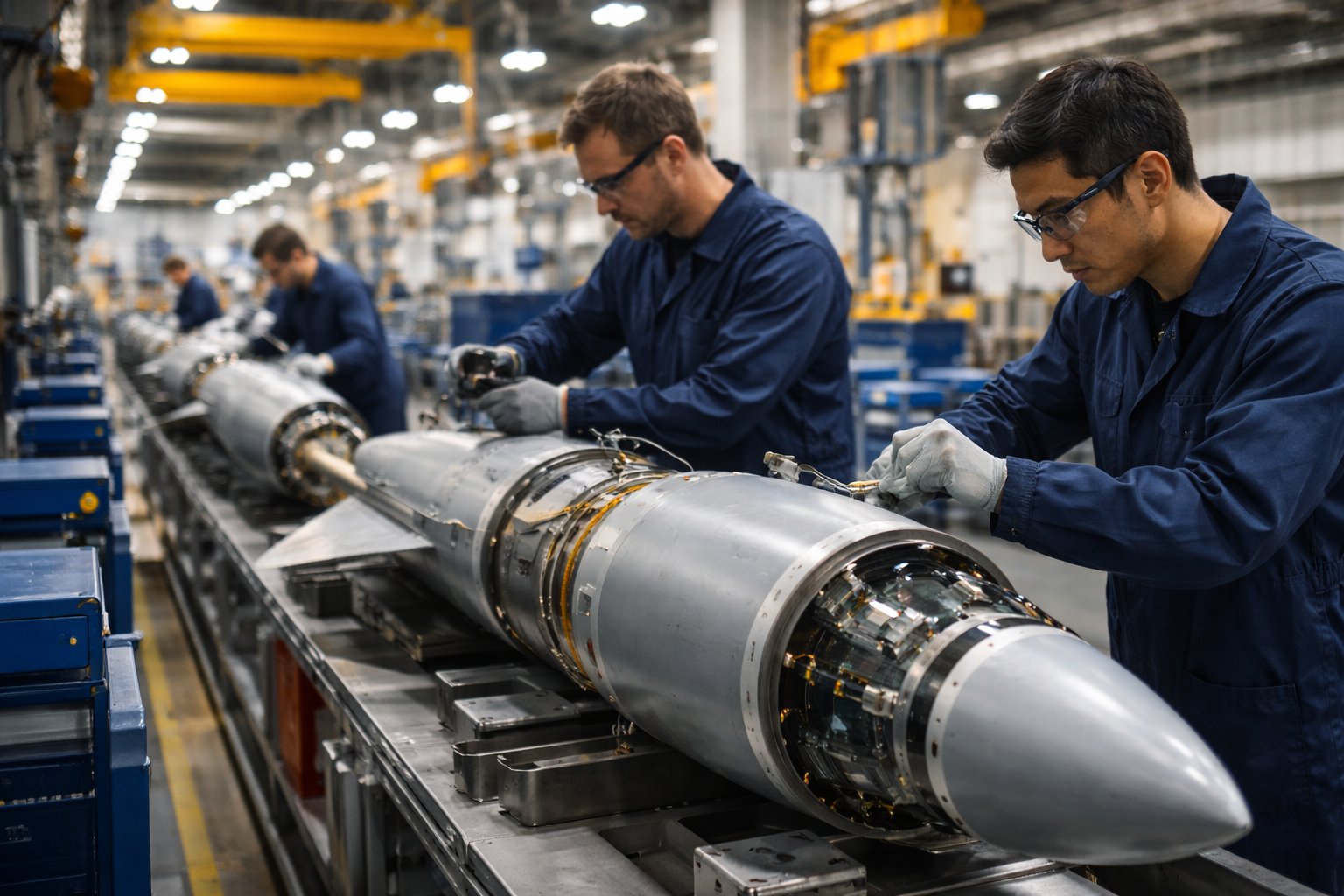
Production will take place at L3Harris’s Cincinnati operation as the company increases capacity for proximity fuzes and related sensors. The award continues C-HOBS manufacture rather than funding a new technology demonstrator, placing the emphasis on production output, reliability, and availability of a component that connects aircraft mission planning with the final effects produced by an air-delivered weapon.
C-HOBS allows crews to select a detonation altitude suited to the intended target and operating environment. Instead of relying on a single fixed burst setting, the system supports selectable heights while its radar sensing determines proximity to the surface and triggers the munition at the programmed point.
The capability changes the way an existing class of weapon can be employed without requiring a complete munition redesign for each target set. A surface burst, lower airburst, and higher airburst produce different fragmentation and pressure effects, so control of detonation height provides another variable alongside weapon type, aim point, delivery geometry, and other fuzing functions.
The sensor occupies a comparatively small part of the weapon but has a disproportionate influence on whether the munition behaves as intended at the end of its flight. Its electronics have to survive aircraft carriage, environmental exposure, vibration, release loads, and high-speed weapon flight before making a timing decision at a point where there is effectively no opportunity for correction.
Radar proximity sensing is established technology, but current systems are expected to provide greater employment flexibility while remaining resistant to false triggering and environmental effects. C-HOBS combines radar-guided operation with selectable burst settings intended to give crews a wider range of options from a common sensor.
For the Air Force, continued production also reduces dependence on retaining ageing fuzing hardware indefinitely while munition inventories are replenished or expanded. Fuzes, sensors, batteries, energetic devices, and other components can become limiting items even when bomb bodies or warheads are available because each has its own supplier network, qualification history, tooling, and test requirements.
L3Harris says it is increasing proximity-fuze and sensor capacity as US military demand grows. That industrial context is more consequential than the contract value alone because munition production is increasingly being judged by the rate at which qualified hardware can be delivered, not simply by whether a mature design exists.
Electronics manufacture introduces its own scaling problems. Radar sensors require controlled radio-frequency performance, calibrated timing, environmental protection, configuration control, and acceptance testing that verifies individual units rather than assuming a batch is suitable because it came from the same assembly line.
Increasing output therefore requires parallel investment in test equipment and inspection as well as component assembly. A sensor that passes visual inspection but operates outside its specified radio-frequency or timing behaviour is not a usable fuze, while intermittent defects may only become visible after vibration or temperature cycling.
Supply-chain resilience is another constraint. Defence electronics increasingly draw on semiconductor processes and components whose commercial lifecycles can be shorter than the weapon programmes using them. Manufacturers have to manage obsolescence, alternate sources, redesigns, and qualification without changing the behaviour of equipment already cleared for operational use.
The C-HOBS award illustrates why mature weapons still require continuing engineering activity. Production drawings and acceptance limits remain controlled, suppliers change, processes are updated, and test equipment has to be maintained and calibrated while customers expect later production lots to remain compatible with earlier units.
Cincinnati’s work also sits inside L3Harris’s broader missile and munitions portfolio. The company supplies propulsion, fuzing, sensors, energetic components, and other technologies across several weapon families, giving it exposure to the wider US effort to rebuild ammunition inventories and increase output.
That industrial breadth can create efficiencies where manufacturing disciplines, components, and suppliers overlap, but it can also expose common bottlenecks. Skilled electronics technicians, radio-frequency test equipment, specialised parts, and quality engineers may be needed by several programmes simultaneously, so capacity added for one product has to be considered against demand across the wider factory.
The Air Force has not disclosed the number of sensors covered by the latest award, the delivery schedule, or a unit value. The approximately $60 million contract therefore gives limited visibility into the precise production rate, but the continuation award and L3Harris’s wider capacity increase point to an enduring requirement rather than a short evaluation batch.
For aircrews, the sensor is intended to make a familiar class of munition more adaptable at the point of use. For the industrial base, the requirement is more straightforward: manufacture radar electronics repeatedly, verify each unit, maintain configuration across successive production lots, and prevent a relatively small component from becoming the reason a much larger stock of weapons cannot be completed.