IN Brief:
- Dstl has completed Phase 1 of the Software Defined Swarms Concept Demonstrator using two industry-led collective-control approaches.
- British Army operators have already completed eight weeks of experimentation with an eight-UAV Swarm Capability Test Bed.
- Further trials through 2026 and 2027 will examine operational use, open architectures and future procurement options.
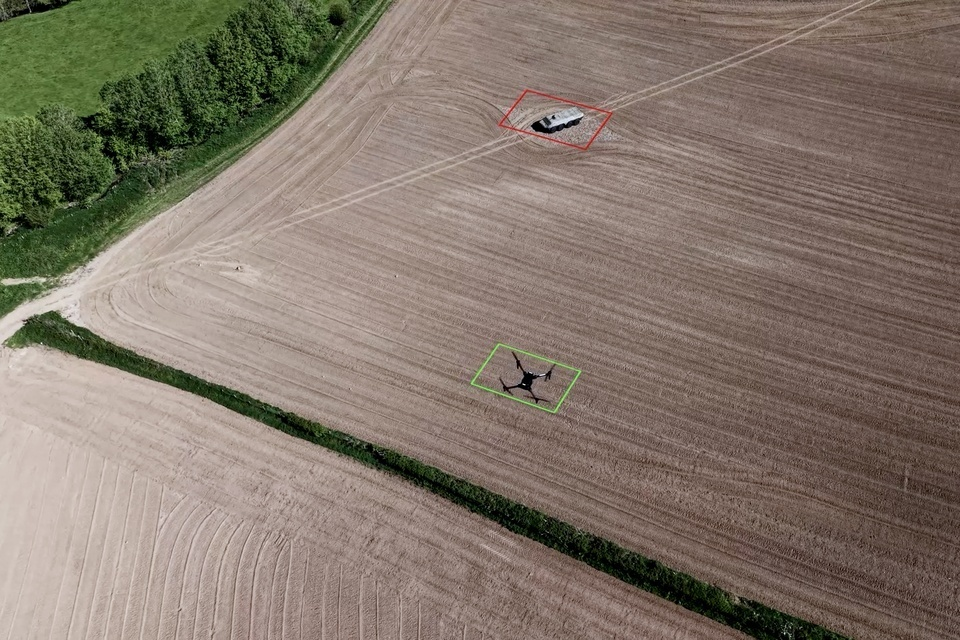
The British Army has completed the first phase of a software-defined drone swarm demonstrator, placing an eight-aircraft test bed with soldiers for further experimentation after trials of competing collective-control approaches in realistic military environments.
The programme was delivered by Defence Science and Technology Laboratory with Army Headquarters and industry. Phase 1 of the Software Defined Swarms Concept Demonstrator assessed two industry-led options: one developed by BlueBear, now a Saab company, and another from the Disruptor Group, a consortium of UK companies led by Applied Intuition.
Both approaches were tested against representative military tasks, giving the Army an opportunity to assess collective control rather than simply operating several remotely piloted aircraft at the same time. Dstl describes the work as its first high-technology-readiness demonstration of swarming drones based on collaborative control.
The programme has produced a Swarm Capability Test Bed consisting of eight uncrewed aerial vehicles. British Army operators have already completed eight weeks of experimentation with the system, and further experiments, field trials and live flying are planned through 2026 and 2027 under the Army’s Experimentation and Trials Group.
Collective control changes the operator problem as aircraft numbers rise. Conventional small-UAS operations tend to allocate significant attention to individual vehicles, creating a manpower constraint as formations attempt to field more systems. A swarm architecture instead distributes parts of navigation, coordination and task allocation across the machines, allowing personnel to command the group at a higher level.
That model still requires clear limits around autonomy. Vehicles need rules governing separation, routing and response to changing tasks, while operators need to understand when the system will act independently and when intervention is required. Communications failures, aircraft losses and unexpected obstacles become collective-management problems once several vehicles are coordinating their behaviour.
Dstl has deliberately placed open architecture at the centre of the demonstrator. Small drones, processors, radios and sensors change much faster than conventional military platforms, making an architecture tied closely to one airframe or supplier vulnerable to early obsolescence. Standard interfaces can allow new vehicles and payloads to be introduced without rebuilding the complete control system.
The same underlying technology could also extend beyond aircraft. Dstl says collective-control methods demonstrated with UAVs could potentially be applied to uncrewed ground vehicles and surface vessels, creating the possibility of common autonomy approaches across several physical domains.
Mixed fleets would add another layer of complexity. Ground vehicles, aircraft and surface craft have different speeds, communications ranges, mobility constraints and endurance, so a common control system would have to allocate tasks while accounting for markedly different platform characteristics. The eight-UAV test bed provides a more controlled environment in which to mature those principles before expanding the concept further.
The demonstrator brings together more than a decade of Dstl research in artificial intelligence, autonomy and swarming. It also builds on work under AUKUS Pillar 2, where the UK, Australia and United States have been testing autonomous and resilient systems with an emphasis on interoperability and rapid insertion of new technology.
Army involvement has moved the programme beyond laboratory demonstrations. Soldiers can now assess how much training collective control demands, how rapidly operators can understand the behaviour of several aircraft and whether a swarm can complete useful reconnaissance or other tasks when conditions differ from those anticipated by software developers.
Those trials will also provide evidence for acquisition decisions. Procurement of a swarm cannot be reduced to buying a fixed quantity of drones because the control software, communications network, operator interfaces and supported airframes form a combined capability. Configuration control becomes particularly important when software is expected to evolve faster than the physical fleet.
Cost and manpower will influence any eventual fielding model. The Army has linked autonomous systems to lower-cost attritable and consumable equipment, but increasing aircraft numbers is useful only if command arrangements scale efficiently. A swarm requiring nearly one operator per vehicle would surrender much of the manpower advantage associated with collective autonomy.
The test bed now provides a repeatable means of establishing where that balance lies. Experiments through 2026 and 2027 can measure system behaviour when communications deteriorate, individual aircraft fail or mission priorities change, while allowing the Army to compare technical performance with the workload placed on its operators.
Those results will provide a stronger basis for procurement than the number of aircraft controlled in a demonstration. The programme has moved collective autonomy into sustained Army experimentation; its next phase has to establish whether the software, communications and human-control model can remain dependable enough to support an operational fleet.