IN Brief:
- LightPath has received a funded prototype agreement under the CLEAR programme to mature BlackDiamond chalcogenide glass for defence EO/IR systems.
- The material is being developed as an alternative to germanium used across infrared surveillance, targeting, and situational-awareness equipment.
- Successful prototype completion may permit a follow-on production agreement without a further competition under the cited US prototype-acquisition mechanism.
LightPath Technologies has received a funded US defence prototype agreement to mature its BlackDiamond chalcogenide glass as an alternative to germanium in electro-optical and infrared systems, moving the material further towards qualification for surveillance, targeting, and situational-awareness applications.
The award forms part of the Critical Low-risk Electro-optic Alternatives for Resilience programme, or CLEAR, sponsored by the US Department of War Advanced Materials Office. The programme is intended to accelerate domestic alternatives to optical materials whose availability has become a supply-chain concern for defence EO/IR equipment.
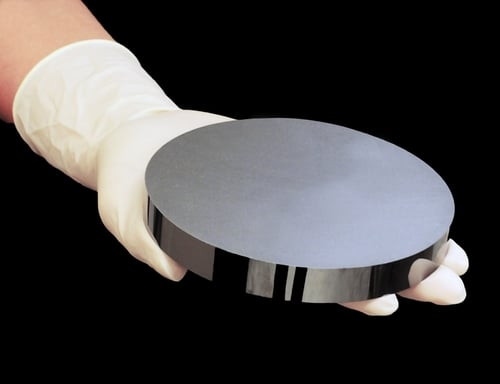
Under the agreement, LightPath will continue development of BlackDiamond materials and optical components for government applications. The company describes the material as a chalcogenide-based infrared glass intended to reduce reliance on germanium while supporting the spectral requirements of thermal-imaging and other infrared systems.
Germanium remains important across military infrared equipment because of its transmission characteristics, but its supply chain has become more difficult to treat as a routine materials issue. China is the dominant global supplier and introduced export controls in 2023, while US defence procurement policy is moving towards tighter restrictions on materials and optical systems sourced from covered countries.
That creates an engineering problem well before an existing material becomes unavailable. Infrared sights, targeting systems, surveillance equipment, and sensor payloads can remain in production or support for decades, and replacing an optical material inside a qualified system is not equivalent to substituting a standard commercial component.
Refractive index, thermal behaviour, transmission range, coatings, mechanical properties, and manufacturing methods all affect an optical design. Introducing a new material can therefore require lenses or assemblies to be redesigned and then subjected to environmental, optical, and production qualification before the revised equipment can enter service.
BlackDiamond is LightPath’s proprietary family of chalcogenide infrared glasses. The company manufactures the material in Orlando, Florida, and also produces lenses, optical assemblies, coatings, and infrared imaging systems. That vertical integration gives the CLEAR work an industrial route extending from glass production through component manufacture and into assemblies that can be supplied to system integrators.
The prototype agreement is significant because it funds material maturation rather than a feasibility study alone. The US prototype-acquisition framework is intended to develop and demonstrate new capability outside conventional procurement timelines. LightPath states that a competitively awarded prototype successfully completed under the relevant mechanism can be eligible for a follow-on production contract or transaction without another competition.
That provision does not constitute a production award. LightPath has not disclosed a future manufacturing quantity, platform, customer programme, or production value associated with BlackDiamond under CLEAR. The current work remains a prototype and qualification activity whose later commercial effect depends on technical performance and customer adoption.
The qualification cycle is particularly important for optics. Defence programmes cannot normally wait for an existing material route to fail before beginning redesign work. Coatings, lens geometry, environmental performance, mounting, and sensor calibration may all need to be reassessed when the optical material changes, particularly where the finished sensor is already qualified for an aircraft, vehicle, weapon, or surveillance installation.
Manufacturing scale presents another requirement. Demonstrating that chalcogenide glass can replace germanium in one optical design is different from supporting several programmes in series production. Material batches must remain consistent, polishing or moulding processes must hold repeatable tolerances, coatings have to perform reliably, and output needs to expand without undermining quality control.
LightPath says its Orlando operation has in-house capability to manufacture chalcogenide infrared glass, including BlackDiamond compositions, and can increase output by adding production furnaces. Its broader manufacturing footprint includes optical fabrication and thermal-imaging activities in the United States and Latvia.
That manufacturing control could matter if defence customers begin approving the material across multiple systems. EO/IR technology appears on aircraft, armoured vehicles, counter-UAS equipment, weapons, surveillance systems, and fixed installations, meaning dependence on a constrained optical material can affect otherwise unrelated programmes simultaneously.
Supply resilience is therefore the central industrial issue rather than a simple materials substitution. A replacement has to meet optical requirements, remain available over the equipment’s service life, and be manufactured in sufficient quantity for both new production and spares.
CLEAR moves that problem into a funded engineering programme with defined government involvement. LightPath still has to demonstrate that BlackDiamond can satisfy programme-specific performance and qualification requirements, but the prototype award gives the material a route towards adoption before germanium sourcing becomes a more acute constraint.