IN Brief:
- Rheinmetall’s Telford facility can dynamically test structures and assemblies weighing up to 40 tonnes.
- The equipment reproduces vertical movement, pitch, roll, vibration, and shock using controlled test profiles.
- Challenger 3 is the first major defence application, while the facility is also intended to support later programmes and other engineering sectors.
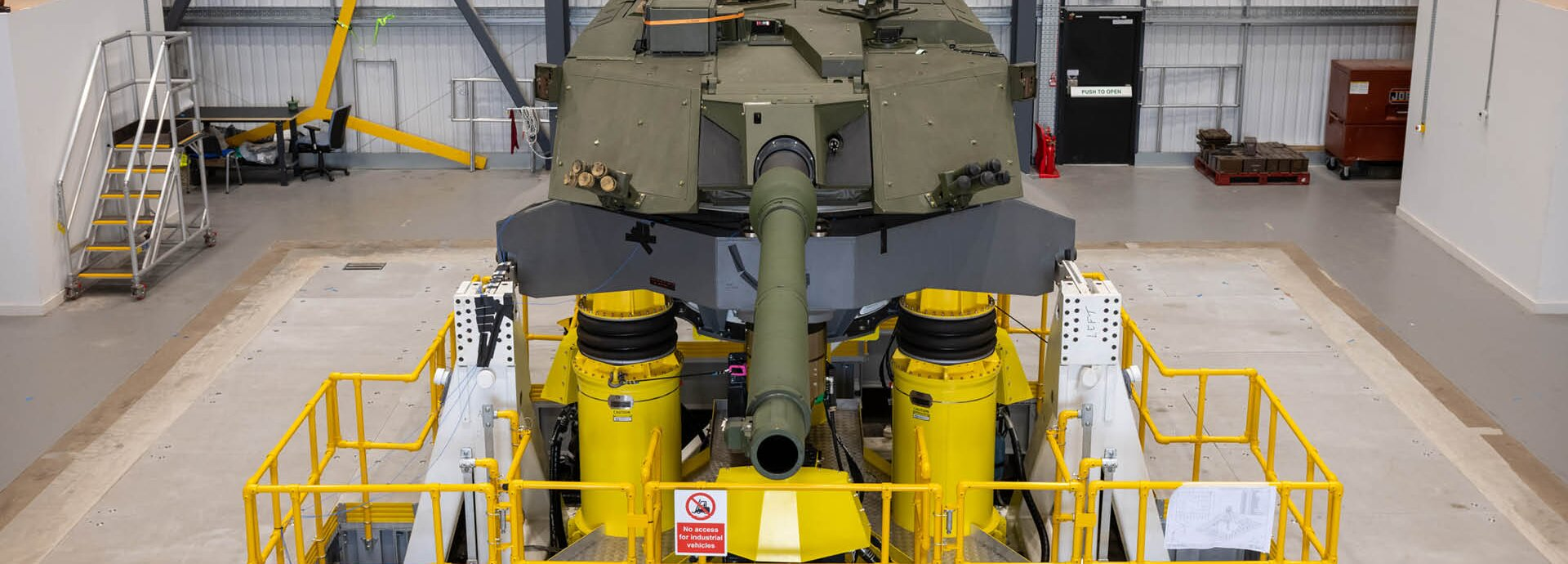
Rheinmetall has opened a large-scale vibration test facility at its Telford site, adding a UK engineering capability able to test structures and assemblies weighing up to 40 tonnes while supporting development of the British Army’s Challenger 3 main battle tank.
The Vibration Test Facility is designed to reproduce representative vibration, shock, and platform movement in controlled conditions. Rheinmetall says it can apply vertical motion, pitch, and roll, using operational data to build test profiles that allow engineers to examine reliability, identify weaknesses, and assess how complex structures or integrated subsystems respond over extended use.
Challenger 3 is the facility’s current major defence application. The programme is converting 148 Challenger 2 vehicles under an £800 million contract awarded to Rheinmetall BAE Systems Land in 2021, introducing a new turret, 120mm L55A1 smoothbore gun, revised sights, protection, and a more capable electronic and electrical architecture.
That level of modification creates an extensive assurance requirement because mechanical, electrical, and digital systems all have to tolerate the vibration and shock generated by a heavy tracked vehicle. Mountings, connectors, cable routes, electronic assemblies, and structural interfaces can all be exposed to repeated loads that may not create an immediate failure but can shorten service life if weaknesses go undetected.
The Telford installation gives engineers another route to build durability evidence without relying entirely on extended vehicle trials. Controlled dynamic testing cannot replace field trials, firing activity, or environmental qualification, but it can reproduce defined loading conditions repeatedly and allow instrumentation to record how structures, mountings, and subsystems respond.
Repeatability is particularly useful when engineers are investigating a specific weakness. A suspected component or mounting can be subjected to the same test profile before and after a design change, allowing the revised arrangement to be compared under controlled conditions rather than relying on two different field trials with varying surfaces, temperatures, and vehicle loads.
The capability becomes increasingly useful as a platform moves from prototype development towards a stable production standard. Heavy armoured vehicles combine armour structures, weapons, electronics, cooling, power distribution, sensors, and mechanical equipment within a tightly packaged architecture. A modest weakness in a bracket, connector, or cable route can become a fleet-scale problem if it is repeated across series production.
Rheinmetall says the VTF can support accelerated durability and reliability testing as well as representative shock and vibration profiles. Its 40-tonne capacity allows large structures, components, and integrated subsystems to be assessed rather than restricting work to small laboratory specimens. The company is consequently positioning the facility as a long-term UK engineering asset rather than equipment dedicated solely to Challenger 3.
The test work draws on mechanical and electrical engineering, instrumentation, software, and data analysis. Dynamic programmes depend on all of those disciplines: the mechanical rig must reproduce the required movement accurately, sensors must capture the response, control software has to execute and record the test, and engineers must determine whether the measured behaviour remains within the required limits.
The installation adds another specialist function to Telford’s place in the UK land-defence industrial base. RBSL’s Challenger 3 activity already ties the site to vehicle conversion, integration, and support. Bringing large-scale dynamic testing closer to engineering and manufacturing work can shorten the route between detecting a problem, modifying a design, and verifying the resulting change.
It can also reduce the logistical burden associated with moving heavy structures or complete assemblies between separate specialist facilities. A 40-tonne test capacity is large enough to accommodate equipment that would require significant lifting, transport planning, and preparation if the nearest suitable test installation were elsewhere in the country.
Rheinmetall is keeping the facility available for work beyond armoured vehicles. The company identifies potential applications in aerospace, automotive, rail, energy, and civil engineering, where large structures face similar questions around fatigue, vibration, and shock. Cross-sector utilisation could help maintain specialist test skills when individual defence programmes move between intensive development phases.
For Challenger 3, the facility arrives while qualification and production evidence are increasingly important. A vehicle intended for a long service life has to demonstrate that its systems can tolerate accumulated mechanical loading rather than simply perform on a single trial day. Dynamic testing adds another controlled source of data to that assurance process.
The practical value of Telford’s investment will lie in how quickly engineers can reproduce faults, verify design changes, and establish durability margins before later vehicles reach the same production stage. The 40-tonne rating defines the scale of the machinery; the engineering data generated by it will determine whether the facility reduces rework and improves repeatability across the programme.