IN Brief:
- Romania’s first K9 programme vehicles have arrived from South Korea ahead of the original early-2027 delivery schedule.
- The wider contract covers 54 K9 howitzers, 36 K10 ammunition vehicles, support equipment, and around 18,000 rounds of 155mm ammunition.
- Most K9 and K10 production is intended to move to Hanwha’s H-ACE Europe facility at Petrești.
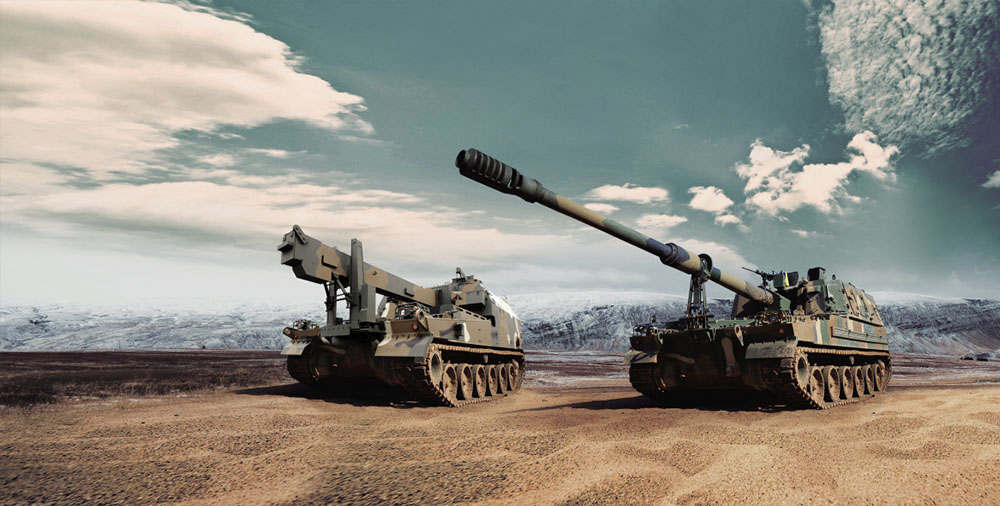
Romania has received the first vehicles under its K9 artillery programme from South Korea, moving the nearly $1 billion acquisition into delivery ahead of the original early-2027 timetable. The shipment includes K9 self-propelled howitzers and K10 ammunition resupply vehicles, while current delivery material also shows K12 recovery vehicles accompanying the first systems.
Romania’s July 2024 contract with Hanwha Aerospace covers 54 K9 howitzers, 36 K10 ammunition resupply vehicles, support equipment, and approximately 18,000 rounds of 155mm ammunition. Hanwha’s original public contract announcement did not separately identify K12 recovery vehicles, so their appearance in the initial shipment should be treated as part of the current delivery configuration rather than as a change to the publicly stated K9 and K10 quantities.
The first vehicles were built in South Korea while Romania prepares domestic production capability. Most of the programme is intended to move into Hanwha’s new Armoured Vehicle Centre of Excellence Europe, known as H-ACE Europe, at Petrești in Dâmbovița County. Ground was broken in February for the 181,055-square-metre site, which is planned to include assembly areas, validation facilities, laboratories, and a 1,751-metre driving test track.
Hanwha is targeting localisation of up to 80% through Romanian industrial participation and says it is already working with more than 30 Romanian companies. Moving towards that figure requires more than transferring final assembly. Armour structures, machined parts, running gear, wiring, hydraulic equipment, electronics, fabricated assemblies, coatings, and documentation need qualified suppliers capable of meeting controlled military specifications on repeated production batches.
The Korean-built vehicles provide a reference configuration for that transition. Romanian personnel can use the initial fleet to establish acceptance procedures, maintenance routines, ammunition handling, diagnostic practices, tooling requirements, and spare parts demand before locally produced vehicles begin emerging from Petrești. The same baseline gives inspectors a standard against which domestic structures, assemblies, and completed vehicles can later be compared.
Configuration control will become more demanding as the Romanian supply base expands. Locally produced parts need traceability, inspection records, and approved manufacturing processes, while any design change has to be reflected in Korean and Romanian production documentation. A supplier capable of producing a component dimensionally is not automatically qualified to supply it into a military vehicle if materials, welding procedures, coatings, heat treatment, or documentation do not match the approved specification.
The K9 is a 155mm/52-calibre tracked self-propelled howitzer, while the K10 is designed to replenish ammunition under operational conditions. The two vehicles are closely linked in sustained artillery operations because firing rate becomes constrained by ammunition movement once onboard stocks are depleted. Recovery vehicles add another support layer for a fleet of heavy tracked equipment that cannot rely on ordinary recovery assets when vehicles are immobilised.
Hanwha has also been expanding the K9 beyond its original gun configuration. Development work has connected the platform with new targeting, automation, wheeled derivatives, and data-led sustainment, while several export customers have coupled procurement with domestic production or industrial participation. Romania follows that pattern by taking initial systems from the established Korean line before shifting a substantial share of subsequent manufacture into the customer country.
Petrești will eventually be measured by repeatable output rather than the construction of the factory itself. Tracked vehicle production requires controlled welding, machining, metrology, torque management, calibrated tooling, software loading, inspection, functional checks, and driving trials, backed by enough engineers and technicians to maintain those processes as throughput increases. Supplier development and quality assurance therefore sit directly on the delivery schedule rather than alongside it.
The first vehicles give Romania equipment for evaluation and training while that industrial system is still being built. South Korean production has brought the programme into the delivery phase early; the next test is whether Romanian suppliers and the Petrești facility can reproduce, integrate, test, and support the same vehicle family as local content moves from contractual ambition into serial hardware.