IN Brief:
- Cambridge Aerospace plans to establish Japanese production of Skyhammer before offering the interceptor to Japan’s Ministry of Defense.
- Skyhammer has a stated 30km range and 700km/h maximum speed and is already under UK Ministry of Defence contract.
- Japanese localisation would add another production base as Cambridge Aerospace targets output of 2,500 interceptors a month by early 2027.
Cambridge Aerospace plans to establish production of its Skyhammer interceptor in Japan as the British defence company extends a manufacturing programme already supplying the UK Ministry of Defence. The company intends to manufacture the interceptor locally before offering it to Japan’s Ministry of Defense, combining an export proposal with domestic industrial participation rather than relying solely on shipments from Britain.
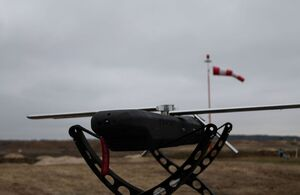
Skyhammer is designed to engage Shahed-type attack drones and other relatively slow aerial threats without consuming surface-to-air missiles intended for more demanding targets. The system has a stated range of 30km and a maximum speed of 700km/h, with a turbojet propulsion system and autonomous interception architecture. Japanese reporting puts the intended unit price at several million yen, although no Japanese procurement decision has been announced.
Cambridge Aerospace has also been developing cooperation with Kawasaki Heavy Industries around Japanese manufacturing capability. Local production would require drawings, software baselines, test procedures, approved suppliers, acceptance standards, and controlled engineering changes to remain consistent with the British production line. Japanese defence procurement increasingly combines equipment acquisition with national sustainment and industrial participation, particularly where a system may require continued production, upgrades, and support over several years.
Skyhammer moved from development into government testing and procurement during 2026. The UK Ministry of Defence announced its intention to acquire the interceptor in April, with an initial delivery planned for May, before the system completed further trials in Jordan. The British package includes missiles, launchers, integration, technical support, and end-user training, creating a support structure around the weapon rather than treating it as a standalone munition purchase.
Production volume has become the next constraint. Cambridge Aerospace raised $300 million in August to expand interceptor manufacturing and is targeting output of 2,500 Skyhammer units a month by the end of the first quarter of 2027. Reaching that rate requires propulsion systems, seekers, electronics, airframe structures, launch equipment, and test capacity to arrive in consistent quantities while engineering changes continue to move through the programme.
A Japanese line would add capacity but also introduce another configuration control problem. Components manufactured in Japan need to remain interchangeable with hardware produced elsewhere, while software and acceptance procedures have to follow the same approved baseline. A change to a seeker, motor, connector, control surface, or processor can affect purchasing, test equipment, documentation, and maintenance across both production systems if it is not controlled centrally.
Counter-UAS procurement is also exposing the economics of air defence inventories. Conventional air defence missiles remain necessary against aircraft, cruise missiles, and other demanding threats, but repeated use against inexpensive one-way attack drones can consume magazines faster than they can be replenished. Skyhammer is intended to occupy the space between shorter-range gun or electronic warfare systems and substantially more expensive guided missiles, placing production cost and replenishment rate alongside range and interception performance as core programme measures.
Japan presents a demanding environment for that model. Dispersed bases, ports, radar sites, ammunition infrastructure, and other fixed assets create a broad protection requirement, while the country’s geography places additional emphasis on mobile systems that can be integrated with existing sensors and command networks. Local manufacture could also provide Japanese industry with a role in maintenance and future changes, although national trials, contracting, safety certification, and integration work would have to precede any substantial production commitment.
The Japanese proposal therefore extends the industrial model behind Skyhammer rather than simply creating another export territory. Cambridge Aerospace is moving from contracted UK production towards a distributed manufacturing structure while attempting to retain the cost and output characteristics on which the interceptor is marketed. Establishing a second line will test whether those manufacturing controls can travel with the product as readily as the missile itself.