IN Brief:
- EOS plans to manufacture the new generation of Slinger at Huntsville, Alabama, from 2027.
- The revised system will add enhanced sensing and selectable autonomy while retaining stabilised firing while moving.
- Current Slinger combines a 30mm cannon, radar, optical sensing and EOS stabilisation technology in a system weighing less than 400kg.
EOS Defense Systems USA plans to manufacture a new generation of its Slinger counter-UAS remote weapon system at Huntsville, Alabama, from 2027, combining a change in production geography with additional sensing and selectable autonomy. The product is in the final stages of development, with EOS aiming to add those functions without losing the mobility and relatively low mass of the current system.
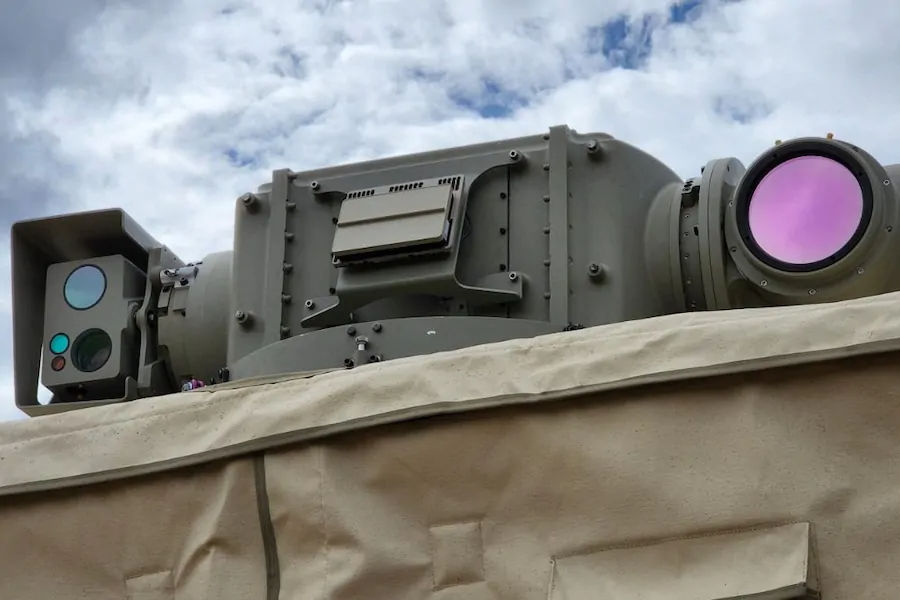
Slinger is derived from the company’s R400 remote weapon station and currently combines a 30mm Bushmaster M230LF cannon, radar, optical sensing and EOS pointing and stabilisation technology in a package weighing less than 400kg. That mass allows installation on vehicles unable to accommodate a substantially heavier turret, making weight control central to any redesign.
Maintaining that relatively low mass is only part of the challenge because the existing system also has to stabilise the weapon while the host vehicle moves. Suspension movement, steering input and uneven terrain continually disturb the mount, so the sight and weapon drive have to correct fast enough to maintain alignment with a small moving target rather than relying on the vehicle to stop before every engagement.
Counter drone missions make the control problem more demanding because the target is also moving in three dimensions and may present only a small radar or visual signature. The current Slinger uses an Echodyne electronically scanned radar and a sighting system with four axes, allowing the sensor unit to move independently of the cannon in elevation and azimuth.
The new version will add enhanced sensing and selectable autonomy on top of that architecture, allowing operators to choose how much of the sequence from detection through tracking and engagement support is automated. EOS has not defined the precise authority boundaries for those modes, so the final balance between automatic processing and operator decision making remains part of the development work.
Those choices become increasingly consequential when several small drones approach together because engagement windows can be measured in seconds. Software can maintain several tracks continuously and present priority threats faster than one operator could assess them manually, but faster processing only improves the engagement if the sensor inputs being processed are reliable.
A classification error or inaccurate track early in the chain can propagate into a poor recommendation later, which means the revised system still depends heavily on the quality of radar and optical data. Slinger can also receive cueing from a wider air defence network, allowing the weapon station to begin orienting towards a target before its own sensors acquire the track independently.
Bringing additional sensing and computing into the same mount puts pressure on the weight, power and thermal margins that make the current system suitable for comparatively light vehicles. EOS also intends the new version to switch between aerial and ground targets without physical reconfiguration, so new electronics have to be incorporated without eroding mobility or increasing integration demands beyond what the host vehicle can support.
The planned move to Huntsville production places an industrial deadline around that technical work because the manufacturing configuration has to stabilise in time for production from 2027. EOS already manufactures remote weapon systems in Alabama and has received US contracts for Army equipment and Slinger systems used in Northrop Grumman counter drone work, providing an established factory base rather than requiring a new production system from zero.
That existing base can shorten industrial preparation, but the revised product still needs controlled assembly instructions, software baselines, test procedures and supplier inputs that match the final configuration. Changes made late in development can affect tooling or acceptance work, so the schedule for production depends on engineering and manufacturing teams converging on a stable design early enough for repeatable output.
Earlier Slinger production has also taken place in Australia, meaning the US line creates another manufacturing route rather than replacing every existing location. Local US manufacture may shorten some transport and support chains, although EOS has not disclosed the domestic content or annual production target for the revised system.
While the Huntsville programme progresses, separate Australian development continues through Mission Syracuse, where an R400 Slinger prototype is being developed for local counter drone requirements. The US system should not be assumed to be identical because the Huntsville work specifically centres on the revised sensing and autonomy package and will develop against US customer requirements.
By the time production begins, EOS will have to show that the additional electronics and software can be integrated without compromising the characteristics that made the existing Slinger suitable for mobile platforms. Accuracy while moving, manageable system mass, reliable sensing and clear operator control all have to survive the redesign if the new generation is to preserve the operational role of the current system.