IN Brief:
- Shogei is the seventh Taigei-class submarine and has a standard displacement of approximately 3,000 tonnes.
- Mitsubishi Heavy Industries will complete the vessel’s machinery, electrical, hull-system and weapons outfitting at Kobe.
- Delivery to Japan’s Ministry of Defense is planned for the financial year ending March 2028.
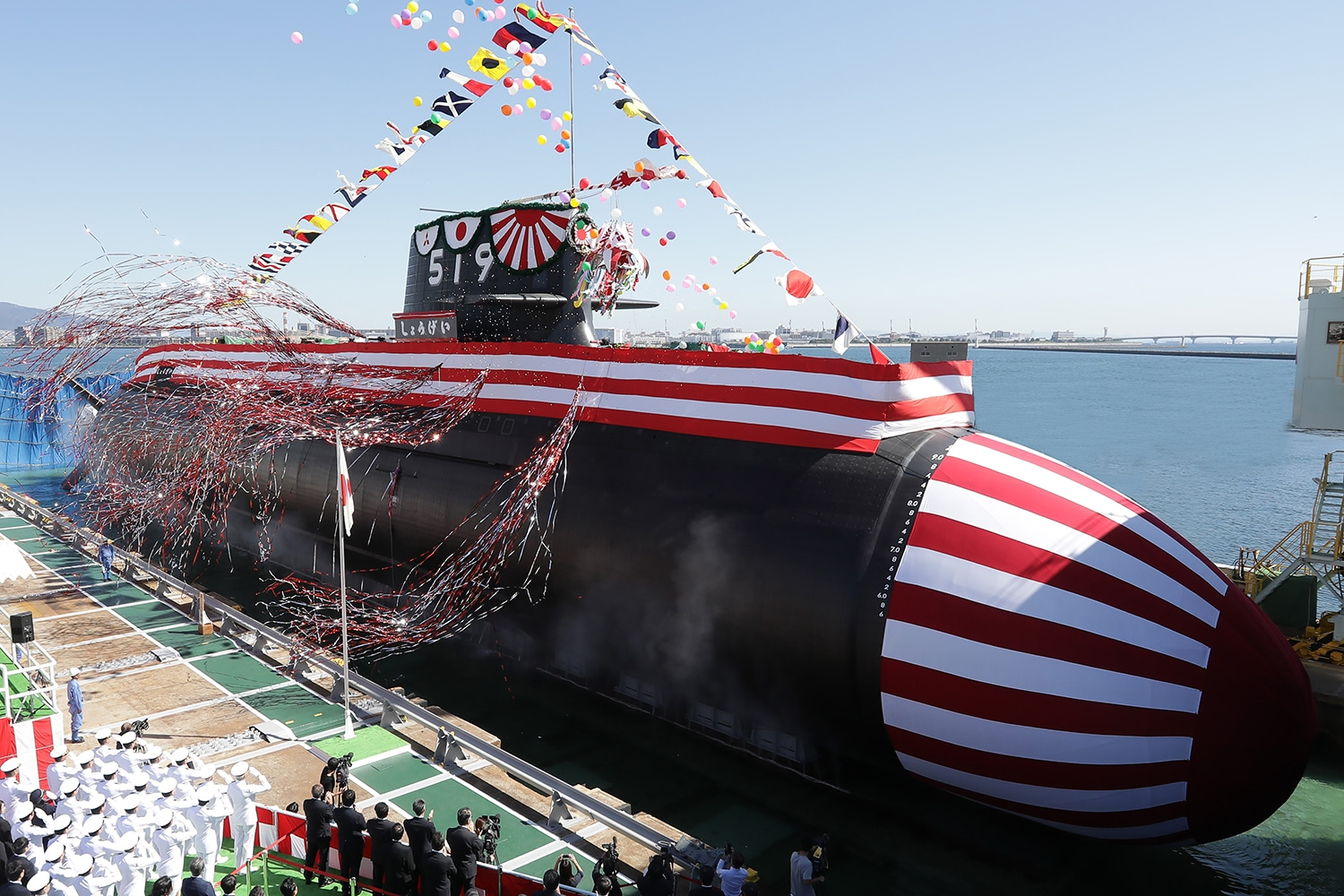
Mitsubishi Heavy Industries has launched Japan’s seventh Taigei-class submarine at Kobe. Named Shogei, the conventionally powered vessel entered the water during a ceremony on 8 October 2026, moving the latest addition to the Japan Maritime Self-Defense Force’s submarine fleet into its outfitting phase. The 3,000-tonne submarine will undergo further work on its machinery, electrical equipment, hull systems and weapons before delivery during Japan’s 2027 financial year, which ends in March 2028.
The naming and launching ceremony took place at Mitsubishi’s Kobe Shipyard in Hyogo Prefecture, where the manufacturer has an established submarine construction operation. Shogei is the seventh vessel in a class designed to replace Japan’s older Soryu-class submarines progressively, combining diesel-electric propulsion with lithium-ion energy storage, improved detection equipment and measures intended to reduce acoustic signatures. The programme is shared between Mitsubishi Heavy Industries and Kawasaki Heavy Industries, with successive submarines moving through construction, outfitting and delivery at their respective Kobe facilities.
Shogei is approximately 84 metres long, with a beam of about 9.1 metres and accommodation for roughly 70 personnel. Its reported construction cost is approximately ¥80.5 billion. Although the dimensions are broadly consistent with preceding Taigei-class boats, the class incorporates substantial changes beneath the hull, particularly in its electrical power arrangements. These systems determine how much energy is available for submerged propulsion and onboard equipment, while placing demanding requirements on charging, thermal management and the integration of the ship’s electrical distribution network.
Unlike a nuclear-powered submarine, a diesel-electric vessel relies on stored electrical energy when operating submerged without using its diesel engines. Lithium-ion batteries offer greater energy density and can support higher discharge rates than conventional lead-acid systems, allowing the available electrical capacity to be used across propulsion and other onboard loads. The arrangement also requires control of battery temperature, electrical isolation and operating conditions over repeated charging cycles. Japan began introducing lithium-ion batteries with the final Soryu-class vessels before adopting them throughout the Taigei programme.
The newer Taigei boats also incorporate Kawasaki’s 12V25/31 diesel engine, first introduced in the fourth submarine, Raigei. The engine and associated snorkel arrangement were developed to improve power generation and battery charging performance. Diesel machinery remains important even though the submarine’s submerged propulsion uses electrical power, because replenishing stored energy is essential to sustaining operations. The overall balance between generation capacity, battery storage and electrical demand consequently influences the vessel’s operating cycle and the engineering systems installed during construction.
Alongside the electrical and propulsion changes, Japan has specified improvements to underwater detection and acoustic signature management. Detecting other vessels depends on the interaction between sonar sensors, signal processing and the acoustic conditions surrounding the submarine, while reducing machinery vibration and transmitted noise can make the vessel harder to locate. Detailed performance figures for Shogei’s sensors, acoustic signature and submerged endurance have not been publicly disclosed, preventing a quantitative comparison with earlier vessels.
With Shogei now launched, Mitsubishi must complete the remaining integration work inside a tightly constrained hull. Machinery installation, cable routing, electrical distribution, fluid systems and weapons equipment have to coexist with watertight structures, crew accommodation and the systems needed to maintain safe operation underwater. Individual components may be qualified before installation, but the completed submarine must also function as an integrated vessel. Its electrical, mechanical and combat systems therefore require further testing and acceptance work before the Ministry of Defense can take delivery.
Moving a vessel into the water establishes a significant structural and production milestone, but does not establish that its propulsion machinery, combat systems or operating systems have completed acceptance testing. Harbour trials and subsequent sea trials provide opportunities to assess the integrated equipment under progressively more demanding conditions. Mitsubishi has confirmed the delivery period without publishing a detailed trial schedule for Shogei. With much of the remaining integration work concealed inside the pressure hull, launching a submarine still leaves a substantial programme of trials before commissioning.
The overlapping launch and handover sequence at Mitsubishi and Kawasaki has kept successive Taigei hulls moving through construction, outfitting and acceptance. Mitsubishi delivered the fifth boat, Chogei, in March 2026 after launching it in October 2024, while Kawasaki launched the sixth, Sogei, in October 2025. Shogei continues that production sequence, providing another example of the overlapping construction and integration work required to maintain a submarine construction programme. Each boat remains a substantial engineering project even where the underlying design, major suppliers and construction methods have already been established.
As the remaining systems are integrated, the shipbuilder’s responsibility extends beyond initial construction to equipment support over the vessel’s service life. The company has identified reduced crew requirements, cybersecurity and lifecycle costs as considerations in future naval development, alongside improvements in conventional submarine capability. Those objectives place continuing demands on system integration and maintainability, because equipment installed during construction must remain accessible for inspection, replacement and upgrades throughout the submarine’s operational life. The immediate programme milestone for Shogei remains completion of outfitting and the acceptance process ahead of its planned delivery by March 2028.