IN Brief:
- Astrolight reports that its ATLAS-1 terminal aboard ERMIS-3 has entered routine customer operations.
- The satellite communicates autonomously with Greece’s Holomondas Optical Ground Station at a reported data rate of 1 Gbps.
- Two daily optical links mark a new operational phase following the ground station’s commissioning earlier in 2026.
Lithuanian space and defence technology company Astrolight has begun routine customer operations using its ATLAS-1 laser communications terminal aboard the Greek ERMIS-3 satellite. The terminal is establishing autonomous optical connections with the Holomondas ground station in Greece, delivering a reported data rate of 1 Gbps during scheduled communications opportunities. Two links are being conducted daily, marking the transition from completed ground infrastructure and planned orbital demonstrations to an operational satellite-to-Earth communications service.
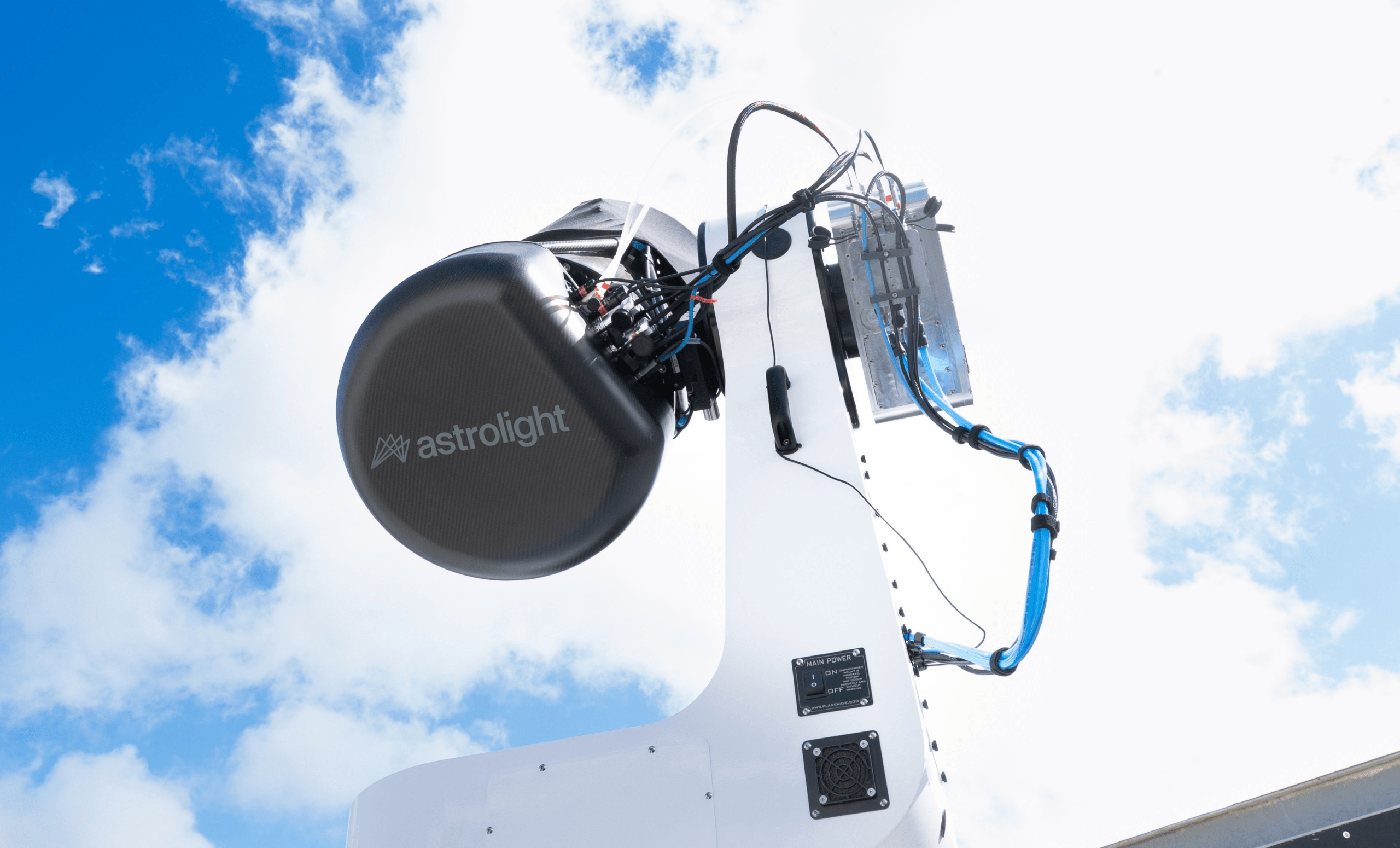
The development follows the commissioning of the Holomondas Optical Ground Station earlier in 2026 under the European Space Agency’s Greek Connectivity Programme. Developed with the Aristotle University of Thessaloniki and supported by the Greek Ministry of Digital Governance, the installation provides the terrestrial equipment needed to receive laser transmissions from spacecraft in low Earth orbit. Astrolight supplied the optical communications hardware for the ground station and the ATLAS-1 terminals carried aboard ERMIS-3 and the separate PeakSat mission, allowing the principal elements of the communications link to be developed as an integrated system.
Launched on 30 March 2026, ERMIS-3 carries the ATLAS-1 terminal as part of a wider Greek CubeSat programme supporting orbital communications demonstrations. The spacecraft was developed through a consortium led by the National and Kapodistrian University of Athens and carries an optical communications payload alongside equipment intended for Earth observation applications. Its mission includes assessing high-capacity laser communications between a compact spacecraft and ground infrastructure, with particular attention to acquisition, pointing, tracking and reliable data transfer under orbital operating conditions. The reported introduction of routine links now provides evidence of the system operating beyond the initial preparation and commissioning of the ground station.
Establishing an optical connection requires the spacecraft terminal and ground station to direct their equipment towards each other with considerably greater angular precision than is typically needed for a broad radio-frequency transmission. The satellite moves rapidly across the sky during a ground-station pass, continually changing the direction of the optical path. The communications system must acquire the other terminal, align the transmitted and received beams and maintain tracking as the relative geometry changes. These functions place demands on the pointing hardware, control software and the coordination between the spacecraft and terrestrial equipment.
The Holomondas installation uses an 808-nanometre laser beacon and a compatible optical receiver operating in the telecommunications C-band. The beacon assists the pointing and acquisition process, while the receiving equipment processes the optical signal carrying data from the satellite. Astrolight designed the ground infrastructure to support communications speeds of up to 2.5 Gbps, but that figure describes the station’s stated capability rather than the operational data rate now reported for ERMIS-3. The current service milestone is 1 Gbps, and the two figures should therefore remain distinct when assessing the demonstrated performance.
Autonomous operation adds another requirement to the optical system because communications opportunities must be established during relatively short satellite passes. The spacecraft and ground equipment need to perform the relevant pointing, acquisition and communications functions without requiring an operator to intervene manually throughout every contact. Control software must coordinate the timing of the connection and the mechanical and optical systems used to establish it. The availability of two daily contacts demonstrates a recurring operating schedule, although it does not establish uninterrupted communications coverage or quantify the duration and data volume of each session.
Cloud and atmospheric variations can interrupt an optical path even after the spacecraft and ground receiver have acquired one another. Clouds can obstruct the optical path, while variations in the atmosphere may affect the received signal and the stability of the communications link. Weather conditions, the satellite’s elevation above the horizon and the performance of the tracking equipment can all influence a particular contact. During the reported trial sequence, the team recorded link availability above 85% for passes at elevations above 15 degrees. That figure applies to the specified passes and does not establish year-round availability or quantify interruptions caused by weather.
The spacecraft’s restrictions on mass, power and internal volume make the size and electrical demands of ATLAS-1 important to its integration. Spacecraft have restricted allowances for payload mass, electrical power and physical volume, making it necessary to balance communications capability against the resources available to other onboard systems. Optical transmission can provide high data rates using relatively narrow beams, potentially allowing sizeable imaging or scientific datasets to be transferred during short contacts. The approach nevertheless requires accurate alignment and suitable ground conditions, so its advantages cannot be assessed from data rate alone.
Astrolight’s provision of both the space terminal and ground equipment has allowed the project partners to coordinate the optical interfaces and associated control functions across the communications chain. Such integration reduces the number of separate hardware interfaces that must be developed independently, although it does not remove the need for verification of complete system operation. The transition to customer operations introduces additional requirements associated with scheduling, monitoring equipment performance and maintaining a repeatable service. The announced link frequency and data rate provide initial operational parameters, while availability and reliability over time will require accumulated service evidence.
The same optical communications architecture may have government and defence applications where spacecraft need narrow-beam, high-throughput links, although ERMIS-3 itself is not identified as a military deployment. Narrow optical beams can make interception and some forms of interference more difficult, although they do not eliminate every communications or cybersecurity risk. ERMIS-3 itself remains a Greek technology demonstration and communications mission rather than a confirmed military deployment. Its operational achievement lies in demonstrating the use of Astrolight’s onboard terminal and Greek ground infrastructure as a functioning communications service, with further performance data needed to establish how consistently the system operates across different conditions.