IN Brief:
- The R1810 uses eight antenna subarrays per panel, compared with four on SRC’s R1540 radar.
- SRC specifies detection up to 21.6km for Group 1 drones and 49.4km for Group 3 drones.
- The radar is designed to track aerial targets and outgoing munitions during Raid Hunter engagements.
US defence research and development company SRC has developed the Gryphon R1810 radar for Northrop Grumman’s Raid Hunter system, a gun-based air defence architecture designed to protect military locations against aerial threats, including coordinated drone attacks. SRC announced the development on 8 October 2026.
Raid Hunter combines networked control, Bushmaster Chain Gun technology and guided 50mm ammunition. Its radar is required to detect and track incoming objects and support the precision information needed by the weapon system during an engagement. SRC says the R1810 can track both targets and the munitions fired against them.
This dual tracking function distinguishes a precision fire-control application from wider-area surveillance alone. A radar may detect an object at distance, but a weapon engagement demands more precise and more frequently updated information about its movement. Tracking a round after firing can help the connected system maintain information about the engagement.
The R1810 builds on SRC’s Gryphon R1540 technology rather than introducing a wholly unrelated radar architecture. SRC says it uses the same core electronics and antenna array modules as the earlier model, with eight antenna subarrays per panel instead of four. The expanded aperture is intended to provide greater range and accuracy.
For Group 1 unmanned aircraft, SRC quotes detection distances of up to 21.6 kilometres for the R1810 and 12.7 kilometres for the R1540. For Group 3 systems, the corresponding figures are 49.4 kilometres and 30.2 kilometres. These are manufacturer-stated detection figures, not verified weapon engagement distances.
Actual performance depends on operating conditions, target characteristics, sensor installation and the wider system. Drone size, altitude and flight path can affect whether and when radar returns become usable. A detection at a stated distance does not by itself establish that a connected weapon can engage the target successfully.
The company describes a single-panel R1810 configuration that can be paired with a turreted weapon. That arrangement is intended to support target and munition tracking during an engagement. SRC also identifies a four-panel version for 360-degree surveillance where broader coverage is required.
These configurations impose different installation demands. A radar located near a turret may need to account for restricted space, vibration, available electrical power and the thermal environment. A four-panel installation requires sufficient mounting locations and appropriate orientation to avoid coverage gaps.
SRC says the R1810 is intended for a more demanding precision fire-control requirement than its smaller predecessor. Retaining core electronics may help reduce development risk and support manufacturing continuity, but a larger antenna still requires its own integration and qualification work.
High-volume attacks can strain a defensive system because several objects may need to be tracked at once. The radar must generate and update useful information, but the number of simultaneous engagements is ultimately constrained by the connected command system, weapon and available ammunition. Radar capability should not be confused with complete system engagement capacity.
There is also a distinction between classification and positive identification. Different sensing methods may contribute information about what a tracked object is. A radar track can support an engagement decision without independently answering every operational question about the nature or intent of the object.
SRC does not disclose a contract value, planned order quantity or delivery timetable for R1810 production in the October announcement. The release confirms that the company developed the radar for Northrop Grumman’s system; it does not demonstrate completion of all operational testing or field deployment.
The development is separate from SRC’s earlier Domestic Shield radar contract, announced on 6 October, which concerns another programme and should not be conflated with the Raid Hunter technical announcement. This distinction is important for maintaining accurate reporting of individual procurements and product developments.
Further system-level testing will determine how the R1810’s stated detection and tracking capabilities translate into a complete gun-based counter-drone engagement sequence. The current milestone is a new radar configuration intended to support that sequence while drawing on SRC’s established Gryphon components.
The published figures refer to detection of specified drone groups and should remain attributed to SRC. Reporting them without the target categories or describing them as tested interception ranges would misrepresent the company’s announcement. SRC also does not quantify the new radar’s cost, cooling power or field-maintenance requirements. The product is a radar subsystem, so the performance of the wider Raid Hunter architecture remains dependent on integration with Northrop Grumman’s command and weapon equipment, followed by relevant end-to-end testing before operational claims can be established.
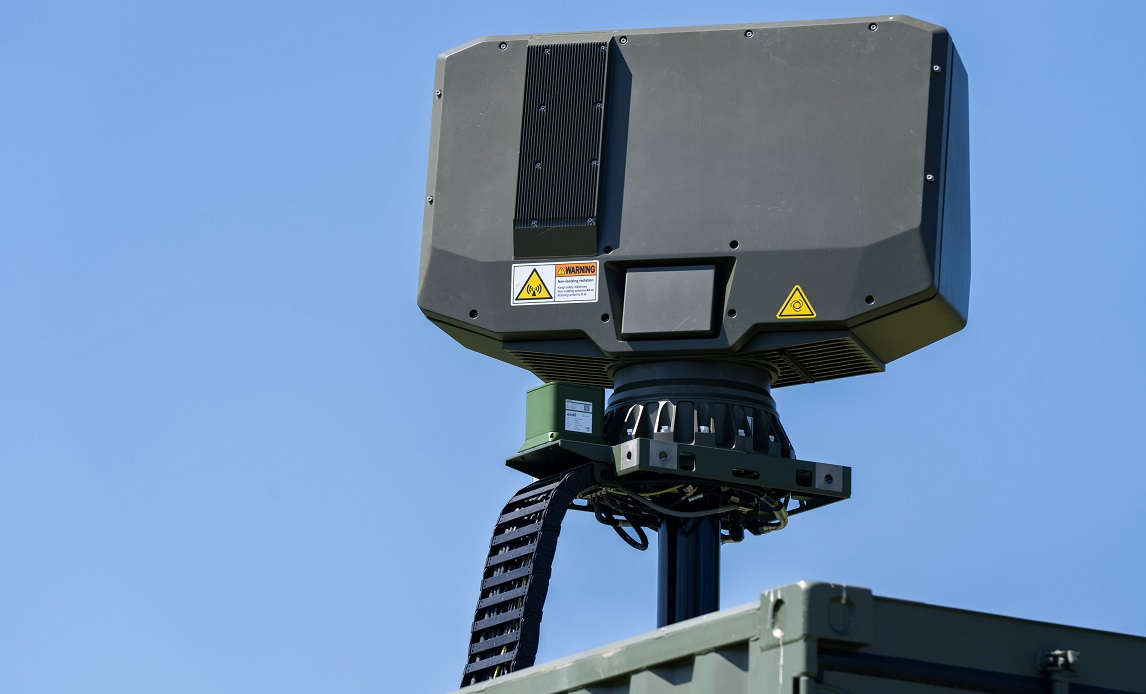
Featured image: Weibel XENTA-M5 radar (illustrative), not SRC Gryphon R1810.