IN Brief:
- The Pentagon selected Somewear Labs to advance resilient networking for the Multi-Domain Collaborative Autonomy programme and other uncrewed platforms.
- The development includes secure satellite links and adaptive software capable of moving mission data across different networks.
- The company has not disclosed the award value or a deployment timetable for the expanded system.
Somewear Labs has received a Pentagon award to expand resilient communications for uncrewed systems, extending its networking hardware and software to a wider range of military platforms and missions. The company announced the selection on 8 October, identifying the Multi-Domain Collaborative Autonomy programme among the intended applications.
The work includes secure satellite communications and software able to direct mission information over different available networks. The objective is to preserve essential data exchange when individual links degrade, a problem that becomes increasingly difficult as military aircraft, ground vehicles and maritime platforms operate at greater distances from their controllers.
Somewear has not disclosed the contract value, the number of equipment sets involved or a schedule for qualification and fielding under the latest award. Its announcement establishes a funded development direction rather than demonstrating that the expanded capability has completed every integration and acceptance stage.
Uncrewed systems depend on more than navigation and vehicle autonomy. Operators may need to transmit new mission instructions, receive telemetry and assess the condition of onboard equipment while platforms travel beyond reliable line-of-sight radio coverage. Different types of data place different demands on bandwidth, latency and reliability.
Video, for example, can consume much more capacity than a position report or control command. A communications architecture operating over narrowband links cannot assume that all information can be transmitted at the same rate as over a high-capacity connection. Software must make decisions about what information to retain, prioritise or delay.
Somewear’s architecture is intended to connect platforms across heterogeneous networks rather than rely on one communications bearer. In practical terms, a system may be able to use terrestrial radio under favourable conditions and another available path, such as satellite communications, when direct connectivity becomes unreliable or unavailable.
Switching between links is not simply a matter of selecting whichever signal appears strongest. Applications must continue to address the correct endpoints, preserve appropriate access controls and tolerate interruptions or changes in available throughput. Some messages may have strict timing requirements, while others can be stored temporarily and forwarded when connectivity improves.
The company describes its Horizon product as a multi-network radio for attritable uncrewed operations, supporting both line-of-sight and beyond-line-of-sight command and control. Attritable platforms are intended to be fielded with a different cost and replacement model from expensive, long-life aircraft, making the cost, size, weight and power demands of communications equipment important design variables.
Equipment for a small drone may have little spare electrical capacity and limited room for antennas or protective enclosures. Adding multiple radios can increase payload mass and affect endurance. A practical networking package must therefore balance its potential coverage and resilience against the airframe’s power and installation constraints.
Somewear says its software-defined architecture is designed for integration with existing command and autonomy tools. This could reduce the need for a platform manufacturer to redesign its ground-control station or embedded software each time a new communications transport is introduced. The actual engineering effort will still depend on the interfaces provided by each vehicle and its control system.
Cybersecurity is another part of the integration challenge. Moving information over multiple communications paths requires management of identity, authentication, encryption and the authority to issue commands. A system that keeps an uncrewed vehicle reachable during disruption must also protect against unauthorised control and unsuitable routing of sensitive mission data.
James Kubik, Somewear’s co-founder and chief executive, said the company is developing the network architecture alongside manufacturers to support changing missions and communications conditions. The announcement refers to integration, testing and refinement with uncrewed-system manufacturers, but does not name the platforms covered by the new award.
That absence matters when assessing the maturity of the programme. Integration demonstrated on one platform does not automatically establish compatibility across vehicles with different onboard networks, antennas or mission software. Wider deployment will require testing against representative hardware, link conditions and operator workflows.
The award is therefore a development in the industrial architecture surrounding autonomous platforms. Increasing the number of uncrewed vehicles in service creates a parallel requirement for communications that can be deployed and supported at comparable scale. Connectivity hardware, integration effort and secure network management become part of the total system cost.
Further meaningful evidence will come from the scope of platform integrations, tested performance under degraded links and any subsequent procurement decisions. The confirmed October step is Pentagon support for expanding Somewear’s resilient networking technology beyond its existing configurations.
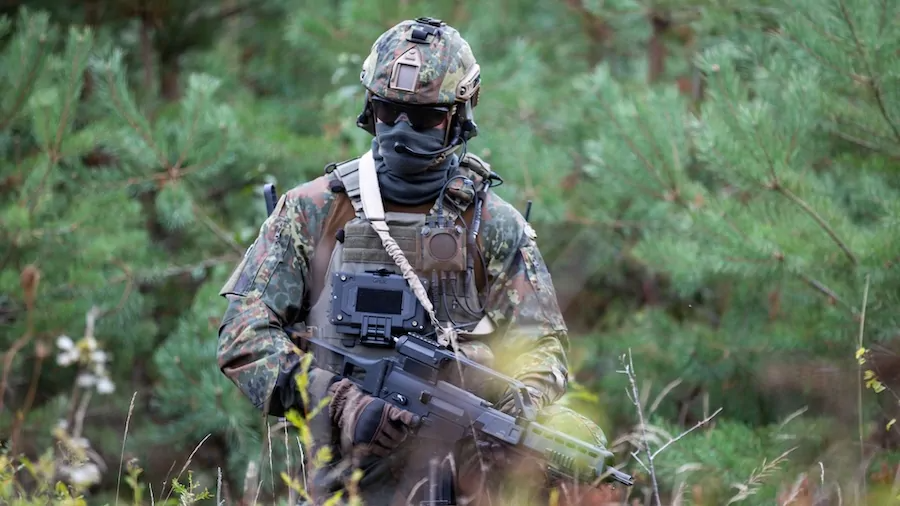
Featured image: Rheinmetall digital soldier systems (illustrative), not Somewear Labs hardware.