IN Brief:
- Australia has disclosed mine, logistics and uncrewed aircraft payloads for Ghost Shark.
- A towed-array sonar configuration has also been announced for BlueBottle.
- AUKUS partners will evaluate selected payloads during Maritime Big Play Pacific.
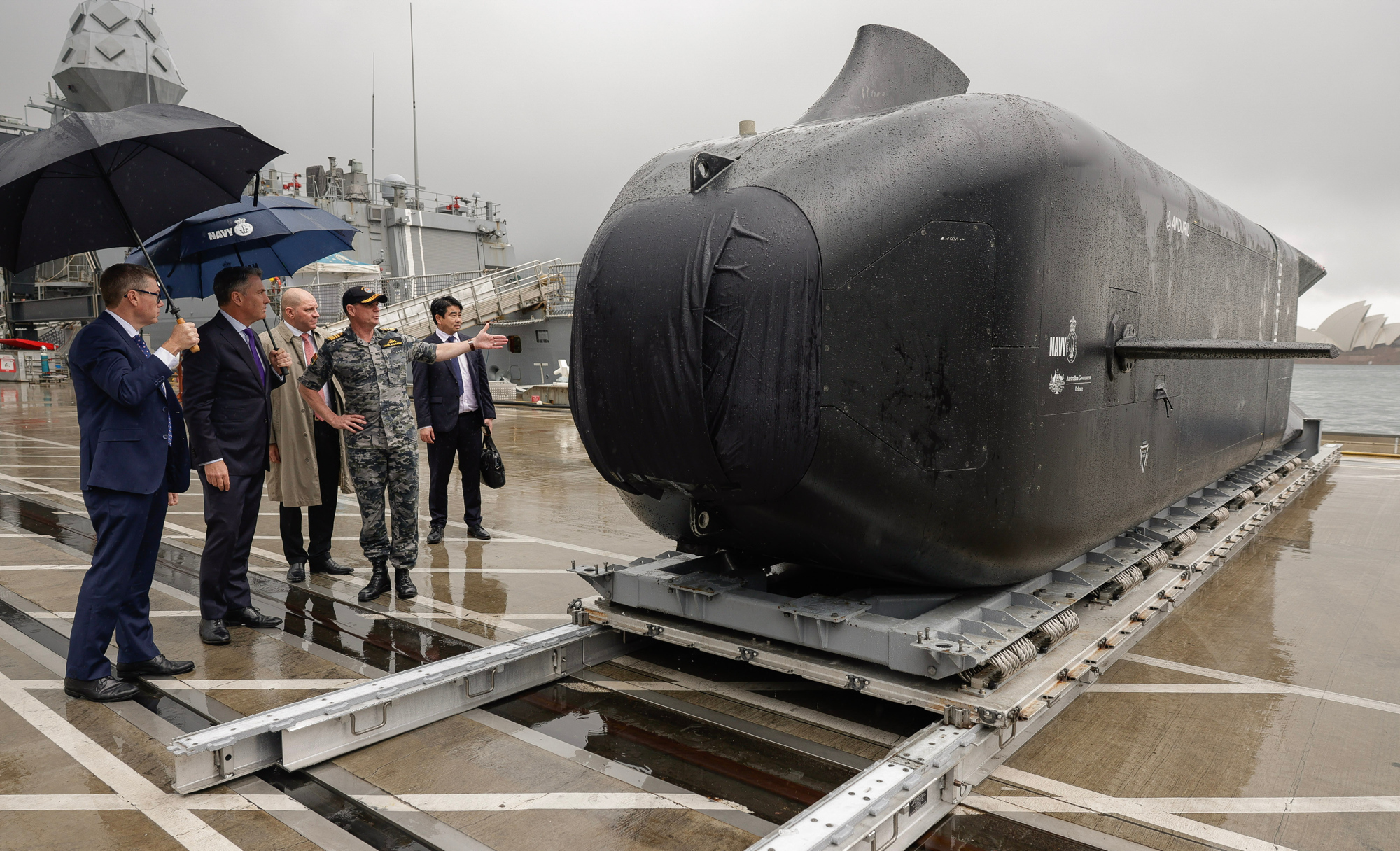
Australia has disclosed new mission equipment being integrated with its Ghost Shark and Speartooth uncrewed underwater vehicles and the BlueBottle surface craft. The changes extend the equipment these vessels are being developed to carry rather than establishing an operationally qualified fleet configuration. The announcement covers naval mines, supply caches and launched uncrewed aircraft, while a thin-line towed-array sonar has been identified for BlueBottle. Some of the equipment is expected to participate in Maritime Big Play Pacific, an AUKUS Pillar II exercise in San Diego during the week of 19 October.
The latest development builds on the Anduril Australia Ghost Shark programme, which moved from co-development into a A$1.7 billion fleet acquisition in September 2025. That contract supports delivery, maintenance and continuing development over five years. The government has allocated up to A$5.8 billion during the decade to autonomous and uncrewed undersea capabilities, a broader programme figure which should not be confused with the narrower Ghost Shark contract.
Ghost Shark is an extra-large autonomous underwater vehicle designed to carry mission equipment over long distances. Defence Industry Minister Pat Conroy identified three payload groups being disclosed for the platform: sea mines, underwater logistics caches and ALTIUS uncrewed aerial vehicles. The minister said the system could carry up to 12 sea mines in a stated configuration and described the ability to launch multiple ALTIUS aircraft. Those are ministerial descriptions of intended or developed capability, not publicly released evidence of every configuration having completed fleet qualification.
The logistics cache is an especially distinct engineering development. Australia’s Defence Science and Technology Group worked on an underwater payload that allows equipment and supplies to be placed beneath the surface and retrieved later. Integrating a subsea cache requires secure carriage and release, control of the deployment location and appropriate protection of the stored equipment against seawater and pressure; the specific Australian release mechanism has not been published. Public information does not specify its storage duration, recovery interface, supported payload mass or production quantity, and those characteristics cannot responsibly be inferred from the mission description.
Aircraft deployment imposes a different integration problem. An underwater vehicle must carry the aerial system and provide a way to release it into an environment where its propulsion and control surfaces can function. The disclosed ALTIUS concept extends the types of missions that could be initiated from an uncrewed undersea platform, including reconnaissance and strike. Australia has not published detailed launch-sequence data, the number of vehicles qualified to carry the launcher, or operational performance results for the configuration announced this week.
The disclosure also covers Speartooth, another Australian uncrewed underwater vehicle, without giving a platform-by-platform inventory of all new payloads. Common payload development does not automatically make equipment interchangeable among vehicles with different dimensions, power architectures and operating profiles. Mechanical mounting, power supply, communications and software integration still have to be validated against the handling limits and operating profile of each platform.
On the surface, BlueBottle is being developed with a thin-line towed-array sonar intended to detect submarines. A towed sensor places the acoustic listening equipment away from the vessel, reducing some platform-generated interference while allowing continuous collection. The practical performance still depends on tow arrangements, vessel speed, sea state, acoustic processing and deployment conditions. Neither the detection range nor the final fleet configuration has been publicly established by the announcement.
BlueBottle has already attracted separate Australian and New Zealand industrial activity. Ocius recently opened expanded Sydney production operations and established support arrangements for the New Zealand fleet. Those manufacturing and sustainment milestones are distinct from the sonar payload announced on 19 October, which introduces a new technical scope rather than another production-facility opening.
The Royal Australian Navy, Defence Science and Technology Group, Advanced Strategic Capabilities Accelerator and industry are collaborating on the payload work. AUKUS ministers announced a signature Pillar II initiative in May focused on payloads and enabling systems that can be used across partners’ uncrewed underwater fleets. It centres collaboration on mission equipment and interface development, without requiring AUKUS partners to adopt identical underwater platforms.
Australian officials say selected systems will be demonstrated or tested at Maritime Big Play Pacific, continuing activity undertaken with partners over the preceding three years. Testing during the exercise can expose handling and integration constraints, although Australia has not said every configuration has completed qualification or that the United Kingdom or United States has ordered any of these payloads. Future delivery will depend on the test results, configuration decisions and procurement arrangements for each platform.