IN Brief:
- Kongsberg reports an additional Danish Naval Strike Missile contract worth about NOK 400m.
- The latest agreement concerns coastal defence, separately from frigate missile procurement.
- Missile quantity and individual delivery milestones have not been disclosed.
Denmark has ordered additional Naval Strike Missiles for its coastal defence system under a contract worth approximately NOK 400 million, extending an acquisition programme begun in 2025. Kongsberg announced the agreement on 19 October and confirmed that the number of missiles is undisclosed. The new order concerns land-based coastal defence and should be kept separate from Denmark’s earlier procurement of missiles for naval frigates.
The purchase is structured as a government-to-government transaction between the Norwegian Defence Materiel Agency, FMA, and Denmark’s Ministry of Defence Acquisition and Logistics Organisation, DALO. Kongsberg is the industrial supplier for the Naval Strike Missile system. The FMA–DALO arrangement is the contracting channel for a Kongsberg-manufactured product; it does not disclose where these particular rounds will be assembled, how the order will be phased or when the customer will receive them.
Denmark contracted for a Naval Strike Missile Coastal Defence System in December 2025, a programme then valued at more than €100 million. Kongsberg identified the acquisition as comprising its fire-control system, launch equipment and missiles. The October 2026 announcement adds an undisclosed missile quantity rather than publicly setting out an entirely new coastal command architecture or additional launcher fleet.
The coastal system links weapon storage and launch arrangements with a fire-control function that prepares an engagement and manages the connection between target information, the weapon and its launcher. On a land-based installation, the underlying engineering tasks include positioning equipment, supplying electrical power, maintaining secure communications and ensuring that missile handling and launch procedures are consistent with the equipment configuration. The newest contract notice gives no specific engineering modification or installation schedule for the Danish sites.
Missiles themselves represent a different element of the procurement programme from the launch and control infrastructure. Increasing the number held in inventory can support the availability of weapons for an existing system, but the size of that change depends on quantities, training allocations and delivery timing. Without those details, the NOK 400 million value cannot be converted into a reliable missile count, a number of deployable launchers or a measure of operational readiness.
Kongsberg’s release identifies Norway and Denmark’s respective procurement bodies as the parties to the intergovernmental route. A similar arrangement underpinned Denmark’s separate March 2025 decision to purchase the Naval Strike Missile and associated equipment for its Iver Huitfeldt-class frigates. That earlier naval contract was valued at NOK 2.1 billion and was intended to replace an ageing anti-ship missile capability. The shipborne procurement and coastal acquisition are related by weapon family but are distinct budget and equipment decisions.
The December 2025 coastal agreement also placed Denmark among NATO countries adopting the land-based NSM configuration, alongside Poland, the United States, Romania and Latvia. Kongsberg’s description of this user group is specific to its coastal defence system; the broader international list of navies using the missile is different. Denmark is expanding an established equipment family rather than introducing a previously unselected missile type into its defence inventory.
The dual use of one missile family across ships and coastal launch systems creates potential advantages for logistics and specialist expertise, although the contracts do not establish identical equipment configurations or shared stocks. Inspection, storage, transportation and periodic maintenance requirements depend on weapon configuration and national support arrangements. Those industrial tasks help determine the lifetime cost of the inventory but were not separately priced in the October announcement.
Kongsberg also announced a separate September US Marine Corps framework worth up to $404 million for NSM launcher and control-system equipment and sustainment. That figure is a potential contract ceiling for a different customer, not Danish expenditure or confirmed orders under the October agreement.
The distribution of future maintenance responsibilities between Denmark, Norwegian procurement agencies and Kongsberg has not been described in the new notice. Nor has the company identified a separate Danish industrial workshare, a new local manufacturing plant or an enlarged missile assembly line attributable specifically to this top-up. The October contract adds missiles to an established Danish coastal-defence procurement through the Norwegian–Danish government-to-government channel. The manufacturer has not disclosed production allocation, dates for physical delivery, the precise number of rounds, or whether other coastal-system components are included. Those details will determine the eventual industrial workload and inventory change; for now, the confirmed development is a NOK 400 million missile supply contract supplementing the 2025 coastal system.
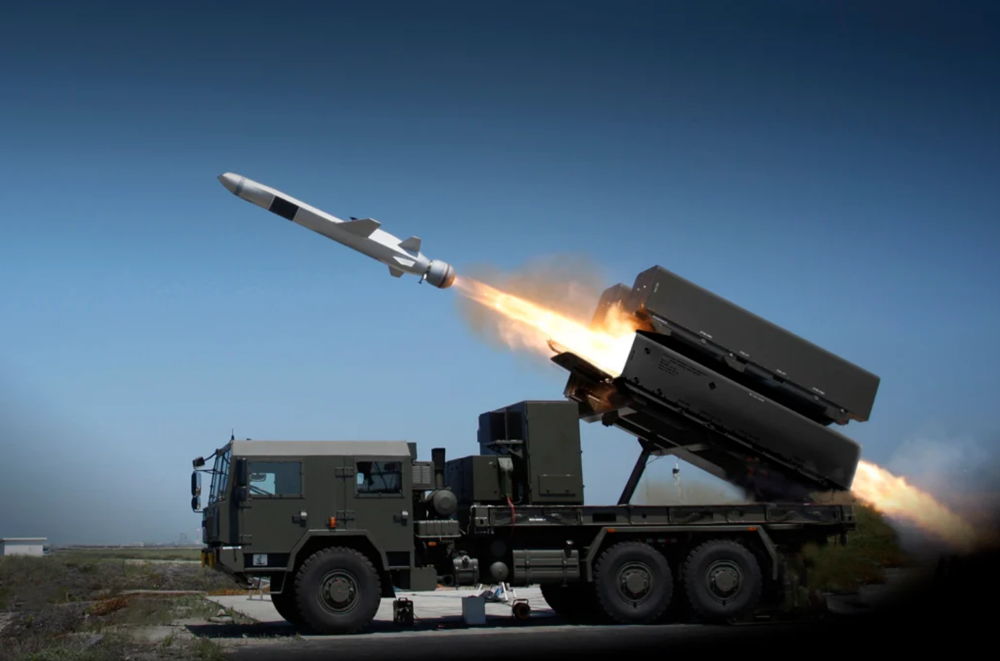
Image: Kongsberg (archival platform photograph).