IN Brief:
- ST Engineering Marine laid the third Al Dorra vessel's keel and marked steel cutting for the fourth and fifth vessels at Benoi Yard on 20 October.
- Eight missile boats are being produced for Kuwait under an EDGE-led programme, with three vessels assigned to Singapore and five to the UAE.
- ST Engineering's six-year subcontract, valued at approximately S$600 million, covers platform design, systems supply, engineering integration and construction of three vessels.
ST Engineering Marine has laid the keel for Kuwait’s third Al Dorra missile boat and marked the beginning of steel work for the fourth and fifth vessels at its Benoi Yard in Singapore, advancing an eight-vessel naval construction programme involving shipyards in Singapore and the United Arab Emirates.
The ceremonies took place on 20 October 2026, attended by representatives of the Kuwait Naval Force, EDGE Group, Abu Dhabi Ship Building and other programme partners. They followed the start of plate cutting for the third vessel in July, providing a further indication of construction progress within the Singapore work package.
ST Engineering expects the third vessel to be launched in the third quarter of 2027. Equivalent launch and delivery dates for the fourth and fifth vessels have not been disclosed. The ceremonies confirm construction milestones rather than completion of the ships or acceptance of their installed systems.
The Al Dorra programme originates from a June 2025 agreement worth AED 9 billion, approximately US$2.45 billion, between Kuwait’s Ministry of Defence and the UAE’s EDGE Group. The contract covers design, construction, trials and delivery of eight missile boats, together with ammunition and support arrangements.
EDGE acts as prime contractor, while its naval shipbuilding subsidiary Abu Dhabi Ship Building is responsible for the construction programme under the group’s industrial arrangements. ST Engineering provides a substantial element of the vessel design, platform engineering and systems supply, as well as constructing three of the eight vessels in Singapore.
The Singapore company’s subcontract with Abu Dhabi Ship Building was awarded in April 2026 and is valued at approximately S$600 million over six years. It covers the design and supply of platform systems across the eight-vessel programme and the construction of three vessels at ST Engineering’s shipyard.
The remaining five vessels are assigned to construction in the UAE. Although the October ceremonies identify hull numbers three, four and five, the public programme information does not provide a complete hull-by-hull production allocation or explain every intermediate manufacturing activity between the two countries. The contracted division of three Singapore-built and five UAE-built vessels remains unchanged.
The ships are based on a design lineage associated with ST Engineering’s Fearless-class platform and EDGE’s Falaj 3 programme. EDGE’s original Kuwait contract specified 62-metre missile boats tailored to the customer’s naval requirements, rather than an unmodified transfer of the precise configuration used by an earlier customer.
Compact naval combatants must accommodate propulsion equipment, electrical distribution, crew facilities, navigation systems, sensors and weapon installations within comparatively restricted hull volumes. Equipment selection affects the vessel’s mass distribution, electrical demand, internal access and the arrangements needed for maintenance.
Ship design consequently has to manage structural and systems requirements together. Heavy equipment needs appropriate foundations and support structures, while machinery and electrical equipment require protected routes for piping, cables and ventilation. Changes to one installation can alter nearby equipment arrangements and the sequence in which systems are assembled.
Constructing a common class at more than one shipyard adds demands for consistent engineering information. Drawings, materials specifications, dimensional tolerances and inspection procedures must identify the approved configuration, allowing manufacturing teams at different locations to produce equipment and structures that meet the same requirements.
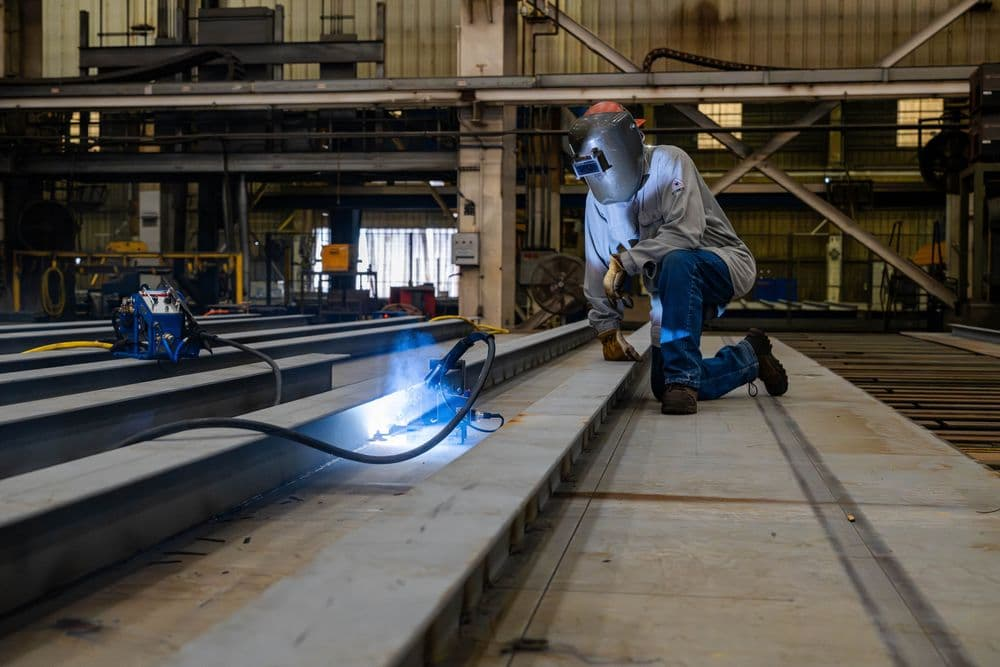
ST Engineering says its Benoi Yard is using automated panel lines, robotic profile cutters and micro-panel fabrication for the programme. These manufacturing methods are intended to improve the accuracy and repeatability of steel processing and assembly, particularly where similar structural components are required across successive vessels.
Robotic profile cutting can produce components according to programmed geometries, reducing dependence on repeated manual marking and cutting. Automated panel production similarly allows plates and structural profiles to be processed through a defined workflow before they are assembled into larger sections.
The accuracy of these operations depends on reliable design information, machine calibration and material handling. A cutting system can reproduce an incorrect programmed dimension as consistently as a correct one, so inspection and configuration control remain necessary throughout fabrication.
Welding introduces a separate source of dimensional variation. Heat applied during joining can cause local distortion, requiring the use of suitable fixtures, controlled welding procedures and subsequent surveying. Such controls become more important as individual panels are combined into larger hull sections with interfaces that must align during final assembly.
Modular construction can also allow selected machinery, piping or electrical equipment to be installed before an entire hull is joined. Completing appropriate work within accessible modules can simplify installation and inspection, although this depends on the production sequence and whether the remaining structural joins and equipment connections can be completed without damage or unnecessary rework.
Coordination between Singapore and Abu Dhabi extends beyond structural fabrication because ST Engineering supplies design, systems and engineering support across the wider fleet. A component revision or change in installation procedure may need to be reflected at both production locations, together with the associated technical documentation and inspection requirements.
Common vessel designs can offer efficiencies through repeatable parts and procedures, but these benefits are not automatic. Supplier deliveries, approved equipment substitutions and customer changes all need to be managed so that the ships remain consistent with their contractual requirements.
Combat-system integration introduces further interfaces between the ship platform and specialist suppliers. Sensors and weapon equipment need suitable power supplies, communications links, mounting arrangements and environmental conditions. Their installation must also be compatible with the ship’s stability, crew operations and other platform systems.
Final acceptance will require verification of structural integrity, propulsion, electrical systems, navigation equipment and the integrated mission configuration. Harbour testing can establish many equipment functions before sea trials assess performance under operating conditions, while defects discovered during either stage may require engineering changes and subsequent verification.
The programme has already passed several construction milestones. The first Al Dorra vessel, Al Noukhitha, was launched at Abu Dhabi Ship Building’s UAE facility in February 2026. The third vessel’s steel cutting followed in Singapore during July, before the October keel laying and associated work on the next two hulls.
These events show progress through different phases of the eight-vessel programme, although the dates of further launches, systems trials and deliveries remain subject to the contractors’ detailed schedules. The third vessel’s planned launch in the third quarter of 2027 is the next publicly identified milestone for the Singapore work.