IN Brief:
- MSI-Defence Systems has received a £29.7 million contract to supply twelve DS30M 30mm naval gun systems.
- The weapons are intended for four German Navy F128 frigates under a shipbuilding programme led by TKMS.
- Deliveries will follow the frigate programme schedule, although individual installation arrangements, equipment configurations and delivery dates have not been disclosed.
British defence engineering company MSI-Defence Systems has received a £29.7 million contract to supply twelve DS30M 30mm naval gun systems for four German Navy F128 frigates, adding to its export order book for shipboard weapons and associated engineering equipment.
The award was disclosed by parent company MS International on 21 October 2026. Its regulatory statement identifies TKMS as prime contractor for the F128 programme and confirms that the twelve weapon systems will be installed across four vessels, with deliveries expected over the coming years according to the shipbuilding schedule.
The contract covers the supply of naval gun systems rather than construction of the frigates themselves. MSI-Defence Systems has not identified the precise configuration of each mounting, the ammunition included, the installation locations aboard the vessels or the dates on which individual units are scheduled for delivery.
The F128 programme is based on TKMS’s MEKO A-200 DEU frigate design, which Germany selected to strengthen its future surface fleet, particularly for anti-submarine warfare. The German Parliament’s Budget Committee approved the initial four-vessel procurement in July 2026, and TKMS confirmed approval for four additional ships in October.
The MSI-Defence Systems award specifically identifies four frigates. The approval of further vessels under the wider programme does not establish a corresponding increase in the gun order, and no additional DS30M systems for those ships have been announced through the October contract disclosure.
TKMS has described the MEKO A-200 DEU programme as a means of bringing additional naval capability into service from 2029, using an established ship design and existing industrial supply arrangements. The gun contract forms part of the equipment procurement needed to construct and integrate the vessels, although its delivery milestones have not been published separately.
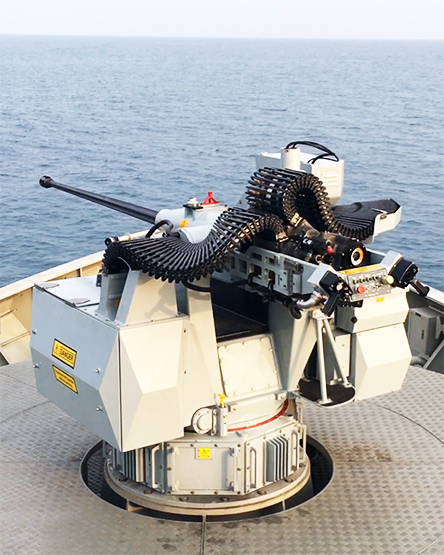
The DS30M is a 30mm naval gun system within MSI-Defence Systems’ broader SEAHAWK family. Its principal role is to give ships a medium-calibre weapon for suitable surface and other local threats, complementing the heavier armament and specialist sensors carried by larger combat vessels.
A frigate’s primary mission does not determine the function of every weapon aboard. Although the F128 programme places substantial emphasis on anti-submarine warfare, its vessels will also require equipment suited to maritime security, local protection and other tasks performed during operations at sea.
Medium-calibre guns can provide a response against smaller surface targets where the engagement conditions permit, but their effectiveness depends on the complete combination of target information, weapon control and ammunition. The published DS30M contract does not provide a detailed performance specification for the version Germany has ordered.
The SEAHAWK DS family supports different cannon and sensor configurations, allowing equipment to be arranged according to vessel requirements. MSI-Defence Systems offers variants incorporating electro-optical sensors on the mounting, while other configurations use an independent electro-optical director to support observation and fire control.
These configurations are distinct and should not be treated as interchangeable descriptions of the German order. An independently mounted director can provide a different field of observation and installation arrangement from sensors attached to the gun, with implications for ship interfaces, cable routing and the location of supporting equipment.
For a moving maritime target, the fire-control system must account for the relative movement of the ship and the object being tracked. Sensor measurements are converted into an aiming solution, while the weapon mounting must control its training and elevation accurately as the vessel moves.
Ship motion introduces further demands because pitch, roll and changes in heading affect the relationship between the gun and the target. Weapon control equipment therefore requires suitable position feedback and movement compensation, together with defined operating limits and safety arrangements.
The manufacturer’s SEAHAWK DS product information identifies options for local control, connection to a ship’s combat management system and use of MSI-Defence Systems’ own fire-control equipment. The arrangement selected for Germany’s frigates has not been disclosed, making it inappropriate to assume that a particular director, sensor package or control console forms part of the contract.
Where a naval weapon exchanges information with a combat management system, data interfaces must define how target information, commands and equipment status are transferred. The receiving system must interpret the messages correctly and apply the appropriate permissions, while equipment faults or lost communications require predictable responses.
Mechanical installation creates a separate set of engineering tasks. The deck foundation has to accommodate the mass and operational loads of the mounting, while nearby ship structures must allow safe movement throughout the intended firing arcs. Space and access arrangements are also required for maintenance, electrical equipment and any associated ammunition handling.
Naval equipment operates in a demanding environment involving vibration, salt exposure and repeated changes in temperature and humidity. Protection of mechanical parts, electronics and electrical connections forms part of the installation and maintenance design, while testing is needed to verify that equipment remains suitable after integration with the ship.
The supply of twelve weapon systems will require repeatable manufacturing and inspection arrangements. Machined assemblies, drive mechanisms, control electronics and other components must conform to approved specifications, with production records allowing faults and engineering changes to be managed across the delivered equipment.
Configuration control is particularly important during a shipbuilding programme extending over several years. Changes to a weapon or its supporting electronics may require revisions to installation drawings, software interfaces, maintenance documentation or spare parts arrangements. Such changes must be coordinated with the shipbuilder so that delivered equipment matches the approved vessel configuration.
MSI-Defence Systems manufactures naval weapon systems in Britain, with its established engineering operations based in Norwich. The German contract adds to its existing business supplying shipboard protection equipment, although the announcement does not specify any new factory investment, additional employment or subcontractor workshare associated with this order.
The £29.7 million award is a total contractual value, not a separately reported price for each gun mounting. It may cover contractual elements beyond the principal hardware, but the published statement does not contain a sufficiently detailed breakdown to calculate individual unit prices or quantify engineering and support work.
The next confirmed milestones will depend on the F128 construction schedule and the requirements for equipment delivery and integration. The October award establishes MSI-Defence Systems as a supplier of twelve DS30M systems for four frigates, while the final mounting configuration, installation arrangements and acceptance dates remain undisclosed.