IN Brief:
- A modified Malloy TRV-150 intercepted multiple one-way attack drones during US military experimentation at Eglin Air Force Base in late September.
- The aircraft used a production-ready three-pod launcher carrying laser-guided APKWS rockets, engaging successive targets during one flight.
- SURVICE Engineering adapted the aircraft for US Army requirements, while BAE Systems FalconWorks developed and integrated the weapon modification kit.
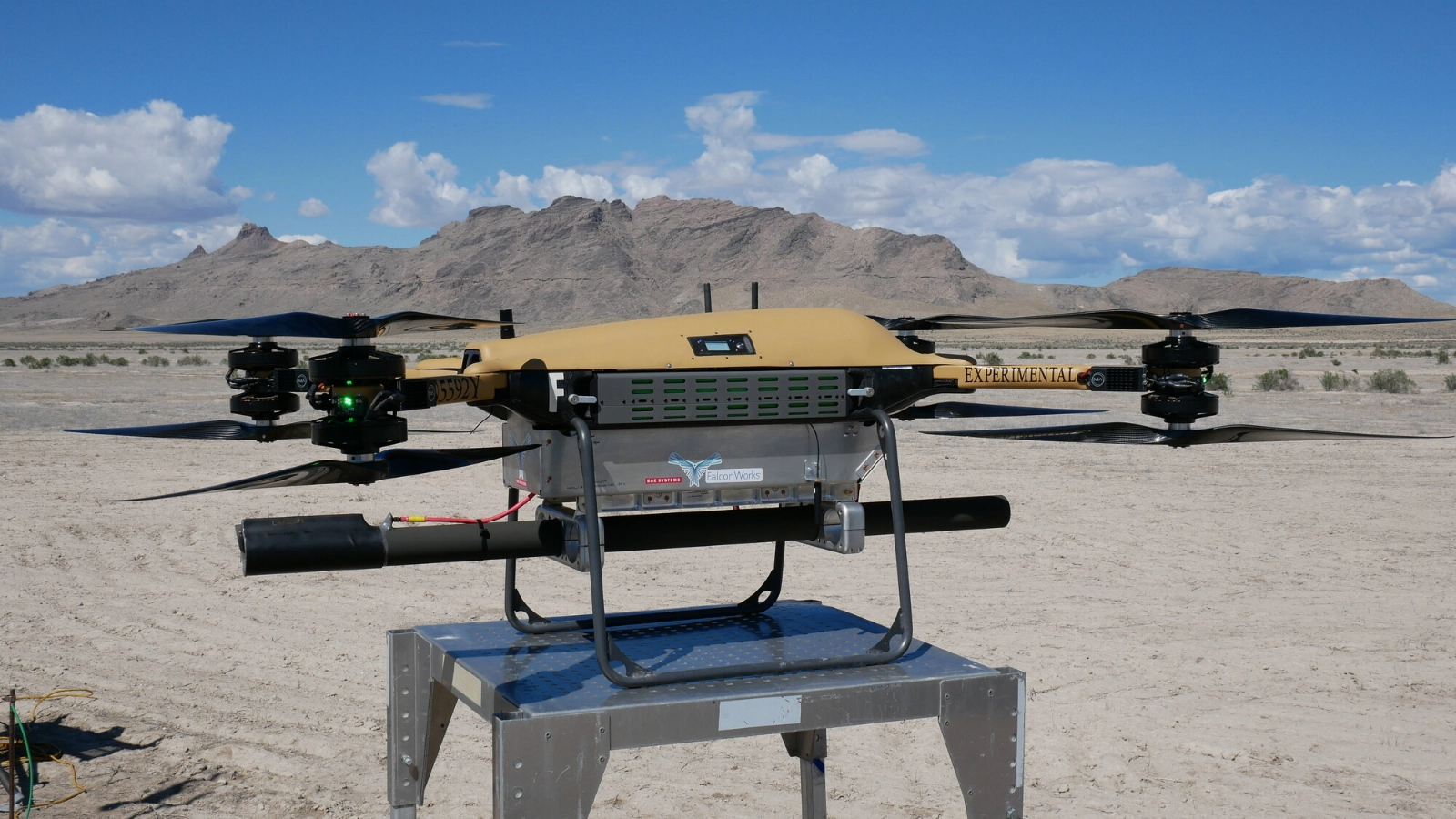
A modified TRV-150 uncrewed aircraft developed from BAE Systems subsidiary Malloy Aeronautics’ T-150 platform has intercepted multiple one-way attack drones using laser-guided APKWS rockets, extending a military logistics aircraft into an experimental counter-UAS role.
The engagements took place at Eglin Air Force Base in Florida during late September 2026, as part of a US defence research and engineering experimentation event. BAE Systems disclosed the results on 21 October, confirming that the TRV-150 engaged successive airborne targets without landing or reloading between engagements.
The aircraft carried a production-ready three-pod launcher developed for the adapted platform. It fired Advanced Precision Kill Weapon System rockets, combining an established precision-guided munition with a comparatively small vertical take-off and landing aircraft.
BAE Systems conducted the demonstration with Maryland-based SURVICE Engineering. SURVICE adapted the TRV-150 to US Army requirements, while the company’s FalconWorks organisation developed and integrated the modification kit required to carry and employ the rockets.
The September demonstration builds on an earlier test in July 2025, when an adapted T-150 fired a precision munition for the first time. The subsequent work advances that integration from an individual firing event to several aerial target engagements during a single mission, using a launcher configuration intended to be suitable for production.
That distinction does not establish that the complete armed aircraft has entered production or been accepted for operational military service. The public account identifies successful experimental engagements, but does not announce a procurement contract, fielding decision or completed qualification programme.
The underlying T-150 was developed as an uncrewed logistics aircraft capable of carrying equipment between military locations. Its multirotor arrangement allows vertical take-off, hovering and landing without a runway, providing flexibility for operations where suitable aircraft infrastructure is limited.
Adapting such an aircraft for counter-drone operations introduces different payload and control requirements. A logistics mission normally involves transporting a load to a designated destination, while an armed interception mission requires the platform to maintain a suitable relationship with a moving airborne target and employ its weapon under controlled conditions.
The payload configuration influences aircraft performance. Launch equipment and rockets add mass and can alter the position of the vehicle’s centre of gravity, affecting the forces and control responses needed to maintain stable flight. The aircraft’s propulsion system must retain sufficient capacity to operate safely within the resulting weight and balance limits.
Installing weapons also requires assessment of structural loads, secure mounting arrangements and the clearance needed during launch. Components must be positioned so that weapon operation does not interfere with the aircraft’s propellers, supporting structure or essential onboard equipment.
The modification kit therefore has to be considered as part of the complete aircraft rather than a detachable load assessed solely by weight. BAE Systems has not disclosed the structural changes, revised mass properties or detailed flight-control modifications applied to the experimental TRV-150 configuration.
APKWS is based on the 70mm rocket and uses a laser-guidance section to support precision engagements. Its employment against aerial targets depends on appropriate target information and a guidance arrangement capable of maintaining the conditions needed for the rocket to reach the intended object.
Target detection and fire control are separate functions from the rocket’s guidance mechanism. Information about an aircraft’s position and movement must be available before an engagement, while the firing platform must remain within permitted operating conditions. The published account does not identify the complete sensor suite or laser designation architecture used during the Eglin trials.
Several factors influence the performance of a small airborne interceptor. Target speed and direction affect the time available for engagement, while environmental conditions and the relative movement of the two aircraft can change the firing geometry. A sequence that succeeds against selected exercise targets may require further testing against other aircraft types and operating conditions.
The ability to engage successive targets without landing or reloading nevertheless establishes a technical development beyond the July 2025 firing. It demonstrates that the configured aircraft could employ several rockets during one mission under the conditions of the September experiment, rather than returning to a launch location after each attempted interception.
BAE Systems has not disclosed the exact number of rockets fired, the number of targets presented, engagement distances or complete success-rate data. The company describes multiple successful interceptions, but the available information does not support calculation of an independently verified probability of interception.
Using a relatively small uncrewed aircraft also creates operational questions concerning endurance and communications. Electrical power is required for flight control, navigation and mission equipment, while an armed payload reduces the capacity available for other equipment within the aircraft’s operating limits.
The ability to sustain an interception mission therefore depends on the installed configuration and the time spent reaching, identifying and engaging a target. BAE Systems has not published endurance figures for the armed TRV-150 under the demonstrated load, making comparisons with its original logistics configuration unreliable.
Weapon control must also be integrated with the aircraft’s safety functions. Flight-control commands, weapon-system status and launch authorisation have different purposes, requiring suitable arrangements to manage faults, prevent unintended operation and maintain control of the aircraft during the engagement sequence.
These requirements extend into test and evaluation. Engineering teams must assess the interaction between aircraft movement, weapon operation and software behaviour, while repeatable trials are needed to determine whether the configuration performs within approved limits under different conditions.
BAE Systems and SURVICE have described the approach as a potentially economical response to the growing use of one-way attack drones. The relative price of the rocket is only one component of that assessment, however, because the complete system also requires aircraft, maintenance, operators, sensors and supporting equipment.
No total system cost or independently validated cost per successful engagement has been disclosed. Those measurements would be necessary before a reliable comparison could be made with other counter-UAS methods.
The T-150 has previously supported British military logistics, including the Royal Navy’s Carrier Strike Group during its Indo-Pacific deployment. That service experience relates to the logistics aircraft and cannot be treated as evidence that the armed modification has entered operational use.
Following the Eglin demonstration, BAE Systems and its partners intend to examine maritime applications of the counter-drone configuration. Shipboard operation would introduce further requirements involving deck handling, aircraft recovery, vessel movement, corrosion protection and the safe integration of armed aircraft with other naval systems.
The next substantive development will depend on additional trials and any customer decision to move the modified aircraft towards qualification or procurement. The September engagements provide evidence of successful weapon integration under experimental conditions, while the availability and performance of a fielded counter-UAS system remain unconfirmed.