IN Brief:
- Elbit Systems completed its acquisition of Vancouver-area International Submarine Engineering on 20 October.
- ISE has supplied more than 250 underwater vehicles to customers in more than 20 countries.
- Elbit intends to expand underwater surveillance, mine countermeasures and anti-submarine warfare offerings; no new integrated platform has been identified.
Elbit Systems has completed its acquisition of Canadian robotics manufacturer International Submarine Engineering, or ISE, extending its portfolio of autonomous and remotely controlled maritime systems. The transaction gives the Israeli defence group access to established underwater vehicle designs, subsea engineering personnel and specialist robotics capabilities developed over more than five decades.
Elbit confirmed the completed acquisition on 20 October and said the purchase price was not material to its financial position. It did not disclose the exact consideration, transaction structure or an additional capital investment programme for the Canadian business. The new ownership should therefore be distinguished from any future contract to develop or supply a combined naval system.
Headquartered in the Vancouver area, ISE develops and manufactures autonomous underwater vehicles, remotely operated vehicles and associated control and robotic equipment. Elbit says the company has supplied more than 250 underwater vehicles to customers in over twenty countries, across defence, research and commercial applications.
The acquisition expands an existing Elbit naval portfolio that includes unmanned surface vessels, underwater systems, sonar, electronic warfare equipment, communications and command systems. Elbit identifies underwater intelligence, surveillance and reconnaissance, mine countermeasures and anti-submarine warfare as areas where ISE’s technology may strengthen its future offering.
An autonomous underwater vehicle, or AUV, executes a mission using onboard navigation, sensors and control software. It can operate without continuous operator commands, although mission planning, monitoring and recovery remain part of the wider operating arrangement. The available range and tasks depend on the vehicle configuration and its energy, communications and navigation systems.
A remotely operated vehicle, or ROV, follows commands from an operator, commonly through a tether that carries information and sometimes electrical power. ROVs can support inspection or intervention tasks requiring immediate human control, while an AUV may be suited to surveying an area according to a programmed route.
Those roles overlap in some applications but impose different engineering requirements. A tether may constrain the movement of a remotely operated system, whereas an autonomous platform must make selected navigation and control decisions using information available onboard. Each requires suitable sensors, propulsion, structural systems and arrangements for deployment and recovery.
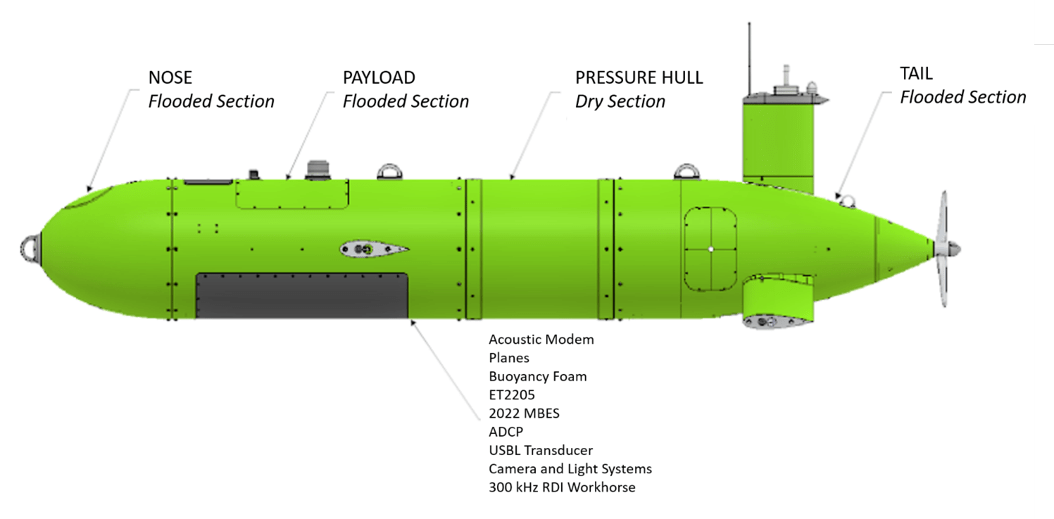
ISE’s Explorer family uses a modular configuration intended to accommodate different mission equipment. The manufacturer describes a free-flooding forward section, a pressure hull and a rear section, with payload options selected for the operating depth and intended task. Different Explorer configurations are offered for depth requirements ranging from hundreds to thousands of metres.
Possible sensors include side-scan sonar, multibeam echo sounders, sub-bottom profilers, cameras and instruments measuring environmental conditions. Some versions may carry several sensors simultaneously, allowing operators to collect different categories of information during the same mission. The final capability depends on what is actually installed and qualified.
Modularity can help customers adapt an existing vehicle for new missions, but changing a sensor or payload still requires electrical and mechanical compatibility and suitable software interfaces. Added equipment affects power consumption, mass distribution and the volume available for other components, with those factors influencing endurance and vehicle handling.
Underwater navigation and communication also differ substantially from similar tasks above the surface. Conventional satellite navigation signals are not normally available to a deeply submerged vehicle, while the propagation and bandwidth of underwater communications limit how information can be exchanged during a mission.
An AUV may therefore rely on onboard navigation sensors and planned procedures, while detailed survey information can be stored for later recovery or transferred through a suitable communications arrangement. The reliability of the final survey depends on the sensors, navigation estimates and the conditions encountered.
ISE has developed docking, recovery and related subsea technologies intended to support longer periods of operation. Such arrangements may allow a compatible vehicle to return to a subsea location for charging or data transfer, but they still require reliable docking guidance, suitable connectors and infrastructure installed for the mission.
Mine countermeasures are one potential application for this equipment. Sonar can support the detection and examination of objects on or close to the seabed, but classifying a suspected threat and deciding on subsequent action remain distinct stages. A survey vehicle is not automatically an explosive disposal system merely because it can collect relevant information.
For surveillance missions, data from underwater platforms may need to be passed to a surface vessel or command system. Integrating ISE hardware with Elbit’s wider products would require agreement on data formats, communications and operating procedures, followed by development and testing for the intended configuration.
Elbit has not identified a ship class, naval customer or funded integration programme connected specifically to the acquisition. Nor has it disclosed changes to ISE’s Canadian manufacturing footprint or workforce. Its stated objective is to extend its maritime offering using the acquired technology, not to claim delivery of a newly qualified combined system.
ISE’s existing customers will also require support for equipment already in service, including spare parts, maintenance and software assistance where contracted. Any future reorganisation of those services has not been announced. The confirmed industrial milestone is the transfer of ownership of an established subsea robotics manufacturer.
Future product development will determine how Elbit combines ISE’s designs with its existing sonar, control and autonomous maritime systems. The acquisition provides technology and engineering experience immediately, while the performance, availability and customers of any newly integrated equipment remain open.