IN Brief:
- The Arsenal of Freedom facility opened in Camden, Arkansas, on 20 October 2026.
- L3Harris designed the plant to double current motor capacity and consolidate GMLRS propulsion manufacturing.
- The facility forms part of a 2023 US$216m government cooperative agreement; planned capacity is not output already achieved.
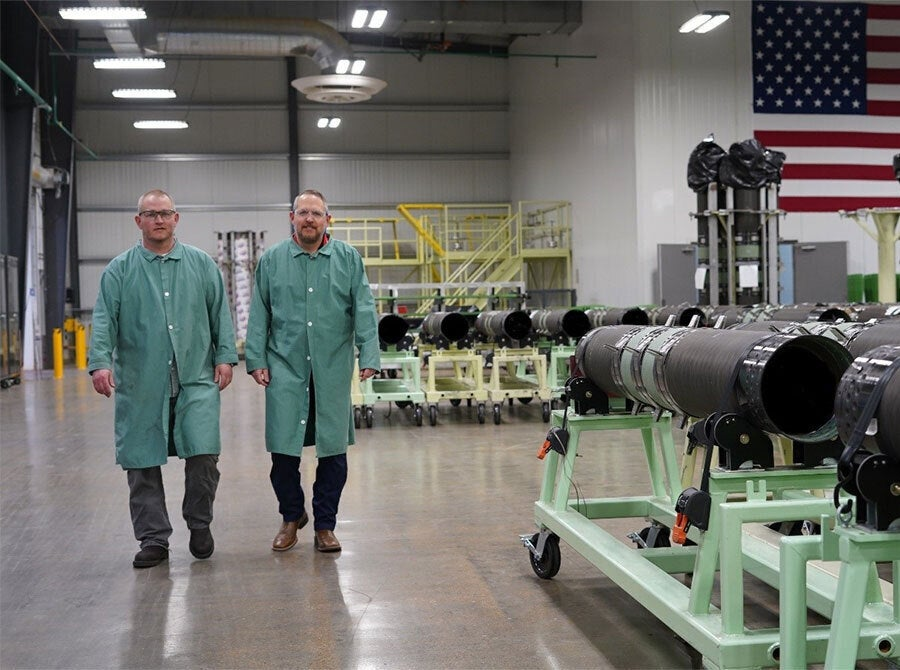
L3Harris Technologies has opened its Arsenal of Freedom solid rocket motor manufacturing facility in Camden, Arkansas, establishing additional infrastructure intended to double existing propulsion production capacity. The plant will support the US Army’s Guided Multiple Launch Rocket System, or GMLRS, by bringing previously distributed manufacturing activities into a more concentrated production arrangement.
The company opened the factory on 20 October alongside federal, state and local officials. It describes the new installation as designed for twice its previous capacity, with room for further expansion. Opening a factory is a completed infrastructure milestone, but the doubled rate remains a designed production capability rather than a reported measure of motors already delivered.
The project forms part of a US$216 million cooperative agreement concluded in 2023 under the Defense Production Act Title III programme. That earlier agreement was intended to expand American propulsion manufacturing for tactical weapons including GMLRS, Javelin and Stinger. The October opening does not represent a second US$216 million contract or a new award for those weapon systems.
The Camden building is intended to centralise production of the solid rocket motors used by GMLRS rockets. Other propellant processing facilities will also support the programme, demonstrating that completing the assembly building alone is insufficient to establish the output rate of the wider manufacturing system.
GMLRS rockets are fired from compatible Army artillery launchers and use a dedicated solid propulsion system to accelerate the round after launch. Manufacturing the motor requires controlled handling and processing of specialised materials, followed by appropriate inspection and verification before the unit can be accepted for integration into the finished rocket.
In a solid rocket motor, a prepared propellant charge produces gas during operation, with the gas exiting through the motor nozzle to generate thrust. The structural casing, propellant, nozzle and associated components must function together within the thermal and mechanical limits set by the weapon design.
The quality of that integrated assembly depends on the consistency of its manufacturing processes. Materials and components have to satisfy specified requirements, while the finished product must be checked for characteristics relevant to its intended operating conditions. More floor space cannot substitute for the production discipline needed to deliver repeatable results.
L3Harris says the new plant uses advanced automation, digital manufacturing and experienced production personnel. The company has not provided a complete public inventory of equipment installed at the site, and the announcement does not quantify achieved changes in output, inspection yields or manufacturing costs.
Automation can reduce repeated manual handling and improve the consistency of some production activities, while digital systems can support traceability and the recording of equipment and process data. The usefulness of those systems depends on how they are integrated into the approved manufacturing sequence and the requirements of each propulsion programme.
Planning a higher manufacturing rate also involves the supporting supply chain. Qualified materials, production equipment, trained employees and test capacity must be available at the rate demanded by the factory. A shortage at one stage can restrict final throughput even where downstream assembly equipment has unused capacity.
The factory’s opening follows a separate Lockheed Martin follow-on contract announced by L3Harris on 12 October, valued at US$250 million for standard-range GMLRS propulsion units. The company said that work would be fulfilled within the new Camden facility. The purchase award and the subsequent factory opening are separate developments within the same industrial expansion programme.
Camden is also the location of the company’s broader Arkansas Advanced Propulsion Facilities work and two facilities being developed for PAC-3 propulsion. Those construction projects have different production objectives from the new GMLRS building and must not be counted as additional capacity already operating within it.
Elsewhere, the original government cooperative agreement includes work in Orange County, Virginia, and upgrades in Huntsville, Alabama. L3Harris has described a larger multistate investment programme involving dozens of buildings and significant additional manufacturing space, with projected increases varying across propulsion products.
The company has not supplied a common production baseline from which the stated doubling, tripling or quadrupling objectives can be converted into reliable unit numbers for every weapon type. Each motor programme has its own components, qualification requirements and demand, so broad capacity targets cannot be interpreted as identical production rates.
Increasing rocket motor output must also be matched by other suppliers producing the guidance, structural and other components needed for finished munitions. The availability of propulsion units is important, but it is not the only determinant of how many complete GMLRS rockets can be delivered to the customer.
The Arsenal of Freedom opening provides new facilities for an established production requirement. Subsequent milestones will be the qualification and ramp-up of the installed equipment, the delivery of motors under existing contracts and evidence that the designed capacity can be sustained in normal production.