IN Brief:
- Composite Energy Technologies demonstrated its Hadalus-XL autonomous underwater vehicle during Maritime Big Play Pacific.
- A recoverable RECALL underwater target and Kraken uncrewed surface craft supported separate technical demonstrations.
- These demonstrations add system-specific information to previously covered Bluebottle and Ghost Shark trials.
New demonstrations at the AUKUS Maritime Big Play Pacific event have shown how an underwater cargo vehicle can fold into a shipping container, how a recoverable acoustic target can support submarine detection exercises, and how an uncrewed surface vessel can launch multiple aerial drones. The systems were displayed and tested in Southern California during October, adding distinct engineering detail to the maritime autonomy programmes already reported by IN Defence.
Among the distinct systems discussed during the 20–21 October events was Hadalus-XL, developed by Composite Energy Technologies. The vehicle is described as roughly 34 feet long, with major panels and components able to fold for transport in a standard 20-foot container. The company demonstrated the platform during a five-day period at sea and displayed a configuration with a launcher able to carry six cylindrical payload containers.
Hadalus-XL’s folding panels and modular components allow a vehicle longer than the container carrying it to be moved as a compact set of assemblies. For deployment, the structure must be reassembled with the integrity of its connections, seals and mission equipment maintained. The claimed transport advantage comes from reducing oversized handling requirements, while the published demonstration does not quantify how long assembly takes or what specialist checks are required before launch.
Composite Energy Technologies described autonomous navigation and obstacle avoidance systems for Hadalus alongside equipment interfaces that permit different payload arrangements. Its representative reported acoustic observations from five days at sea and asserted that the platform was difficult to detect. Those are company statements made during the exercise; no independent detection trials across varying sensors, distances and sea conditions have been published to establish a general stealth rating.
A second demonstration involved Seaber’s RECALL underwater device, distributed in the United Kingdom by Portsmouth-based RS Aqua. The recoverable vehicle acted as a submarine-like acoustic target for anti-submarine warfare trials, transmitting signals intended to mimic an underwater contact. A company technician said the system can operate down to about 300 metres, allowing exercise participants to test detection and tracking without requiring a crewed submarine to generate every target scenario.
By producing an acoustic signature that other systems can seek and track, RECALL lets participating crews and autonomous sensors practise detection against a controllable underwater target. The equipment can then be recovered for inspection and reuse. Public reporting confirms its role in the trial, but it does not supply comparable sonar ranges, classification accuracy or an independently assessed success rate for the systems that detected it.
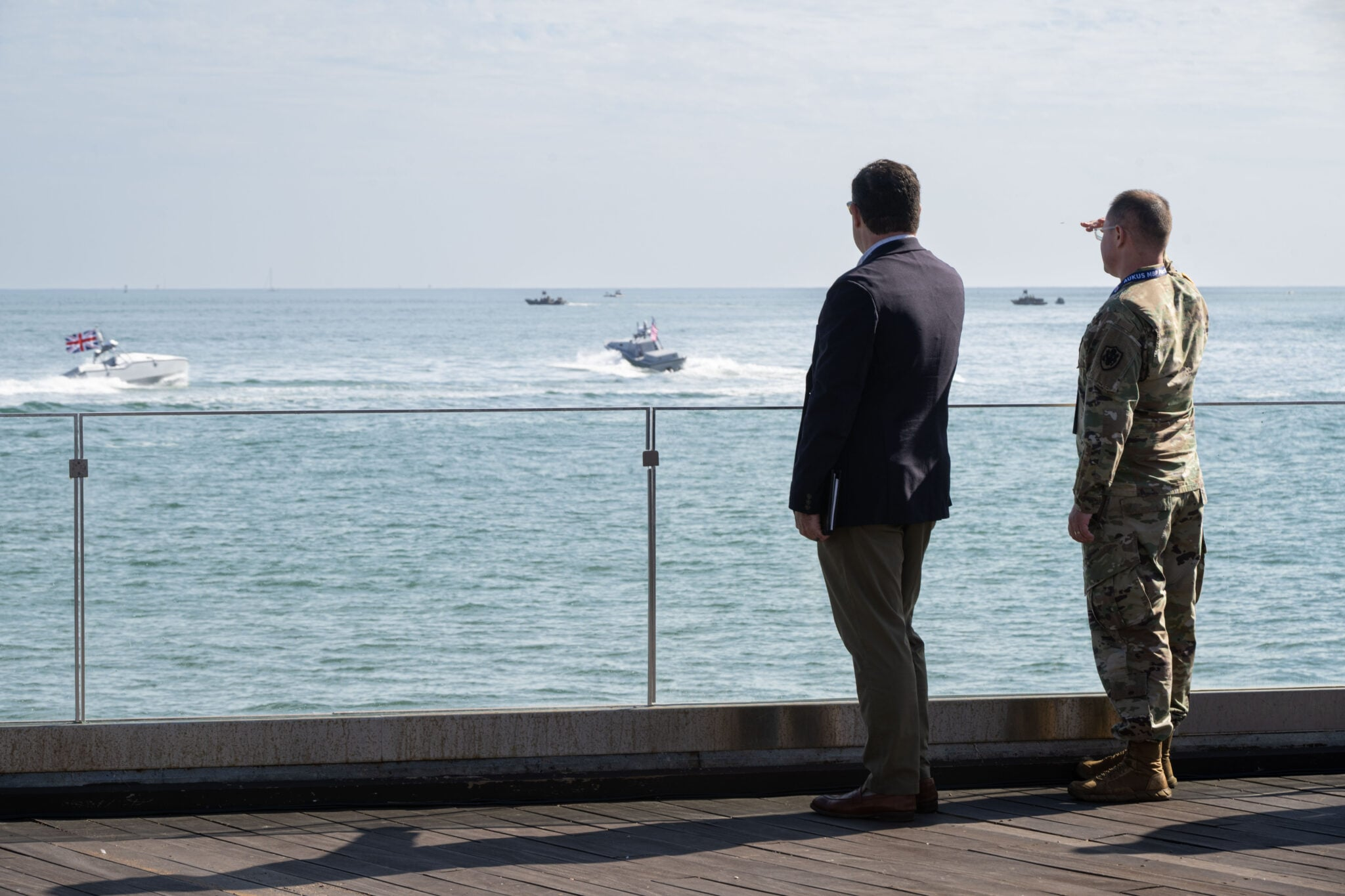
The Royal Navy’s Kraken K3 uncrewed surface craft also demonstrated launch integration for aerial systems, releasing three short-range quadcopters during a display while one operator controlled them. The launch requires coordination between the vessel, the aircraft and the operator’s command arrangement, making it a useful example of combining two kinds of uncrewed platform. The Royal Navy has described Kraken vessels as operationally deployed, but this particular demonstration does not establish an autonomous weapons engagement capability.
Alongside the Bluebottle Hybrid exercise activity and Australian Ghost Shark payloads already documented, these demonstrations address three other equipment functions. Hadalus introduces transportable underwater cargo capacity, RECALL supplies a reusable detection target, and Kraken demonstrates a surface vessel launching aerial systems. Each poses different demands on deployment, control and recovery.
More than 40 government and industry systems participated across the exercise, according to the Royal Navy. Interoperability depends on more than having individually capable vehicles: sensor data must reach an appropriate operator or receiving platform in compatible formats, at usable intervals and with enough context to support an informed response. The event brought those systems into a common test setting, but comprehensive performance metrics for the combined architecture have not been made public.
Anduril’s Dive-XL was another underwater platform represented at the demonstration, with configurable bays for sensors and other mission payloads. Seabed surveillance introduces an additional communications constraint because a sensor operating at depth still needs a method of transferring observations into the wider command network. Public displays established the proposed hardware integration and trial participation, while qualification of any complete sensing-and-response chain remains separate work.
AUKUS representatives have also identified export controls and restricted transfer of technical information as obstacles to closer industrial integration. A partner may be able to operate a complete platform while lacking permission to access the interfaces or software needed to combine it with another supplier’s equipment. The October demonstrations therefore provide concrete examples of platforms being tested together; procurement orders and independently verified operational performance must be evaluated as subsequent milestones.
FEATURED IMAGE: IMAGE FALLBACK REQUIRED — primary-source image not verified for reuse.